Short-run production function: the relationship showing how a firm's output changes as more of a variable factor is added to at least one fixed factor of production.
- Production is the process that turns inputs into an output of goods and services.
- The inputs are the four factors of production: land, labour, capital and enterprise.
Fixed factor: an input, often capital such as machinery or premises, whose quantity cannot be changed within the short run.
Variable factor: an input, often labour, whose quantity is raised or lowered to change output.
- In the short run, at least one factor is fixed while the others can be varied.
- In the long run, every factor is variable, so the short run is defined by the fixed factor, not by a set length of calendar time.
Total, average, marginal product
Total product (TP): the total output produced by all units of the variable factor.
Average product (AP): output per unit of the variable factor.
Marginal product (MP): the extra output gained from adding one more unit of the variable factor.
Average product:
AP=TPL \text{AP} = \dfrac{TP}{L} AP=LTPMarginal product:
MP=ΔTPΔL \text{MP} = \dfrac{\Delta TP}{\Delta L} MP=ΔLΔTP- A bakery has one fixed oven and adds bakers, giving total product per hour of 8, 20, 36, 48, 55, 60 and 63 loaves for 1 to 7 bakers.
- With 3 bakers, total product is 36 loaves.
- Average product is 12 loaves per baker.
- Adding the 4th baker raises total product from 36 to 48 loaves.
- The 4th baker adds 12 loaves, 25% fewer than the 3rd baker's 16, so diminishing returns have set in.
Shape of the product curves
- The first units of the variable factor may raise marginal product as workers specialise and use the fixed capital more fully.
- Beyond a certain point marginal product falls because each extra worker shares a smaller amount of the fixed factor.
- While marginal product is above average product, average product is rising.
- While marginal product is below average product, average product is falling, so the marginal product curve cuts the average product curve at its maximum.
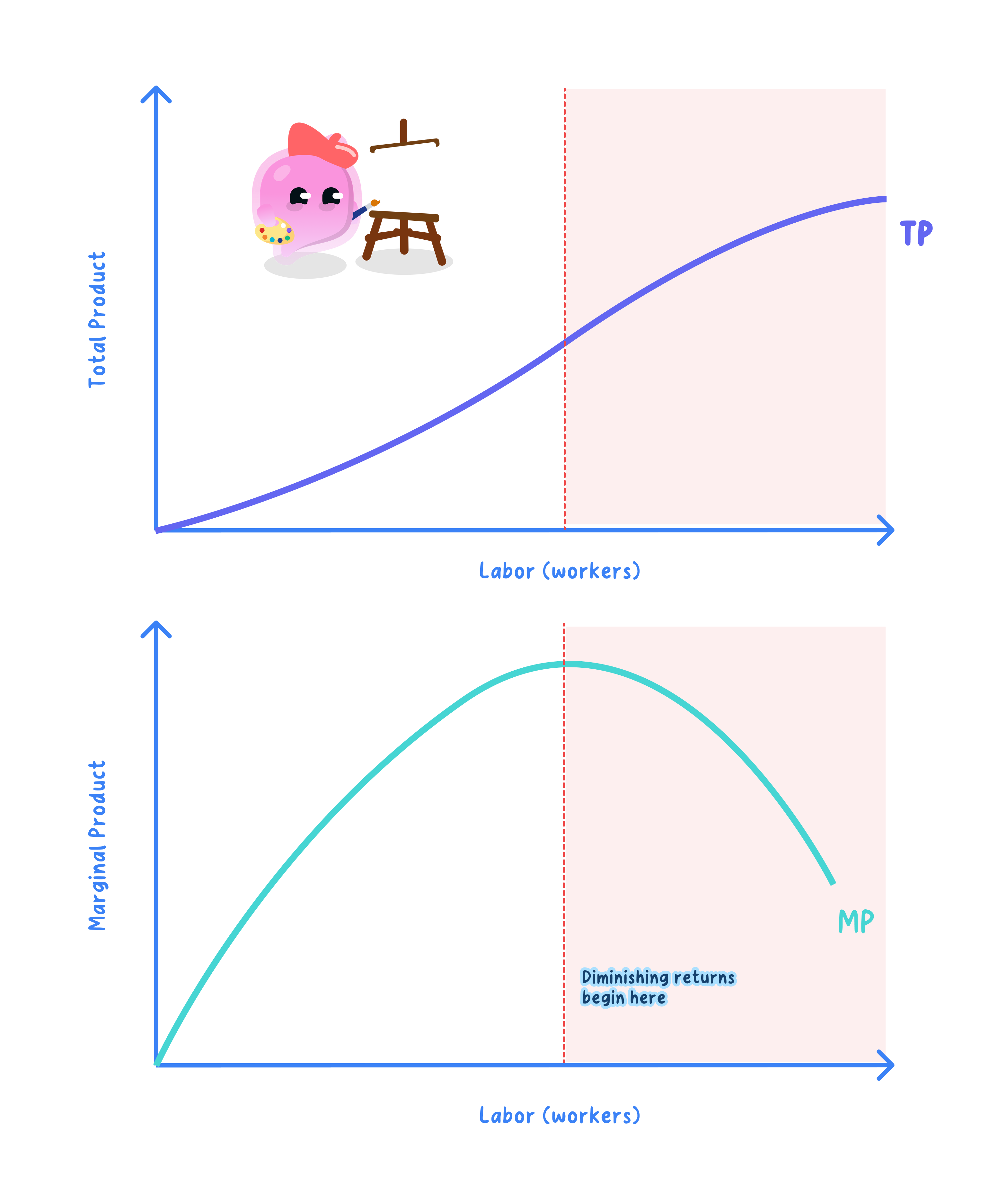
Law of diminishing returns
Law of diminishing returns: as successive units of a variable factor are added to a fixed factor, the marginal product of the variable factor eventually falls.
- It is also called the law of variable proportions and applies only in the short run.
- It occurs because each extra worker has a smaller share of the fixed capital, so the extra output they add eventually falls.
- How quickly returns diminish depends on how much fixed capital there is relative to the variable factor, so a well-equipped plant delays the effect.
- Diminishing returns arise because at least one factor, usually capital, is fixed in the short run.
- As marginal product falls, short-run marginal cost and average variable cost rise.
Link to short-run costs
- Falling marginal product means each extra unit of output needs more of the variable factor.
- So the marginal cost of output rises as the firm expands in the short run.
- This link explains the upward-sloping short-run marginal and average cost curves studied next.
- A workshop pays each extra worker £120 per day and runs one fixed machine.
- The 3rd worker adds 16 units, so the day's £120 is spread over 16 units.
- Marginal cost is £7.50 per unit while marginal product is high.
- The 6th worker adds only 5 units, so the same £120 is spread over far fewer units.
- Marginal cost rises to £24 per unit as diminishing returns take hold.
- Define the short run by the fixed factor, not by a length of time.
- Calculate marginal product as the change in total product ÷ the change in the variable factor.
- Do not confuse diminishing returns with diseconomies of scale.
- Diminishing returns is a short-run effect with a fixed factor, while diseconomies of scale are a long-run effect on average cost.
- What distinguishes the short run from the long run?
- How are total, average and marginal product calculated?
- What does the law of diminishing returns state and why does it occur?
- How does diminishing returns affect short-run marginal cost?
- How does diminishing returns differ from diseconomies of scale?
