Definition
Fixed cost (FC): a cost that does not vary with output in the short run, such as rent or insurance.
Variable cost (VC): a cost that changes directly with output, such as raw materials or the wages of extra staff.
Fixed and variable costs
- Total cost (TC) is total fixed cost + total variable cost.
- Total fixed cost (TFC) stays constant at every level of output, while total variable cost (TVC) is zero at zero output and rises as output increases.
- Whether a cost is fixed or variable depends on the time period, so in the long run all costs are variable.
Total cost:
TC=TFC+TVC \text{TC} = \text{TFC} + \text{TVC} TC=TFC+TVCExample
- A bakery pays £500 a week in rent whether it bakes 10 or 1,000 loaves.
- Flour and energy add £0.20 per loaf, so baking 1,000 loaves gives £200 of variable cost.
- Total cost for the week is £700, of which £500 is fixed and £200 varies with output.
Average and marginal cost
Definition
Average total cost (ATC): total cost per unit of output, equal to average fixed cost + average variable cost.
Average fixed cost (AFC): total fixed cost per unit of output.
Average variable cost (AVC): total variable cost per unit of output.
Marginal cost (MC): the addition to total cost from producing one more unit of output.
Average total cost:
ATC=TCQ \text{ATC} = \dfrac{TC}{Q} ATC=QTCAverage fixed cost:
AFC=TFCQ \text{AFC} = \dfrac{TFC}{Q} AFC=QTFCAverage variable cost:
AVC=TVCQ \text{AVC} = \dfrac{TVC}{Q} AVC=QTVCMarginal cost:
MC=ΔTCΔQ \text{MC} = \dfrac{\Delta TC}{\Delta Q} MC=ΔQΔTCExample
- A print shop has total cost of £150 for 10 booklets.
- Average total cost is £15 per booklet.
- An 11th booklet raises total cost from £150 to £158.
- Marginal cost is £8, about 47% below average total cost, so making one more booklet pulls the average down.
Shape of the cost curves
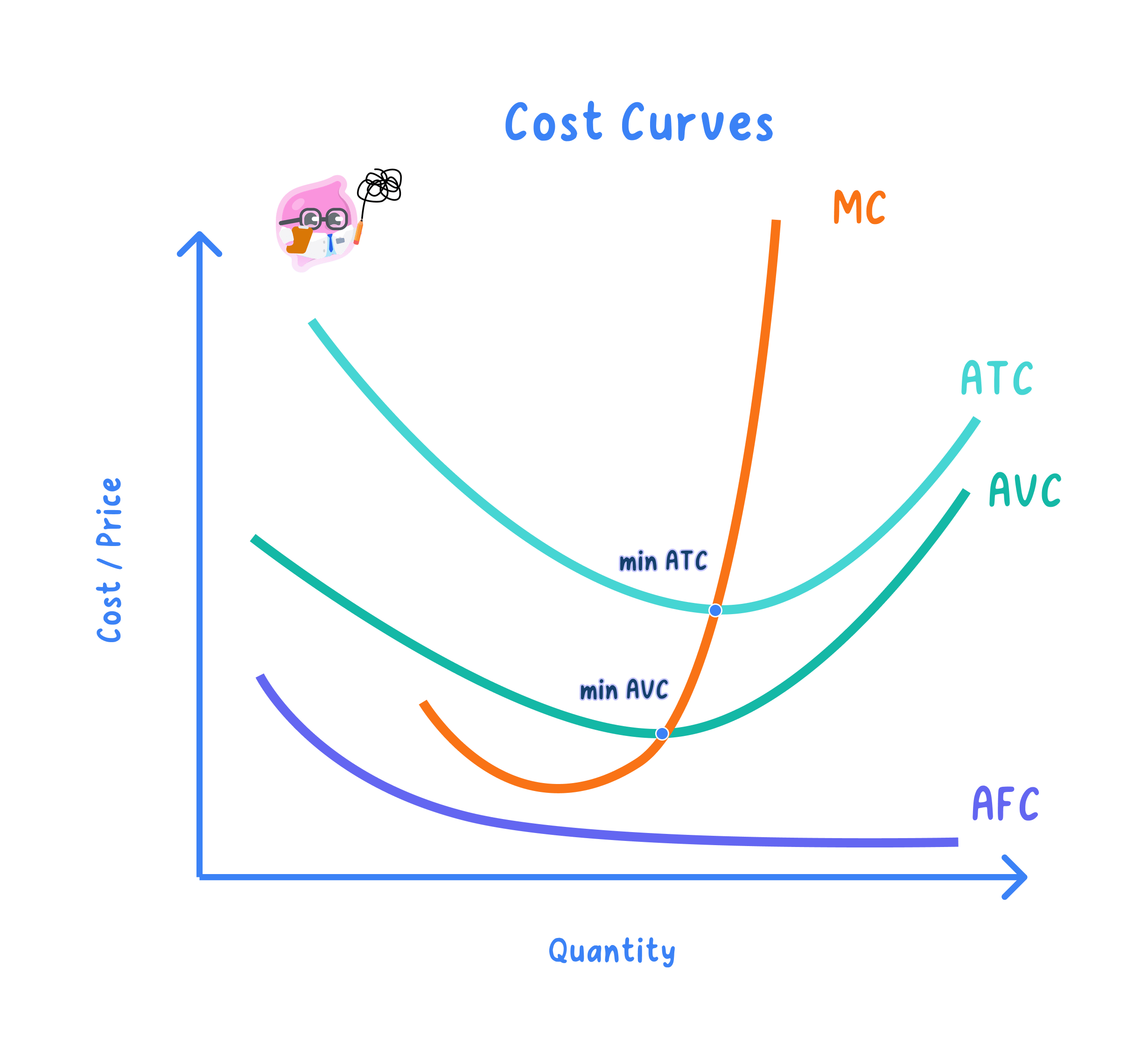
- Average fixed cost falls continuously because a constant total fixed cost is spread over more units.
- Average variable cost and average total cost fall at first, then rise, giving each a U shape.
- Marginal cost also falls then rises, and its upturn reflects the law of diminishing returns as the variable factor is added to fixed capital.
- Marginal cost cuts both average variable cost and average total cost at their minimum points.
- Average total cost reaches its minimum at a higher output than average variable cost, because average fixed cost keeps falling.
Key Idea
- While marginal cost is below average cost it pulls the average down, and while it is above it pulls the average up.
- So marginal cost must pass through the lowest point of both AVC and ATC.
Example
- All figures are in £, with total fixed cost of 100 at every level of output.
| Output (Q) | TVC | TC | AFC | AVC | ATC | MC |
|---|---|---|---|---|---|---|
| 1 | 60 | 160 | 100 | 60 | 160 | 60 |
| 2 | 100 | 200 | 50 | 50 | 100 | 40 |
| 3 | 132 | 232 | 33.3 | 44.0 | 77.3 | 32 |
| 4 | 160 | 260 | 25 | 40.0 | 65.0 | 28 |
| 5 | 200 | 300 | 20 | 40.0 | 60.0 | 40 |
| 6 | 258 | 358 | 16.7 | 43.0 | 59.7 | 58 |
| 7 | 336 | 436 | 14.3 | 48.0 | 62.3 | 78 |
- Average variable cost is lowest at 40 around output 5, where marginal cost equals it, so marginal cost cuts AVC at its minimum.
- Average total cost is lowest near 59.7 at output 6, a higher output than the AVC minimum, and marginal cost cuts ATC there.
Exam technique
- Build total cost first, then divide by output for ATC and split it into AFC + AVC.
- Draw marginal cost cutting AVC and ATC exactly at their minimum points.
Common Mistake
- Do not confuse total cost with average cost, since average cost is total cost ÷ output.
- Do not draw the marginal cost curve missing the minimum points of AVC and ATC.
Self review
- What is the difference between fixed, variable and total cost?
- What are the formulae for ATC, AFC, AVC and marginal cost?
- What is average total cost when total cost is £150 for 10 units?
- Why are the short-run ATC and AVC curves U-shaped?
- Where does marginal cost cross AVC and ATC, and why?
