PED and total revenue
Definition
Total revenue (total expenditure): price multiplied by quantity sold, equal to the total amount consumers spend on the good.
TR=P×Q TR = P \times Q TR=P×Q- Whether a price change raises or lowers total revenue depends on the price elasticity of demand.
- This makes PED central to a firm's pricing decision and to a government deciding what to tax.
Key Idea
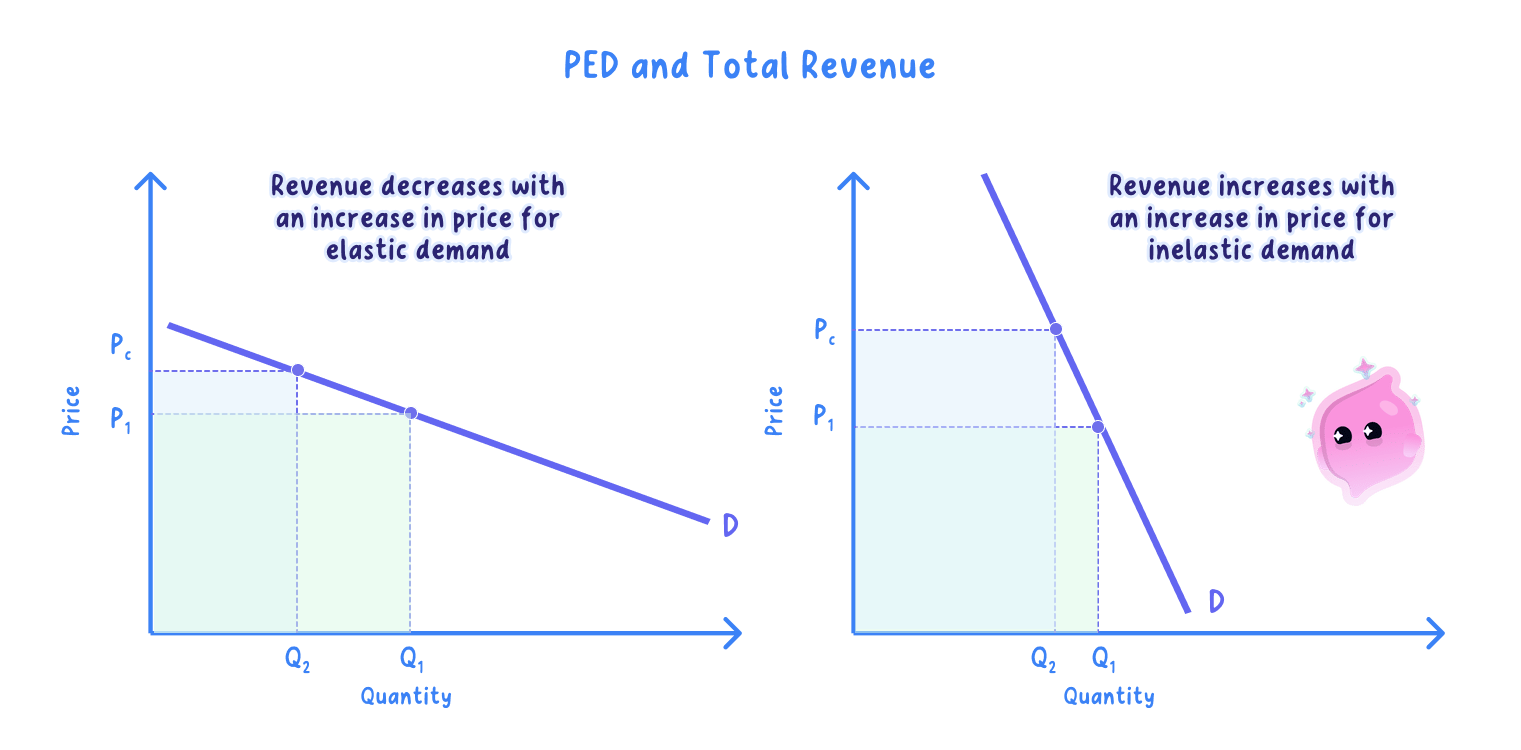
- If demand is inelastic, price and total revenue move in the same direction, so a price rise raises revenue and a price cut lowers it.
- If demand is elastic, price and total revenue move in opposite directions, because the percentage change in quantity outweighs the percentage change in price.
How PED drives revenue
- Inelastic demand
- Quantity falls proportionately less than price rises, so the gain in revenue from the higher price outweighs the loss from fewer units, and total revenue rises. This is why a tax on petrol or cigarettes raises large revenue: demand barely falls.
- Elastic demand
- Quantity falls proportionately more than price rises, so the loss from fewer units outweighs the gain from the higher price, and total revenue falls. A single brand of biscuit behaves this way, since buyers desert it for rivals.
- Unit elastic demand
- The two percentage changes are equal, so total revenue is unchanged and is at its maximum where PED equals 1 in size.
Example
- A firm sells 100 units at a price of £10, so total revenue starts at £1,000.
- It raises price to £12, a rise of 20%, while quantity falls to 90 units, a fall of 10%.
- The size is below 1, so demand is inelastic.
- Total revenue rises, confirming that price and revenue move together when demand is inelastic.
Example
- Now take a different good also selling 100 units at £10, again with total revenue of £1,000.
- Price rises to £12, a rise of 20%, but quantity falls to 70 units, a fall of 30%.
- The size is above 1, so demand is elastic.
- Total revenue falls, confirming that price and revenue move in opposite directions when demand is elastic.
The revenue rule
- When demand is inelastic, price and total revenue move together.
- When demand is elastic, price and total revenue move in opposite directions.
- When demand is unit elastic, total revenue is unchanged and is at its maximum.
Applying it to pricing
- A firm facing inelastic demand, such as a rail operator on a commuter route, can raise price to raise total revenue.
- A firm facing elastic demand, such as one airline on a competitive route, should consider cutting price to raise total revenue.
- Knowing PED turns pricing from guesswork into a calculated decision.
Beyond revenue
- Revenue is not the same as profit, which also depends on costs, so a revenue-maximising price need not maximise profit.
- PED often varies along the demand curve, so the rule can change with the price charged.
- Firms also weigh long-run effects such as customer loyalty, not just immediate revenue, so it depends on the firm's objective.
Should a firm rely on the PED and revenue rule when setting price?
- The rule is a dependable starting point, because it follows directly from the fact that total revenue is price multiplied by quantity: once a firm knows whether demand is elastic or inelastic at its current price, the direction in which to move price to raise revenue is clear.
- But higher revenue is not the same as the firm's true goal: revenue ignores costs, so the revenue-maximising price where PED equals 1 in size rarely coincides with the profit-maximising price, and a firm chasing revenue alone can lift turnover while shrinking profit.
- The rule also assumes a known and stable PED, yet elasticity varies along the demand curve and rivals may react, so a price cut expected to lift revenue can fail if competitors match it or if the firm has misjudged its current elasticity.
- On balance, the PED and revenue link is a sound first step but not a complete pricing rule, so it depends on the firm's objective, its costs and the reliability of its elasticity estimate: it is best used alongside cost and competitor analysis rather than on its own.
Exam technique
- State the PED, then deduce the effect of the price change on total revenue.
- Remember revenue is maximised where PED equals 1 in size.
- Distinguish revenue from profit when you evaluate.
Common Mistake
- Do not claim a price rise always raises revenue; it only does so when demand is inelastic, since with elastic demand revenue falls.
- Do not treat revenue as the same as profit, because profit also depends on costs, which revenue analysis ignores.
Self review
- How is total revenue calculated?
- What happens to revenue when an inelastic good's price rises?
- At what value of PED is total revenue maximised?
- Why should a firm with elastic demand consider cutting price?
- Why is revenue not the same as profit?
