Growth Pulls In Imports
Definition
Current account: the record of a country's trade in goods and services plus net primary and secondary income flows.
Marginal propensity to import (MPM): the fraction of each extra £1 of income that is spent on imports.
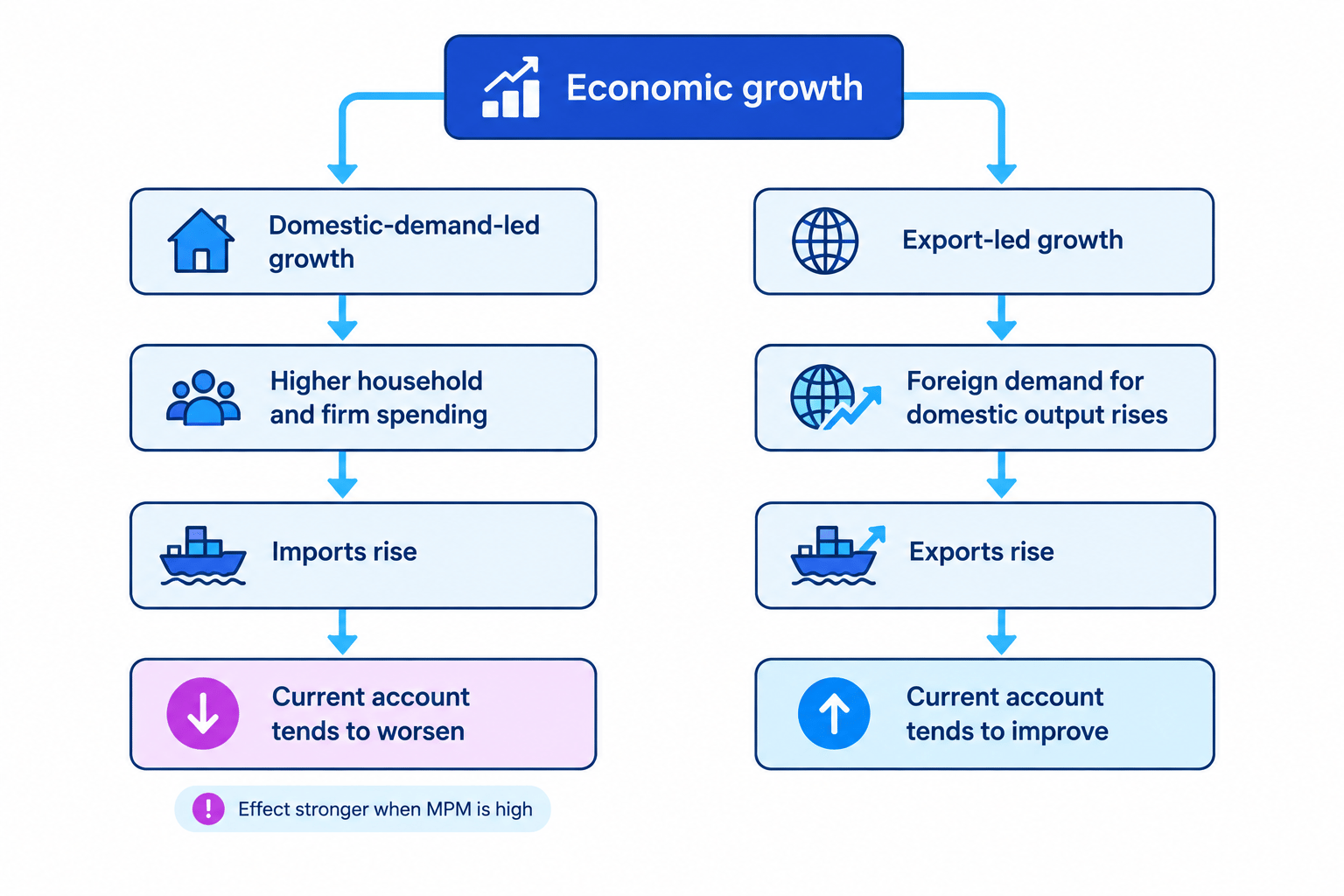
- Fast economic growth raises real incomes, so households and firms spend more, and a share of that extra spending goes on imports.
- Rising imports widen the gap between imports and exports, which worsens the current account of the balance of payments.
- So pursuing faster growth can conflict with balance-of-payments stability, a classic policy trade-off.
Key Idea
- Rapid domestic-demand-led growth tends to suck in imports and worsen the current account.
- Export-led growth is the exception, because rising exports improve the current account.
Why Growth Pulls Imports
- Higher household incomes
- As incomes rise, consumers buy more goods and services, and many, such as cars, phones and food, are imported, so imports rise.
- Rising demand from firms
- Expanding firms import more raw materials and capital equipment to lift output, adding further to import spending.
- The marginal propensity to import
- Each extra £1 of income raises import spending by the MPM, so the faster income grows, the faster imports climb.
Example
- Fast growth lifts national income by £40bn in a year, and £10bn of the rise is spent on extra imports, a 25% leakage.
- So 25% of every extra £1 earned leaks abroad, which is why a booming economy often runs a widening current-account deficit.
The Exception: Export-Led Growth
- If growth is driven by rising exports, foreign demand for domestic output rises, so exports climb and the current account improves rather than worsens.
- Export-led economies such as Germany and South Korea grow by selling abroad, so fast growth and a current-account surplus can coexist.
- Investment-led growth may worsen the current account now, as firms import capital goods, but raise capacity and competitiveness so it improves later.
- So the source of growth, not just its rate, decides whether growth and the balance of payments conflict; it depends on what is driving demand.
Does faster growth always worsen the balance of payments?
- When growth is led by domestic demand, usually yes: higher incomes raise import spending by the marginal propensity to import, so a boom pulls in imports faster than exports and the current account slips towards deficit.
- But the outcome hinges on the source of growth and the size of the MPM: export-led growth, as in Germany or South Korea, lifts exports and can run alongside a surplus, and investment-led growth may worsen the account now yet raise capacity and competitiveness so it improves later.
- On balance, growth threatens external balance mainly when it is demand-led and the MPM is high; where growth is export- or investment-led, or the economy has spare capacity, the conflict is weak or reverses over time, so the driver of growth matters more than its speed.
Exam technique
- Explain the chain: higher income leads to more import spending, which weakens the current account.
- Distinguish domestic-demand-led growth from export-led and investment-led growth.
- Use the source of growth to judge whether growth and the balance of payments actually conflict.
Common Mistake
- Do not assume growth always worsens the balance of payments, since export-led growth can improve it.
- Do not confuse the current account with the whole balance of payments, as growth mainly affects trade flows.
Self review
- Why does fast domestic-demand-led growth tend to worsen the current account?
- What does a marginal propensity to import of 0.25 tell you?
- How can export-led growth improve the balance of payments?
- Why does the source of growth matter more than its rate?
- Which objective can conflict with faster growth?