Measuring Unemployment
Definition
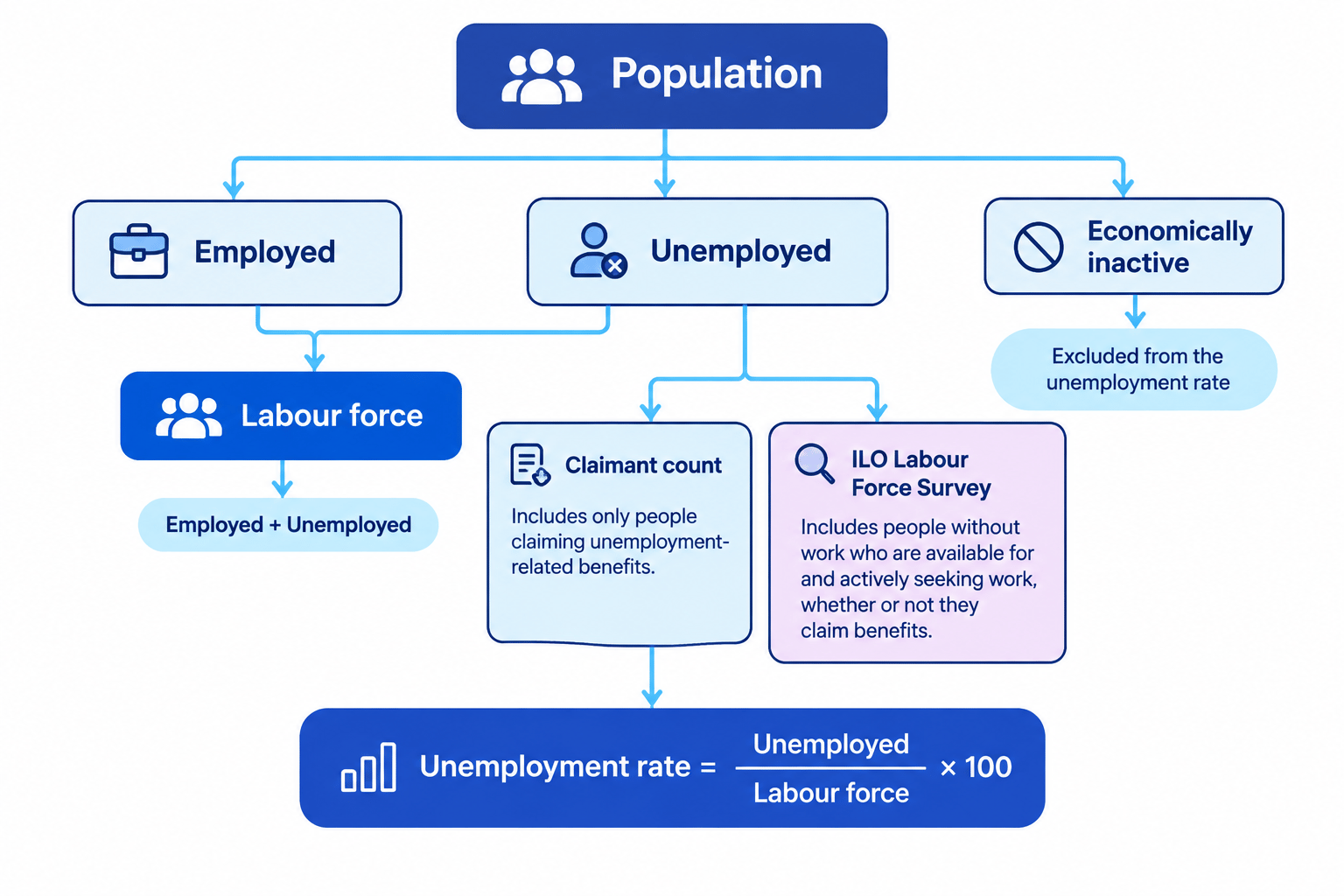
Unemployment rate: the percentage of the labour force that is without work but able, willing and actively seeking a job.
Two Main Measures
- Unemployment is measured in two main ways.
- The claimant count records those claiming unemployment-related benefits.
- The Labour Force Survey underpins the ILO measure, a large sample survey of the population.
- The ILO measure counts everyone available for and actively seeking work, whether or not they claim benefits.
Key Idea
- The claimant count captures only those eligible for and claiming benefits.
- The ILO measure captures anyone seeking work, whether or not they claim benefits.
Calculating the Rate
- The labour force = the number employed + the number unemployed.
- The unemployment rate is the share of that labour force which is without work, expressed as a percentage.
- It is measured against the labour force, not the whole population, so the economically inactive are excluded.
Example
- An economy has 45 million employed and 5 million unemployed, so the labour force = 45 + 5 = 50 million.
- So 1 in 10 of the labour force is without work.
- Now suppose 1 million of the unemployed give up searching: they leave the labour force, which falls to 49 million with 4 million still unemployed.
- The rate falls even though no new jobs were created, so a lower rate can simply mask people leaving the labour force.
Why the Measures Differ
- The claimant count misses those seeking work who do not qualify for benefits.
- It can also include some claimants who are not genuinely seeking work.
- Changes to benefit rules alter the claimant count without any real change in unemployment.
- The two measures therefore rarely give the same figure, and the ILO measure is usually higher.
Example
- A jobseeker claiming Jobseeker's Allowance of about £90 a week appears in both the claimant count and the ILO measure.
- A graduate searching for work but ineligible for benefits appears only in the ILO measure, so the claimant count understates true unemployment.
Difficulties in Measurement
- Hidden unemployment, such as discouraged workers, is missed by both measures.
- The underemployed are counted as employed, which understates spare capacity.
- Survey samples carry sampling error, and self-reported answers can be inaccurate.
- The informal economy is hard to capture, especially in developing economies.
Which measure gives the truer picture?
- The claimant count is cheap, quick and objective, because it comes from administrative records, but it is narrow: it misses jobseekers who do not qualify for benefits and shifts whenever the benefit rules change, so it usually understates true unemployment.
- The ILO measure from the Labour Force Survey is broader and internationally comparable, because it counts everyone actively seeking work, but it relies on a sample and self-reported answers, so it carries sampling error and still misses hidden and informal unemployment.
- On balance, the ILO measure is generally the more reliable guide, though no single figure captures the true slack in the labour market, so it is best read together with the claimant count and alongside the inactivity and underemployment data.
Exam technique
- State the formula and always divide by the labour force, never the whole population.
- Note which measure a question uses: the ILO measure is usually higher than the claimant count.
Common Mistake
- Do not treat everyone not in work as unemployed.
- The economically inactive are excluded from both unemployment measures.
Self review
- State the formula for the unemployment rate.
- In an economy with 90 million employed and 10 million unemployed, what is the unemployment rate?
- What is the claimant count?
- Give one difficulty in measuring unemployment.
- Why do the two measures usually differ?