Supply-side policy
Definition
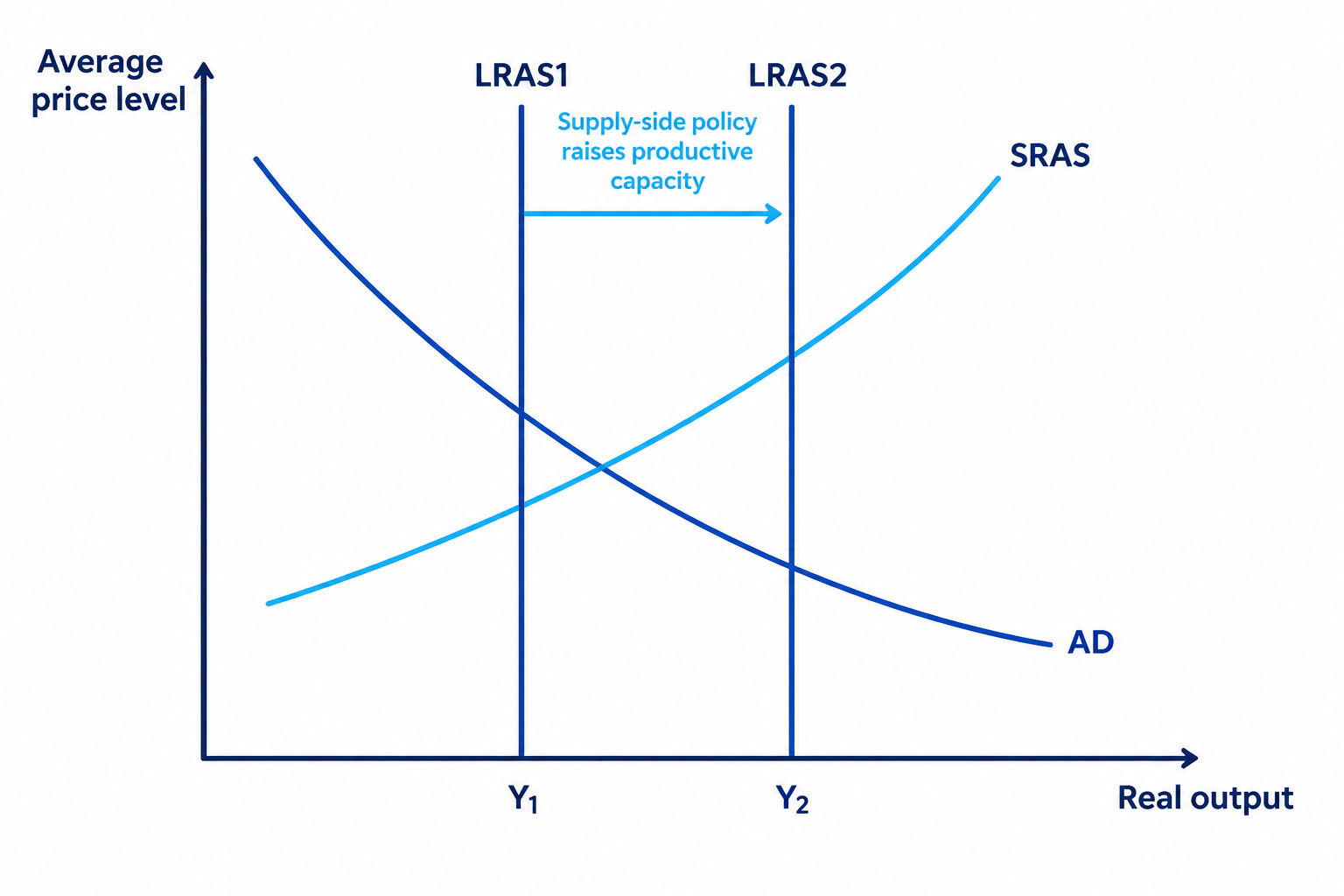
Supply-side policy: any government measure designed to raise the productive capacity of the economy, shifting the long-run aggregate supply (LRAS) curve to the right.
Long-run aggregate supply (LRAS): the economy's potential output when all factors of production are fully and efficiently employed, drawn as a vertical curve.
Effect on LRAS
- It is fixed at the output produced when resources are fully employed.
- A rightward shift raises potential output at every price level.
- The extra capacity is permanent, not a temporary lift to spending.
Difference from demand policy
- Fiscal and monetary policy manage aggregate demand.
- Supply-side policy instead raises the economy's ability to produce.
- It works on the quantity and quality of the factors of production.
- A demand boost that outruns capacity pulls the price level up, adding to inflation.
- Supply-side policy can raise output while easing that price pressure, so it depends on the time horizon which policy suits the aim.
Key Idea
- Supply-side policy shifts LRAS right, raising the economy's potential output.
- This is a structural change, not a temporary boost to spending.
A long-term focus
- Supply-side measures act slowly, often over several years.
- They target the structural performance of the economy.
- Many involve microeconomic reforms to specific markets.
- So they suit long-run growth aims rather than a sudden demand shortfall.
Example
- Suppose the government funds a £5 billion national retraining programme for unemployed workers.
- Workers gain skills, so more of them become employable and more productive per hour.
- The effective quantity and quality of labour rise, so productive capacity increases.
- On an AD/AS diagram (average price level against real output), LRAS shifts right from LRAS1 to LRAS2.
- Real output can rise with lower inflationary pressure, though the gains take years to appear.
Exam technique
- Define supply-side policy as a rightward shift of LRAS.
- Contrast it explicitly with demand-side policy for extra marks.
- Stress that the effects are long term when you evaluate.
Common Mistake
- Do not confuse supply-side policy with a shift in aggregate demand.
- Supply-side policy shifts LRAS, not AD.
- Do not expect instant results, since supply-side effects take time to appear.
Self review
- Define supply-side policy.
- Which curve does supply-side policy shift, and in which direction?
- How does supply-side policy differ from demand-side policy?
- Why can supply-side policy raise output without adding to inflation?
- Why are supply-side effects described as long term?