Indifference and budget lines
Definition
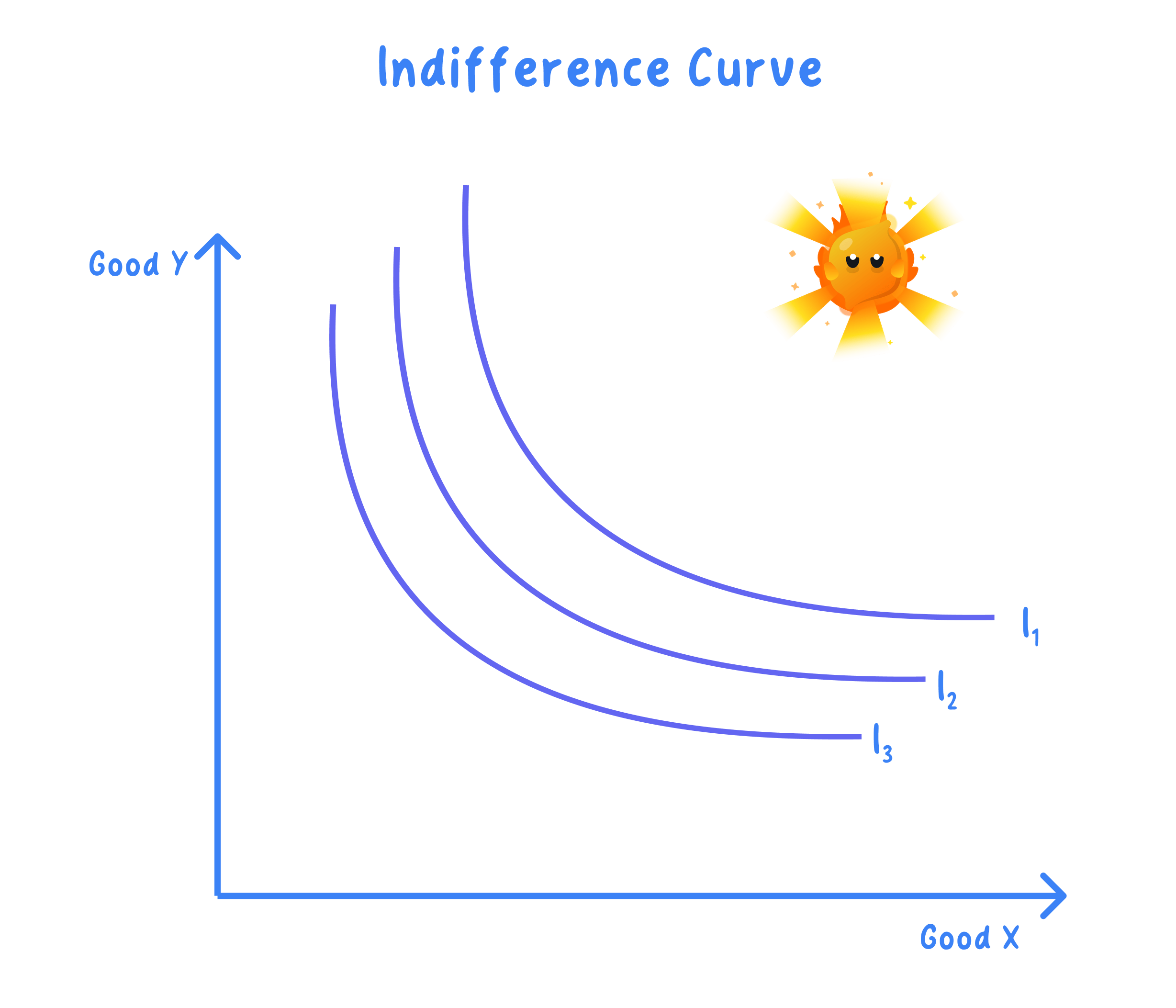
Indifference curve: a line joining every combination of two goods that gives a consumer equal total satisfaction, so the consumer is indifferent between them.
Budget line: a line showing every combination of two goods a consumer can just afford, given a fixed money income and the two prices.
Marginal rate of substitution (MRS): the quantity of one good a consumer gives up for one more unit of the other while total satisfaction is held constant; it is the slope of the indifference curve.
- An indifference curve ranks what the consumer wants, while a budget line shows what the consumer can afford, so the two together pin down the chosen bundle.
- Both are drawn with the quantity of one good on each axis.
- The consumer's optimum is the point where the budget line just touches the highest attainable indifference curve.
Key Idea
- An indifference curve joins equally satisfying combinations of two goods.
- A budget line shows which combinations are affordable.
- The optimum is where the budget line is tangent to the highest reachable indifference curve.
The indifference curve
- Every bundle on one indifference curve yields the same total satisfaction, so the consumer is genuinely indifferent about which of them they end up with.
- The curve slopes downward because gaining more of one good forces the consumer to give up some of the other to keep satisfaction constant.
- Its slope measures the marginal rate of substitution, how much of one good is traded for one more unit of the other at that point.
- The MRS diminishes along the curve, because the more of a good the consumer already holds the less of the other they will sacrifice for it.
- This diminishing MRS is what makes the curve convex to the origin.
- A whole family of curves forms an indifference map, and curves further from the origin show higher satisfaction because they contain more of both goods.
- Two indifference curves can never cross, because each curve stands for one distinct level of satisfaction.
Example
- A consumer feels equally satisfied with 8 cups of tea and 2 cups of coffee, or with 5 cups of tea and 3 cups of coffee.
- Both bundles lie on the same indifference curve, so the consumer would swap freely between them.
- A bundle of 6 cups of tea and 4 cups of coffee has more of both goods, so it must lie on a higher curve.
The budget line
- The budget line shows every combination of the two goods that exactly spends the consumer's whole money income.
- Its two intercepts show the maximum quantity of each good affordable if the whole budget is spent on that good alone.
- Its slope equals the ratio of the two prices, the horizontal-axis good's price relative to the vertical-axis good's price.
- Bundles beyond the line are unaffordable, while bundles inside it leave some income unspent.
Budget-line slope:
slope=PXPY \text{slope} = \dfrac{P_X}{P_Y} slope=PYPX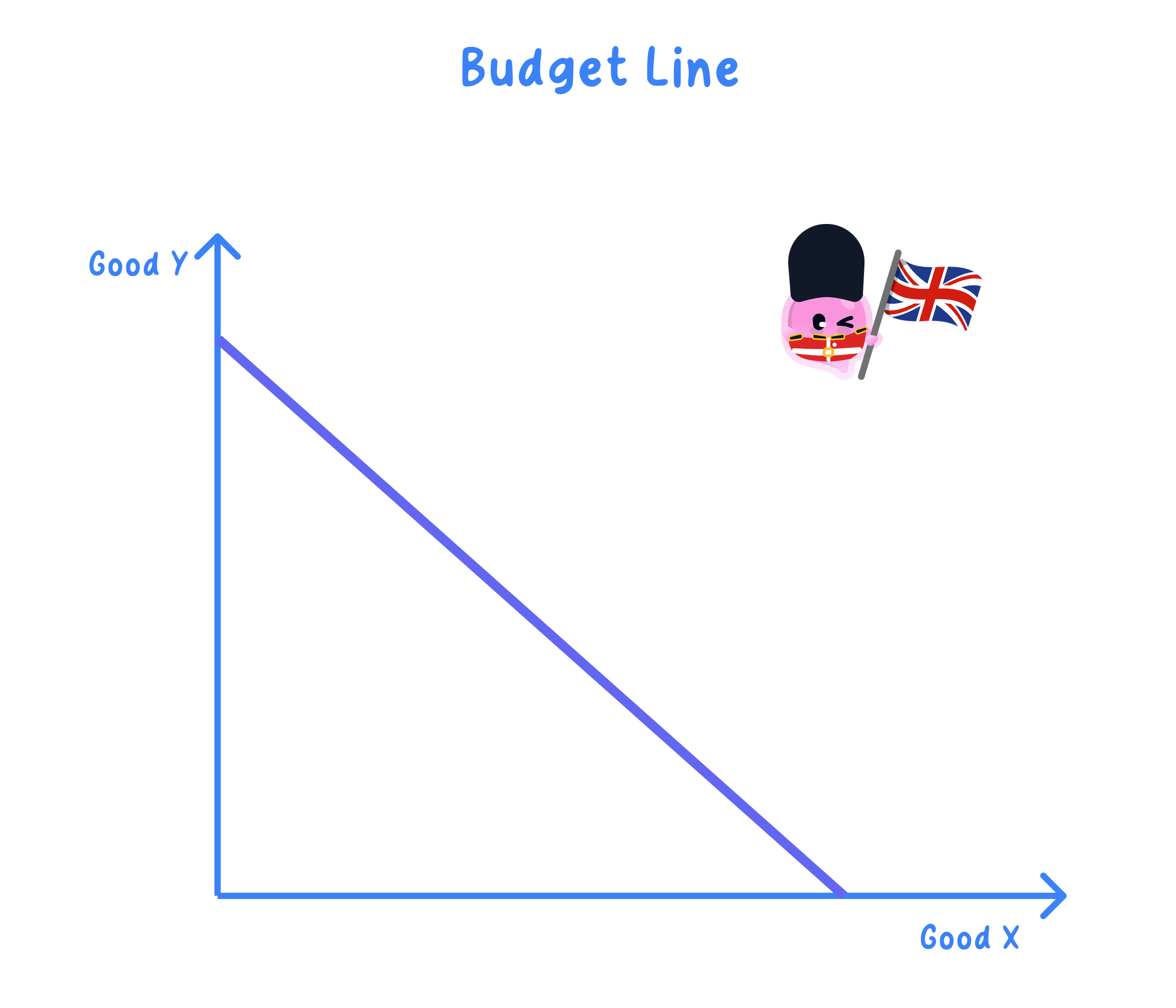
Example
- Money income is £20, good X costs £2 and good Y costs £1.
- Spending the whole £20 on X buys 10 units, so the X-intercept is 10.
- Spending the whole £20 on Y buys 20 units, so the Y-intercept is 20.
- So each extra unit of X means giving up 2 units of Y along the line.
The consumer optimum
- The consumer wants the highest satisfaction their income can buy.
- That is the highest indifference curve the budget line can reach.
- This is the point where the budget line is tangent to, meaning it just touches, an indifference curve.
- At the tangency the slope of the budget line equals the slope of the curve, so the MRS equals the price ratio.
- At any other affordable point the MRS differs from the price ratio, so the consumer could reallocate spending and reach a higher curve.
- It depends on preferences, though: the exact optimum shifts with the shape of the map, so a consumer who values X more settles at a bundle containing more X.
Optimum condition:
MRS=PXPY MRS = \dfrac{P_X}{P_Y} MRS=PYPX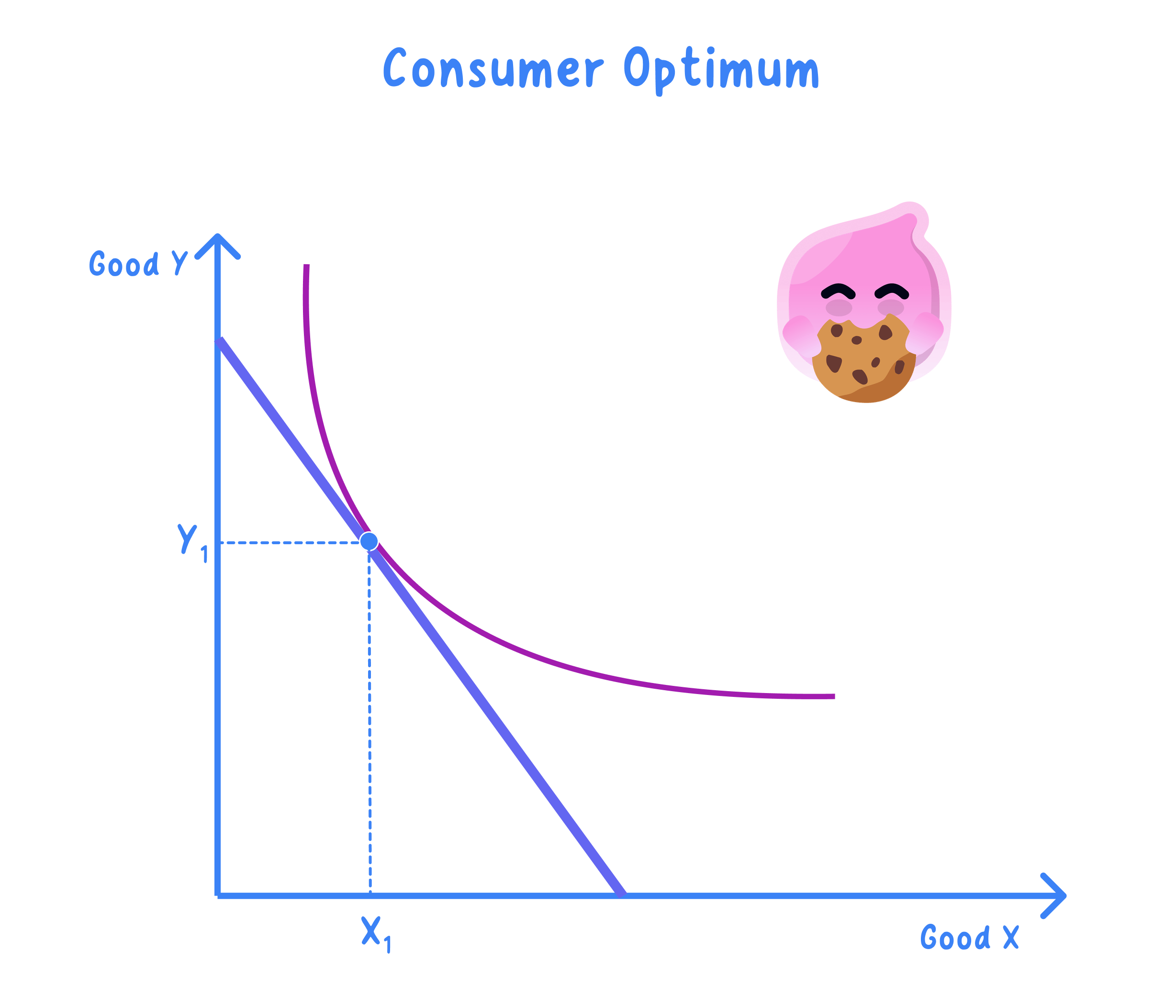
Example
- With income £20 and prices £2 for X and £1 for Y, the highest reachable curve is touched at 6 units of X and 8 units of Y.
- The bundle exactly spends the £20, and here the MRS equals the price ratio of 2, so no reallocation can raise satisfaction.
Exam technique
- Label both axes with the quantity of each good.
- Draw the indifference curve convex to the origin and the budget line as a straight downward-sloping line.
- Mark the optimum where the budget line is tangent to the highest attainable indifference curve.
Common Mistake
- Do not confuse a parallel shift of the budget line with a change in its slope.
- A parallel shift comes from an income change, while a change in slope comes from a change in one price.
Self review
- What is an indifference curve?
- Why is an indifference curve convex to the origin?
- What is a budget line and what determines its slope?
- Where is the consumer's optimum?
- What condition holds at the optimum?
