The national debt
Definition
National debt: the total stock of money a government owes, built up from past budget deficits net of surpluses.
A stock, not a flow
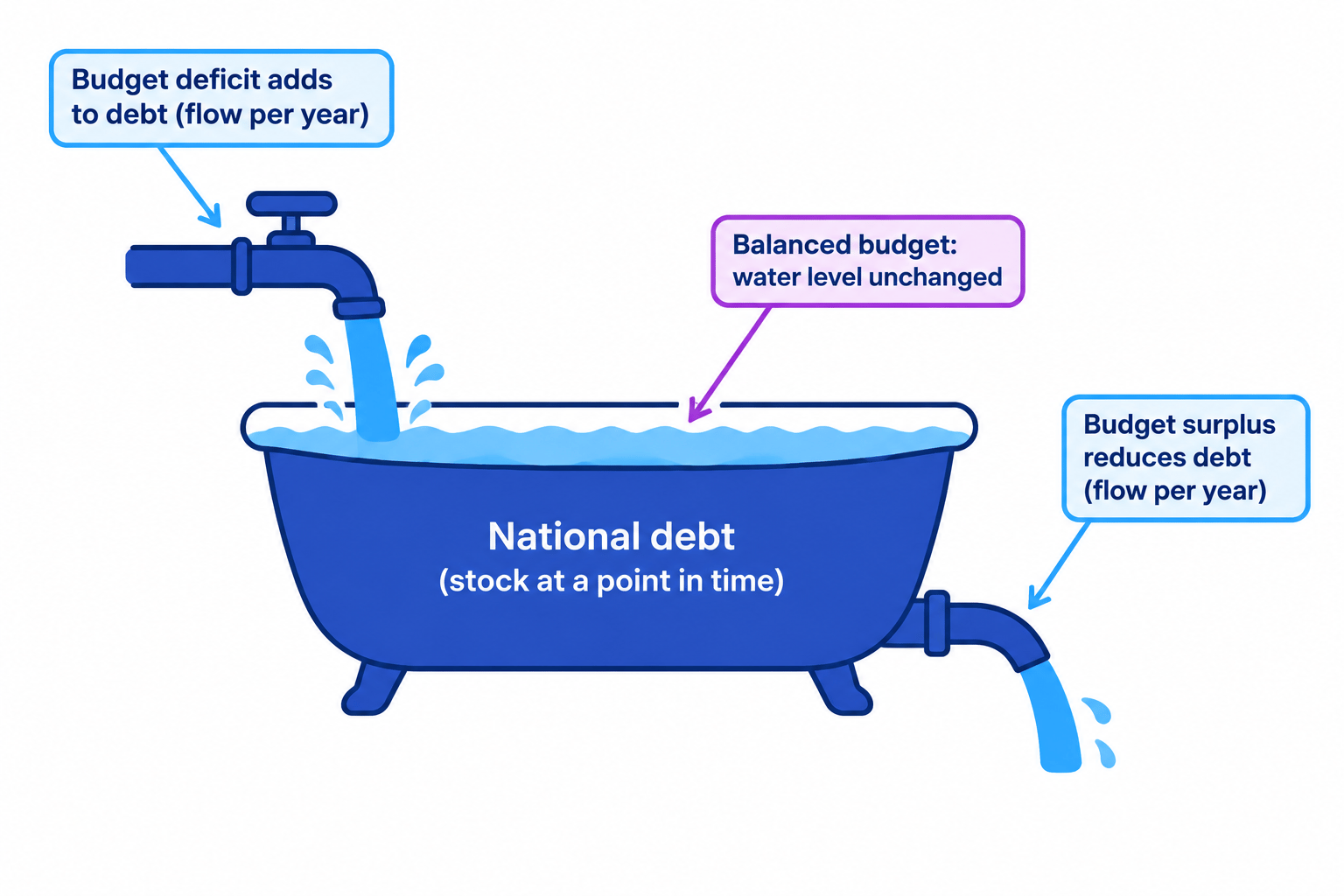
- The national debt is a stock, measured at a point in time, like the level of water in a bath.
- The budget deficit is a flow, measured over a period, like the water flowing in from the tap.
- Each year's deficit adds to the debt, so the debt is the sum of all past deficits net of any surpluses.
Key Idea
- A government can reduce the deficit to 0 and still owe a large national debt.
- Balancing the budget stops the debt rising, but only a surplus can make the stock fall.
How the debt changes
- A deficit raises the debt, while a surplus lowers it.
- The debt is often judged relative to national income as a debt-to-GDP ratio.
- Fast growth in real GDP can lower the ratio even while the debt in cash terms rises.
Debt-to-GDP ratio
national debtGDP×100% \dfrac{\text{national debt}}{\text{GDP}} \times 100\% GDPnational debt×100%Example
- The national debt starts at £1000 billion and the government runs a deficit of £50 billion.
- The flow adds to the stock, so the debt rises to £1050 billion (1000 + 50).
- With GDP of £2000 billion the ratio is 52.5%, so the debt is just over half of annual output.
Significance of the debt
- Interest must be paid on the debt, so that spending has an opportunity cost in forgone public services.
- Heavy government borrowing can crowd out private investment and push up interest rates.
- A debt is more sustainable if it funds productive investment and the economy is growing quickly, so significance depends on why the borrowing was undertaken.
Is a large national debt a problem?
- A large debt can be a genuine burden: interest payments have an opportunity cost in forgone public services, heavy borrowing may crowd out private investment, and if lenders doubt repayment the government faces higher interest rates and refinancing risk.
- However, the size of the debt in cash terms means little on its own. What matters is the debt-to-GDP ratio, the interest rate relative to the growth rate, and who holds the debt: debt owed mostly to domestic residents in the country's own currency is far easier to service than foreign-currency debt.
- The purpose of the borrowing also matters: borrowing that funds productive capital spending such as infrastructure or education can raise future output and partly pay for itself, whereas borrowing to fund current spending adds to the stock with no matching rise in capacity.
- On balance, a large national debt is a problem only when it grows faster than the economy's capacity to service it. The judgement depends on the debt-to-GDP trend, the growth-adjusted interest rate, the currency and maturity of the debt, and whether the borrowing raises future productive capacity.
Exam technique
- State clearly whether a figure is a stock (debt) or a flow (deficit).
- Add the year's deficit to the opening debt to find the closing debt.
- Judge the debt against GDP rather than in cash terms alone.
Common Mistake
- Do not say a falling deficit means a falling national debt.
- While the budget is in deficit the debt keeps rising, only more slowly.
Self review
- Define the national debt.
- Explain the difference between a stock and a flow using the debt and the deficit.
- If the debt is £1000 billion and the government runs a £30 billion surplus, what is the new debt?
- Give one reason a large national debt can be a concern.