Definition
Maximum price: a legal price ceiling above which a good may not be sold, which bites only when set below the free-market equilibrium.
Minimum price: a legal price floor below which a good may not be sold, which bites only when set above the free-market equilibrium.
- Governments use ceilings to protect consumers of essentials and floors to protect producers or discourage harmful consumption.
Key Idea
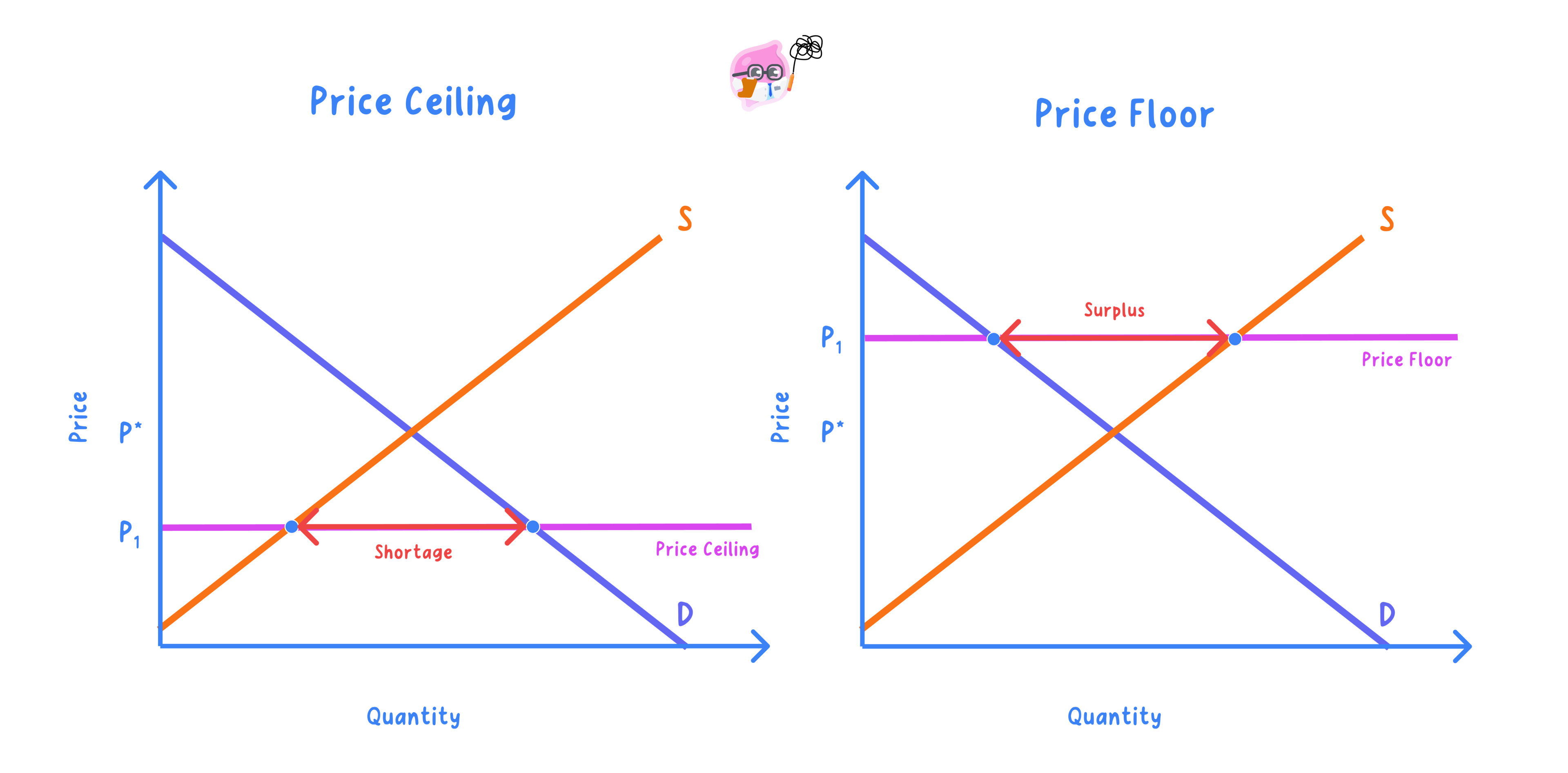
- A binding ceiling creates a shortage because quantity demanded exceeds quantity supplied.
- A binding floor creates a surplus because quantity supplied exceeds quantity demanded.
Maximum prices
- A ceiling keeps the price affordable, for example on rents or staple foods.
- The low price raises quantity demanded but cuts quantity supplied, so a shortage appears.
- The shortage forces non-price rationing such as queues, waiting lists or black markets, so some consumers still miss out.
Example
- The free market for a staple food clears at a price of £8 with 100 units traded.
- The government sets a maximum price of £5, below the equilibrium.
- At £5 quantity demanded rises to 130 units.
- At £5 quantity supplied falls to 70 units.
- The shortage is 130 − 70 = 60 units, equal to 60% of the quantity previously traded.
Minimum prices
- A floor guarantees a price, for example a minimum wage in the labour market or a minimum price on alcohol.
- The high price raises quantity supplied but cuts quantity demanded, so a surplus appears.
- The government may then have to buy up the surplus or accept that it is wasted, at a cost to taxpayers.
Example
- The same market clears at £8 with 100 units, but the government sets a minimum price of £11.
- At £11 quantity supplied rises to 120 units.
- At £11 quantity demanded falls to 70 units.
- The surplus is 120 − 70 = 50 units, equal to 50% of the quantity previously traded.
Do price controls work?
- A binding control does deliver for its target group, because a ceiling gives those who secure the good a lower price and a floor gives producers a higher, guaranteed one, and the size of the shortage or surplus depends on the elasticities of demand and supply, being larger when both are elastic.
- The costs grow the longer the control stays in force, because a rent ceiling deters new building while a price floor draws out ever more surplus, so the imbalance widens over time, some consumers or workers are shut out, and black markets can emerge.
- A government can pair a control with other measures, such as buying surpluses or subsidising extra supply, to reduce the imbalance, so the net effect depends on the whole package.
- On balance a price control is worthwhile where the equity gain to the protected group is large and the good is essential, but whether it does more good than harm depends on how far it is set from equilibrium, the elasticities of demand and supply, how long it stays in force, how the shortage or surplus is rationed, and whether a subsidy or direct provision would correct the problem with less distortion.
Exam technique
- Draw the ceiling as a horizontal line below equilibrium and the floor as a horizontal line above it.
- Mark quantity demanded and quantity supplied at the controlled price and label the gap as the shortage or surplus.
Common Mistake
- A maximum price sits below equilibrium and a minimum price sits above it; reversing this is a common error.
- A control set on the wrong side of equilibrium has no effect at all.
Self review
- Where must a maximum price be set relative to equilibrium to have any effect?
- At a ceiling of £5 with Qd of 130 and Qs of 70, what is the size of the shortage?
- Does a minimum price create a shortage or a surplus, and why?
- Name one non-price way a shortage is rationed under a maximum price.
