Definition
Buffer stock scheme: a price-stabilising system that buys and stores output when the price is low and releases it from store when the price is high.
- Buffer stocks are used for primary commodities such as grain or coffee, whose prices swing sharply.
- Prices are volatile because supply shifts with harvests while both demand and supply are price inelastic, so a small supply shift causes a large price change.
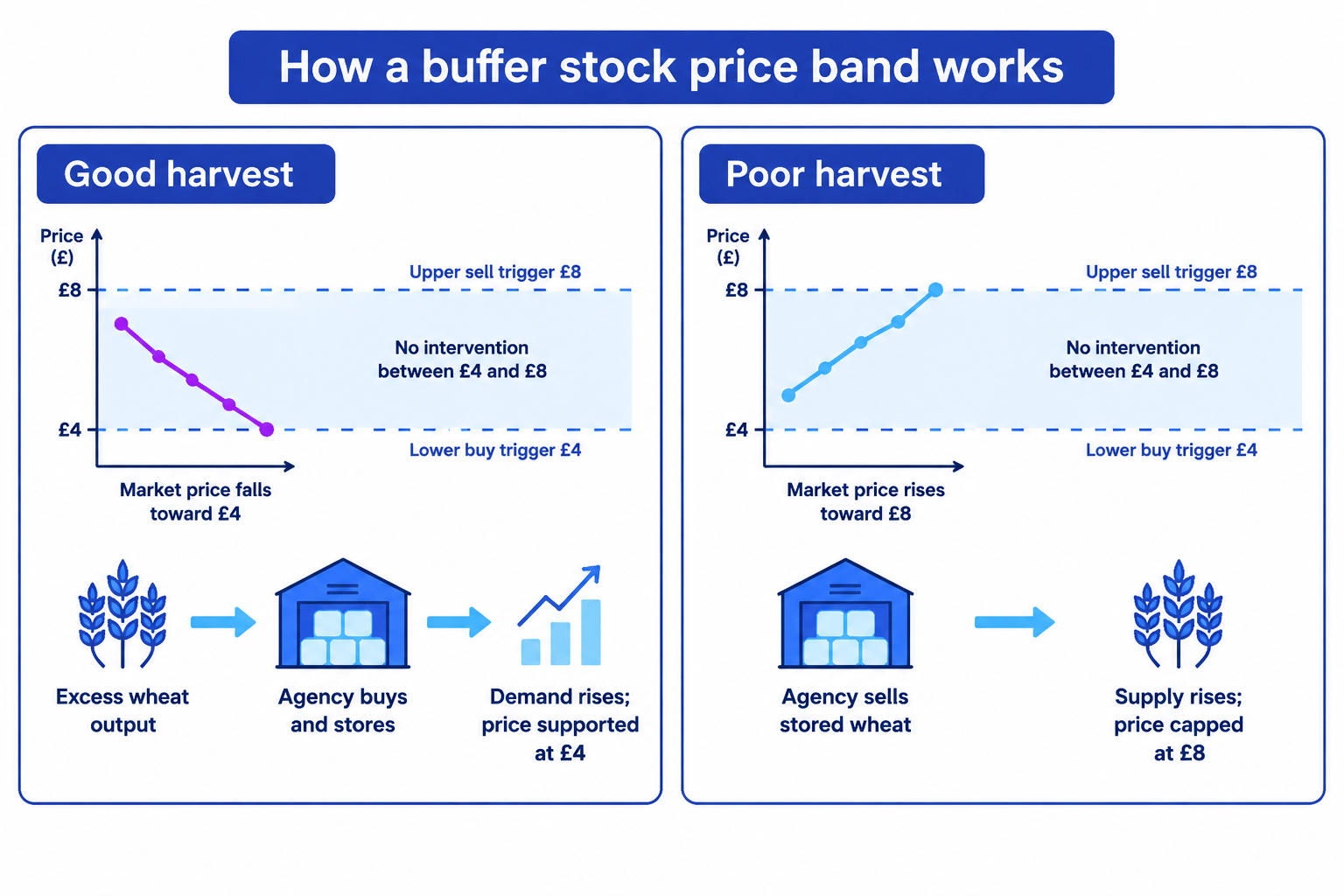
- The scheme sets a price band with a lower buy trigger and an upper sell trigger, and intervenes to keep price inside it.
Key Idea
- When price falls to the lower trigger the agency buys and stores, raising demand and supporting the price.
- When price rises to the upper trigger the agency sells from the store, raising supply and capping the price.
How the band works
- A good harvest shifts supply right and pushes price down towards the lower trigger.
- The agency buys the excess, so stocks build up in good years and prices do not collapse.
- A poor harvest shifts supply left and pushes price up towards the upper trigger, so the agency releases stock to hold the price down.
Example
- An agency sets a price band for wheat with a buy price of £4 and a sell price of £8 per unit.
- After a bumper harvest the market price would fall to £3, so the agency buys until price returns to the £4 floor.
- After a drought the market price would rise to £10, so the agency sells stock until price falls back to the £8 ceiling.
- Capping the drought price at £8 keeps it 20% below the £10 it would otherwise reach, protecting consumers from the spike.
- Between the triggers, from £4 to £8, the agency does nothing and the market sets the price.
Benefits of stability
- Stable prices give farmers a predictable income and help them plan investment.
- In principle the scheme can be self-financing, buying cheaply in gluts and selling dearer in shortages.
- Stable food prices also protect consumers from sudden spikes.
Why schemes fail
- Storage, security and administration are expensive, and perishable goods can spoil in store.
- If the buy price is set too high, persistent surpluses build up and the agency eventually runs out of money.
- A run of poor harvests can exhaust the stock, leaving the agency unable to cap the price, so success depends on setting the band near the long-run equilibrium.
On balance, do buffer stocks work?
- On balance a buffer stock can genuinely stabilise prices and incomes when the band is set close to the long-run equilibrium and the commodity stores well, because buying in gluts roughly offsets selling in shortages and the scheme can pay for itself, but it works poorly for perishable goods, when the buy price is set too high so surpluses and costs pile up, or when a run of poor harvests exhausts the stock, so its success depends on the accuracy of the band, storage costs, and the pattern of harvests over time.
Exam technique
- Show the buy price acting like a minimum price and the sell price acting like a maximum price.
- Explain each intervention as a shift in demand (buying) or supply (selling), not a change in the band.
Common Mistake
- The agency buys when price is low and sells when price is high, not the other way round.
- Setting the buy price above the long-run equilibrium guarantees ever-growing surpluses.
Self review
- What does a buffer stock agency do when the market price hits the lower trigger?
- With a band of £4 to £8, what happens if the free-market price would be £3?
- Why are primary commodity prices so volatile?
- Give one reason a buffer stock scheme can run out of money.