Interest rate determination
Two theories
- The equilibrium interest rate can be explained in two ways.
- Loanable funds theory sets the rate where the supply of saving meets the demand for borrowing.
- The Keynesian liquidity preference theory sets it where the demand for money meets the supply of money.
- Market interest rates are set this way and are distinct from the central bank's policy rate.
Key Idea
- Loanable funds theory looks at the market for saving and borrowing.
- Liquidity preference theory looks at the market for money.
The loanable funds theory
Definition
Loanable funds theory: the theory that the real interest rate is set in the market for saving and borrowing, where the supply of saving meets the demand for investment funds.
Crowding out: when heavy government borrowing raises the interest rate and reduces private-sector investment.
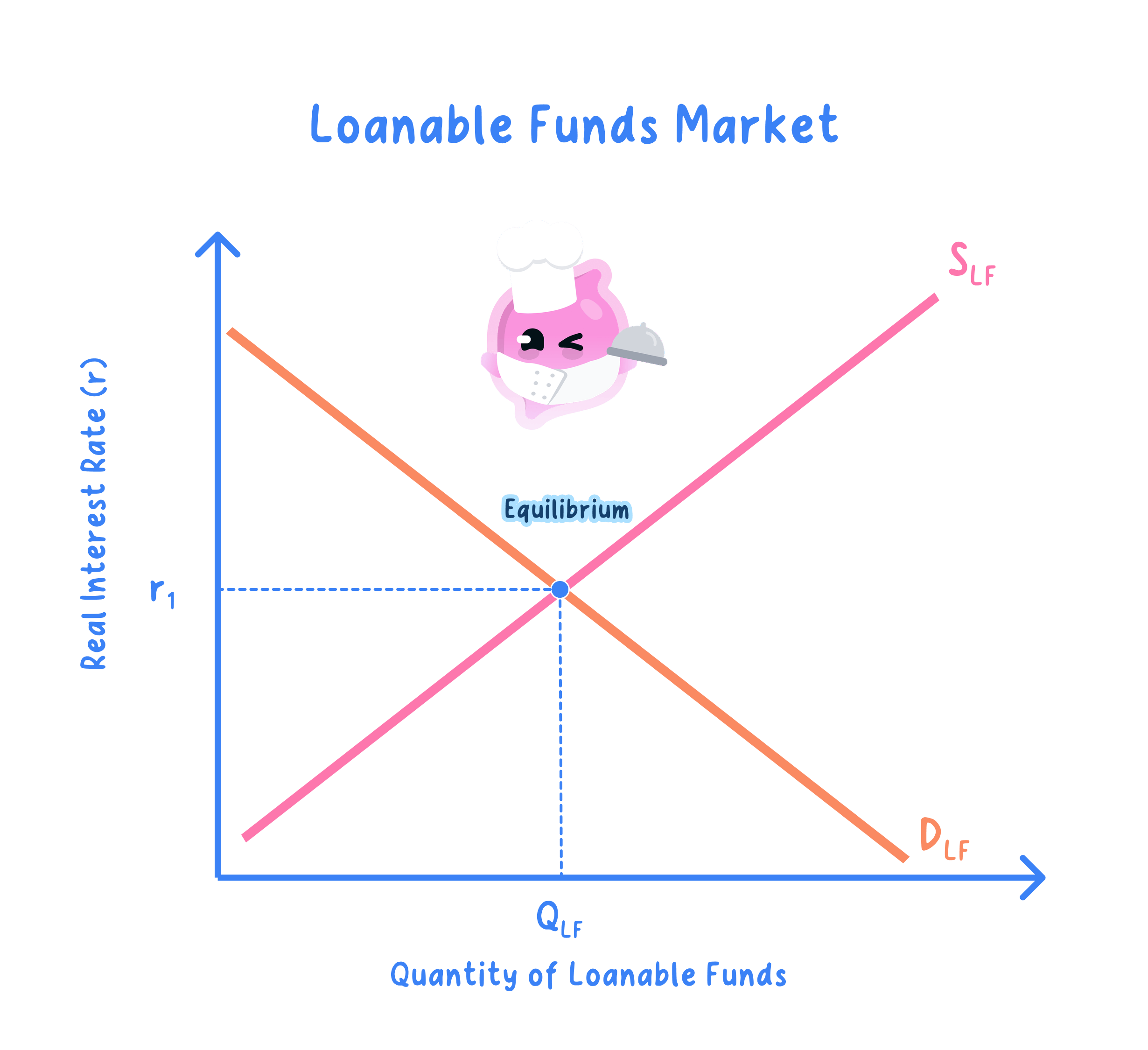
- The supply of loanable funds comes from saving and rises with the interest rate, because a higher return encourages more saving.
- The demand for loanable funds comes from borrowing for investment and falls as the rate rises, because fewer projects are profitable at higher borrowing costs.
- The real interest rate settles where the quantity saved equals the quantity borrowed.
- More saving shifts supply to the right → the rate falls.
- Heavy government or business borrowing shifts demand to the right → the rate rises and can crowd out private investment.
Example
- When a government runs a large deficit and borrows heavily, bond yields tend to rise, raising borrowing costs for firms and crowding out some private investment.
The Keynesian liquidity preference theory
Definition
Liquidity preference theory: the Keynesian theory that the interest rate is set in the money market, where the demand for money meets a money supply fixed by the central bank.
- In this theory the interest rate is determined in the money market, not the market for saving.
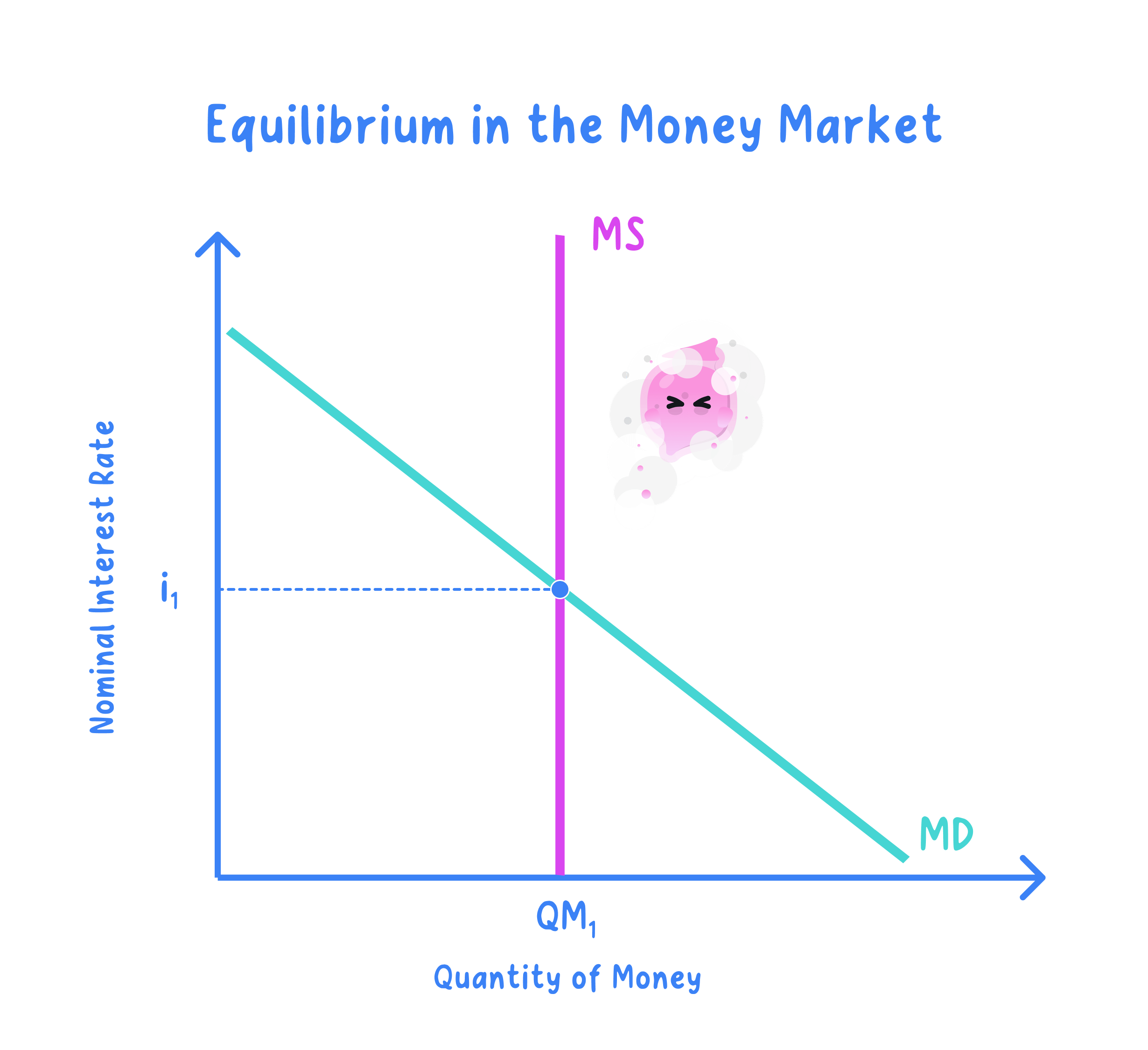
- The demand for money slopes downward against the interest rate, driven by the speculative motive.
- The money supply is set largely by the central bank and is drawn as a vertical line.
- The rate settles where money demand equals money supply.
- A larger money supply lowers the equilibrium interest rate → cheaper credit; a smaller money supply raises it.
Key Idea
- In the Keynesian view the interest rate is determined in the money market, not in the market for saving.
Policy rates and market rates
- The central bank sets its policy rate, the rate it pays or charges banks.
- Market rates on loans and mortgages are influenced by it but not fixed by it, because banks add a margin for risk and profit.
- Changes in saving or borrowing move the loanable funds rate, while changes in the money supply move the liquidity preference rate.
- Both approaches describe the same underlying market for credit from different angles, so which one you use depends on whether the question is about saving and investment or about money.
Note
- A central bank sets its policy rate, but the market rates households and firms pay are set by the demand for and supply of funds.
Exam technique
- Draw the loanable funds diagram with saving and borrowing against the real interest rate.
- Draw the liquidity preference diagram with a downward-sloping money demand and a vertical money supply.
- Distinguish market rates from the central bank's policy rate.
Common Mistake
- Do not assume the central bank alone fixes all interest rates.
- Remember that liquidity preference is the Keynesian theory, set in the money market.
Self review
- Name the two theories of interest rate determination.
- What determines the rate in the loanable funds theory?
- What determines the rate in the Keynesian liquidity preference theory?
- How does more saving affect the loanable funds rate?
- How does an increase in the money supply affect the liquidity preference rate?
