Floating exchange rate
Definition
Floating exchange rate: a rate set purely by the demand for and supply of the currency in the foreign exchange market, with no intervention by the government or central bank.
What determines it
- Equilibrium is the rate at which the quantity of the currency demanded equals the quantity supplied.
- If demand or supply shifts, the equilibrium rate adjusts until the market clears again.
Key Idea
- A floating rate is simply the market price of a currency.
- It settles where demand for the currency equals its supply.
- No authority fixes or targets the rate under a pure float.
Demand for the currency
- Demand for £ comes from foreigners who need it to make payments to the UK.
- Exports
- Foreign buyers must obtain £ to pay for UK goods and services, so rising exports raise demand for £.
- Inward investment
- Foreign investors buy £ to fund direct and portfolio investment in the UK, creating capital inflows.
- Inbound tourism
- Visitors sell their own currency for £ to spend while in the UK.
- Speculation
- Speculators buy £ when they expect it to appreciate, adding to demand.
Example
- Suppose the Bank of England raises interest rates, attracting capital inflows that raise demand for £.
- Say this moves the rate from £1 = $1.40 to £1 = $1.50, a rise of about 7.1%.
- Stronger demand pushes the equilibrium rate up, so the £ appreciates.
- How far the £ rises depends on how mobile and interest-sensitive international capital is.
Supply of the currency
- Supply of £ comes from UK residents who need foreign currency to make payments abroad.
- Imports
- Residents sell £ to obtain the foreign currency needed to pay for imports.
- Outward investment
- Residents sell £ to invest abroad, creating capital outflows.
- Speculation
- Speculators sell £ when they expect it to depreciate, adding to supply.
Note
- A rise in the supply of £ tends to lower the equilibrium rate, a depreciation.
- Rising import spending and capital outflows both increase the supply of £.
The forex diagram
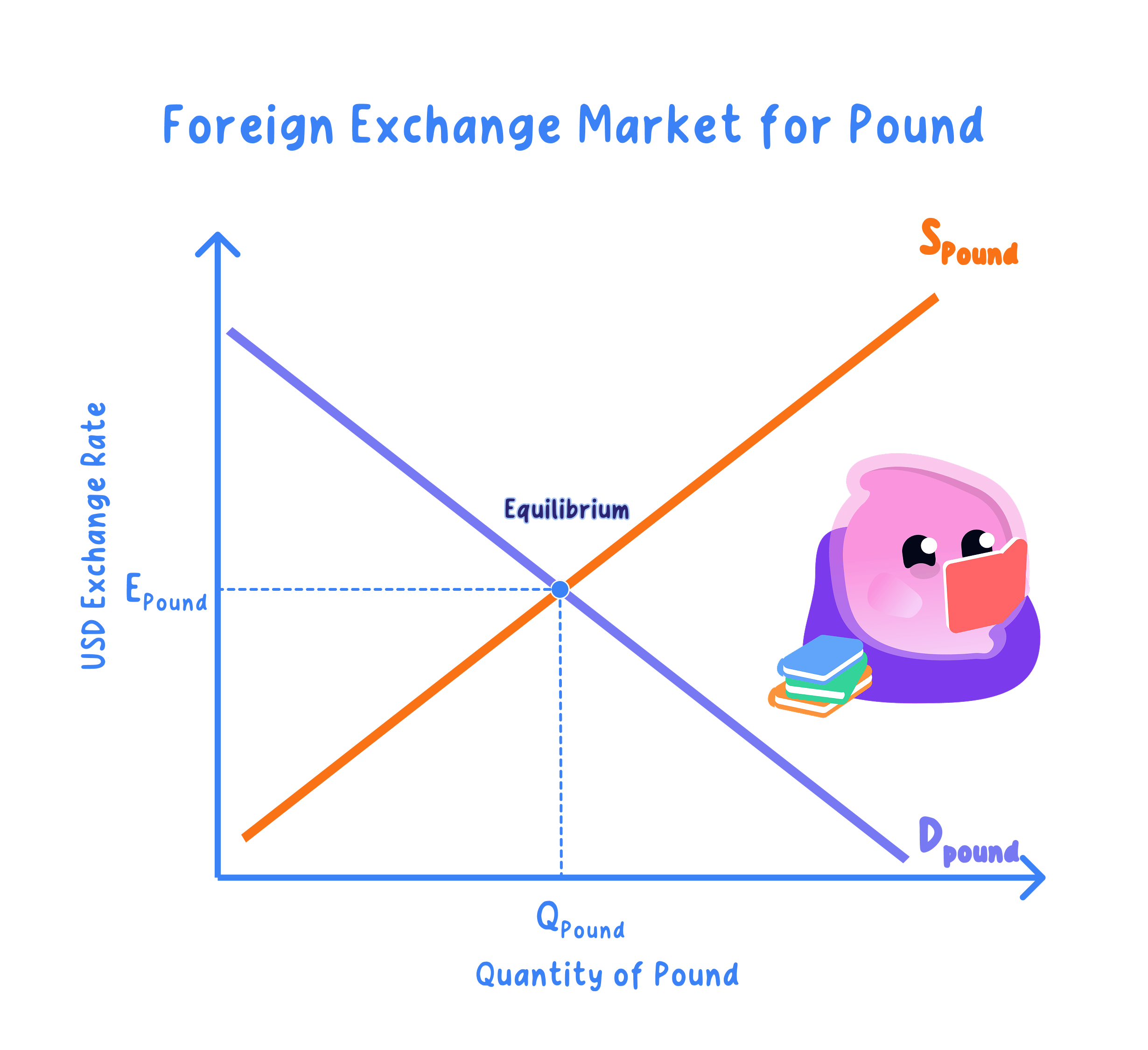
- The vertical axis shows the exchange rate, the price of £ in units of foreign currency per £1.
- The horizontal axis shows the quantity of the currency traded.
- The demand curve slopes downward, because a lower rate makes £ cheaper and more is bought.
- The supply curve slopes upward, because a higher rate makes £ dearer and more is offered.
- The equilibrium exchange rate lies where the demand and supply curves cross.
Note
- A shift right in demand, or left in supply, raises the equilibrium rate and the £ appreciates.
- A shift left in demand, or right in supply, lowers the equilibrium rate and the £ depreciates.
No intervention
- Under a pure float the government and central bank do not buy or sell £ to influence its value.
- The rate can therefore change continuously as demand and supply shift.
Note
- A pure float involves no intervention, so the market alone sets the rate.
- How fixed and managed rates are determined is treated more fully at A Level (Cambridge 9708 11.2.2).
Exam technique
- Put the exchange rate on the vertical axis and the quantity of the currency on the horizontal axis.
- Decide whether a factor changes the demand for £ or its supply.
- Shift the correct curve and read off the new equilibrium rate.
- State clearly whether the £ appreciates or depreciates.
Common Mistake
- Do not confuse a shift of a curve with a movement along it.
- A change in a determinant such as relative interest rates shifts the whole curve.
- Do not assume a floating rate is controlled by the government.
- Under a pure float the rate is left entirely to the market.
Self review
- What determines a floating exchange rate?
- Give two sources of demand for a currency.
- Give two sources of supply of a currency.
- What is measured on each axis of the foreign exchange diagram?
- How does a pure float differ from a rate the authorities manage or fix?
