Elasticity Values
Definition
Unitary elasticity: the case where the coefficient equals 1 in size, so quantity changes in exact proportion to the change in its determinant.
∣E∣=1 |E| = 1 ∣E∣=1- Elasticity coefficients are described using a standard set of terms based on their size, ignoring the sign.
- The same vocabulary applies to elasticities of demand and of supply.
- Reading the coefficient into the right category is essential for interpreting how responsive a good is.
Key Idea
- The size of the coefficient, ignoring sign, sets the descriptive label.
- The five categories run from perfectly inelastic at 0 to perfectly elastic at infinity.
The Five Categories
- Perfectly inelastic, value 0
- Quantity does not change at all when price changes, shown by a vertical demand curve; a life-saving good such as insulin comes close, since a diabetic buys the same dose whatever the price.
- Inelastic, value between 0 and 1
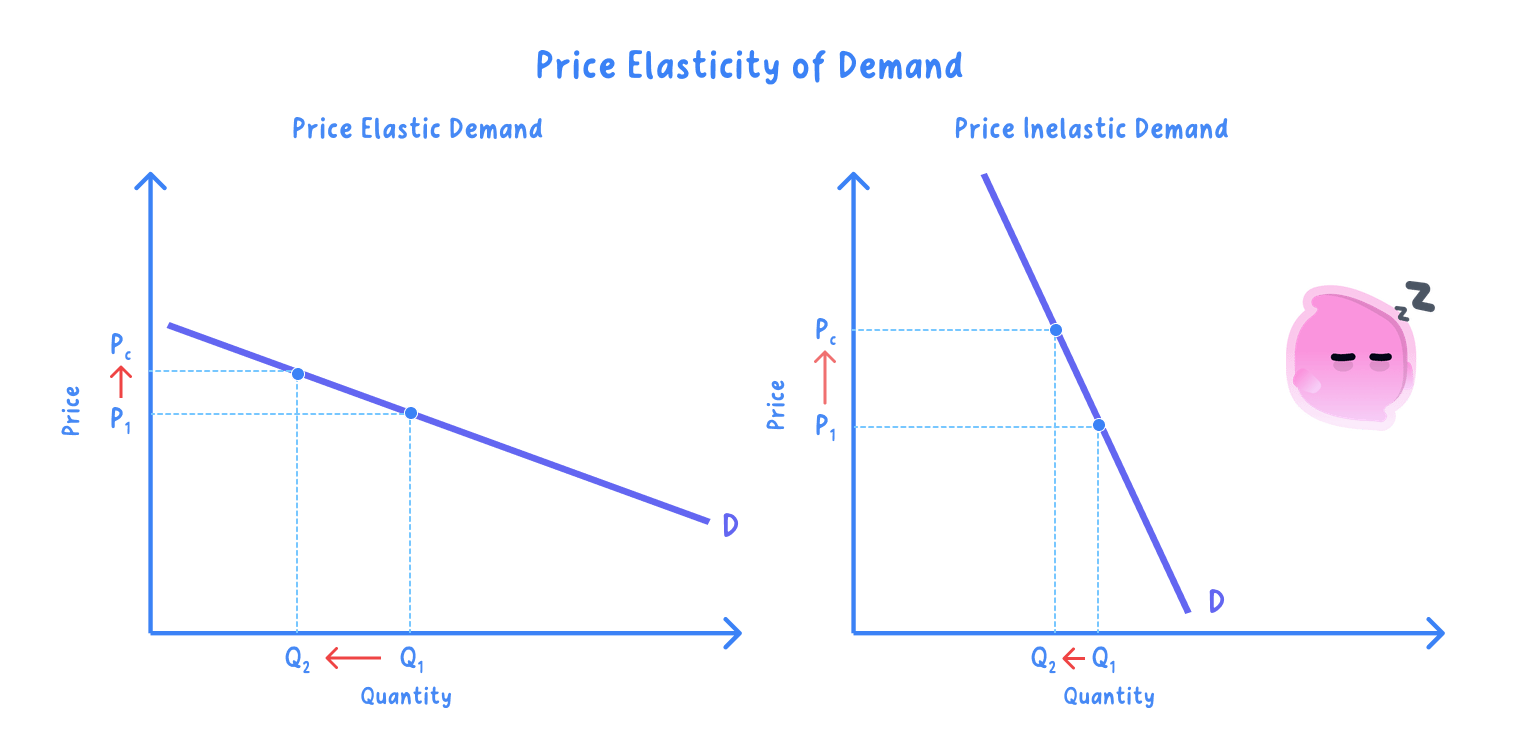
- Quantity changes less than proportionately to price, shown by a steep demand curve; petrol, cigarettes and salt are inelastic because they have few substitutes and take a small share of income, so a price rise barely cuts quantity demanded. The highly inelastic case sits close to 0.
- Unit elastic, value 1
- Quantity changes in exact proportion to price, shown for demand by a rectangular hyperbola, so total spending on the good stays unchanged as price moves.
- Elastic, value greater than 1
- Quantity changes more than proportionately to price, shown by a shallow demand curve; a luxury holiday or one brand of biscuit is elastic because buyers have many alternatives and readily switch. The highly elastic case sits far above 1.
- Perfectly elastic, value infinite
- Quantity changes without limit at a single price, shown by a horizontal demand curve; one farmer's wheat in a perfectly competitive market approaches this, since raising the price above the market price loses all buyers.
Example
- A PED of 0 is perfectly inelastic, a PED of 0.4 (petrol) is inelastic, and a PED of 1 is unit elastic.
- A PED of 2.5 (a luxury holiday) is elastic, and a PED tending to infinity is perfectly elastic.
Note
- The same size scale applies whether the coefficient is for demand or for supply.
- Only the usual sign differs, since PED is normally negative and PES normally positive.
Are the Extremes Realistic?
- The middle categories, inelastic to elastic, describe most real goods well.
- Perfectly elastic and perfectly inelastic are theoretical benchmarks rarely seen in full.
- They remain useful reference points for reasoning about extreme cases.
Exam technique
- Give both the descriptive term and the numerical range.
- Judge the category by the size, ignoring the sign.
- Use the same descriptive scale for demand and supply.
Common Mistake
- Do not let the sign change the category, because size, not sign, decides whether demand is elastic or inelastic.
- Do not treat the extremes as common, because perfectly elastic and perfectly inelastic are benchmarks, not typical cases.
Self review
- What coefficient means perfectly inelastic?
- What range of values counts as inelastic?
- What value is unit elastic?
- Does the sign affect the category? Explain.
- Why are the extremes treated as benchmarks?
