Types of profit
Definition
Normal profit: the minimum return needed to keep a firm in its industry, earned where AR = AC and counted as a cost.
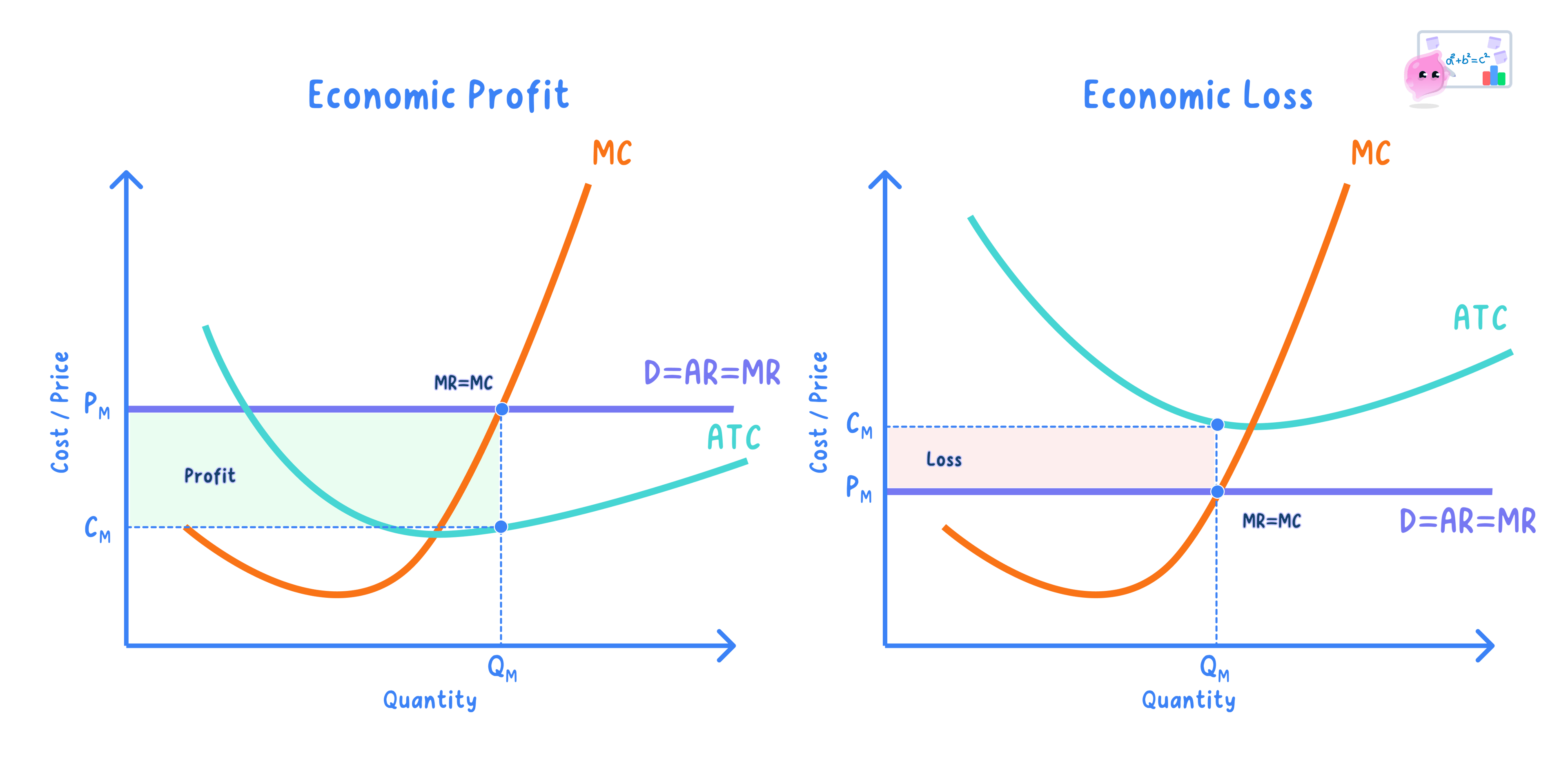
Supernormal profit: profit earned above normal profit, made where AR > AC.
Subnormal profit: profit below normal profit, made where AR < AC, which is an economic loss.
Key Idea
- Normal profit is treated as a cost, since it is the opportunity-cost return to enterprise.
- Supernormal profit is what remains once normal profit is covered.
Normal profit as a cost
- Normal profit is the reward the entrepreneur could earn in the next best use of their resources.
- Because it is an opportunity cost, it is included in the firm's total costs rather than treated as extra reward.
- A firm earning exactly normal profit makes no supernormal profit but is not making a loss, so it stays put.
Example
- A café owner could earn £30,000 a year working elsewhere, so that £30,000 is the normal profit built into the firm's costs.
- If revenue covers all other costs plus exactly that £30,000, the café earns normal profit and the owner stays.
- If revenue beats those costs by £50,000, the £50,000 − £30,000 = £20,000 above the opportunity cost is supernormal profit.
Note
- Normal profit is not zero profit; it is the opportunity-cost return already built into costs.
- This is why economic profit differs from the accounting profit a business reports.
Reading AR and AC
- At the profit-maximising output, compare average revenue with average cost.
- If AR > AC, the firm earns supernormal profit.
- If AR = AC, it earns only normal profit.
- If AR < AC, it makes subnormal profit, which is a loss.
Example
- If AR is £12 and AC is £9, the firm earns £12 − £9 = £3 of supernormal profit per unit.
- If AR is £8 and AC is £9, it makes £8 − £9 = −£1 per unit, a subnormal profit or loss.
Profit as a signal
- Supernormal profit attracts new firms into a market, raising supply and eroding that profit over time.
- Subnormal profit drives firms out towards more valued uses of resources.
- It depends on barriers to entry: supernormal profit persists only where entry is blocked, otherwise new firms compete it away.
Exam technique
- Treat normal profit as part of costs, not as a separate reward.
- Measure supernormal profit as the (AR − AC) gap multiplied by quantity.
Common Mistake
- Do not treat normal profit as zero profit.
- It is the opportunity-cost return already included in the firm's costs.
Self review
- Define normal, supernormal and subnormal profit.
- Why is normal profit treated as a cost?
- What does AR = AC tell you about profit?
- How does profit act as a signal in markets?
