Revenue measures
Definition
Total revenue (TR): the money a firm receives from sales, found as price multiplied by quantity.
Average revenue (AR): revenue per unit sold, which is equal to the price the firm charges.
Marginal revenue (MR): the change in total revenue from selling one more unit.
Total revenue
TR=P×Q TR = P \times Q TR=P×QAverage revenue
AR=TRQ \text{AR} = \dfrac{TR}{Q} AR=QTRMarginal revenue
MR=ΔTRΔQ \text{MR} = \dfrac{\Delta TR}{\Delta Q} MR=ΔQΔTRKey Idea
- The average revenue curve is the firm's demand curve, because AR equals price at every quantity.
- For a price-taker AR = MR = price, while for a price-maker MR lies below AR.
Worked example
Example
- A price-maker faces this demand: £10 sells 1 unit, £9 sells 2, £8 sells 3, £7 sells 4, so each £1 cut is a 10% price reduction from the top price.
- At £9 and 2 units, TR = £9 × 2 = £18; at £8 and 3 units, TR = £8 × 3 = £24.
- At 2 units total revenue is £18, and at 3 units it is £24.
- So average revenue is £9 then £8, always equal to the price charged.
- Moving from 2 to 3 units, total revenue rises from £18 to £24.
- So marginal revenue is £6, which lies below the £8 price.
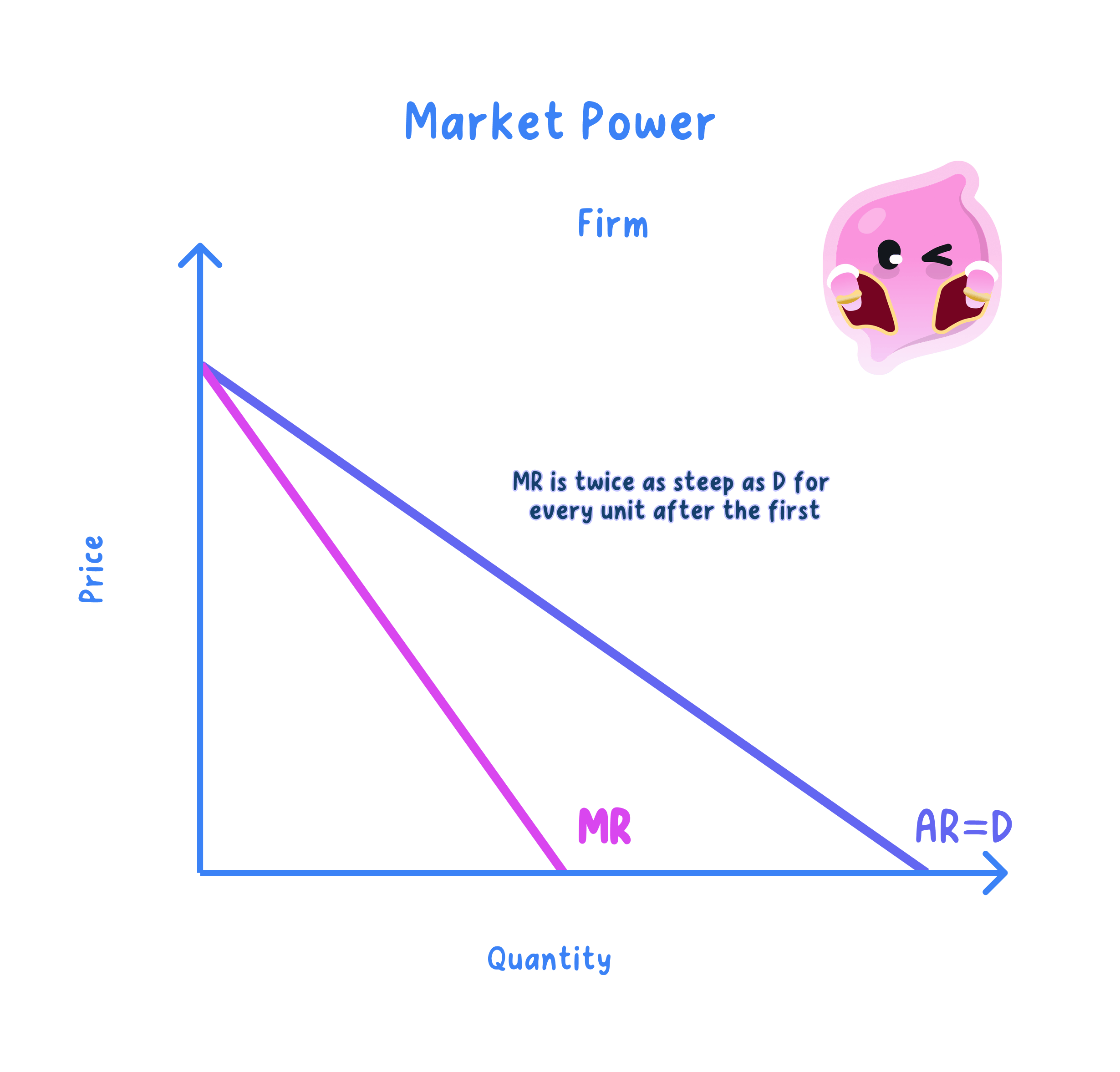
- MR falls twice as fast as AR, so for this straight-line demand curve MR reaches zero at the mid-point.
AR is the demand curve
- Average revenue is revenue per unit, which is simply the price the firm charges.
- The demand curve also shows the price the firm can charge at each quantity.
- So the average revenue curve and the demand curve are the same line.
Price-taker or price-maker
- Price-taker: the firm sells at the going market price, so AR = MR = price and its demand curve is horizontal.
- Price-maker: the firm must cut price to sell more, so MR lies below AR and its demand curve slopes down.
Note
- For a straight-line demand curve, the MR curve falls twice as steeply as AR.
- MR reaches zero at the mid-point of the demand curve.
Linking TR and MR
- Total revenue rises while marginal revenue is positive, because each extra unit still adds to revenue.
- Total revenue peaks when marginal revenue is zero.
- Total revenue falls once marginal revenue turns negative, as extra units then subtract from revenue.
Key Idea
- Marginal revenue is positive when demand is price elastic and negative when it is price inelastic.
- Marginal revenue is zero, and total revenue is at its maximum, at unit elasticity.
Exam technique
- For a price-taker, set AR = MR = price.
- For a price-maker, draw MR below AR and twice as steep.
Common Mistake
- Do not assume marginal revenue always equals price.
- That holds only for a price-taker, while for a price-maker MR lies below AR.
Self review
- Define total, average and marginal revenue and give the formula for each.
- Why is the AR curve the demand curve?
- When does AR equal MR?
- What is marginal revenue when total revenue is at its maximum?
