Social cost
Definition
Private cost (PC): the cost of an activity that falls directly on the decision-maker who undertakes it.
External cost (EC): the spillover cost that lands on third parties who take no part in the transaction.
Social cost (SC): the total cost of an activity to society, equal to private cost + external cost.
Why the divergence matters
- A firm choosing output weighs only the cost it pays, so it treats a partly free input such as clean air as costless → it stops where private cost is just covered.
- Because the spillover is real but unpriced, the true burden on society (SC = PC + EC) exceeds the firm's bill → too many resources are drawn into the activity.
- It depends on the size of EC relative to PC: a small external cost barely distorts choices, whereas heavy pollution pushes market output far above the efficient level.
Key Idea
- A positive external cost makes social cost exceed private cost, so the market ignores part of the true burden.
- A third party is anyone outside the transaction who bears some of that cost.
Working at the margin
Definition
Marginal private cost (MPC): the cost to the producer of supplying one more unit.
Marginal external cost (MEC): the extra spillover cost imposed on third parties by that same unit.
Marginal social cost (MSC): the sum of the two, so MSC = MPC + MEC on each unit.
- Firms decide one unit at a time, so the working comparison is marginal, and MEC is the slice of cost the producer never pays.
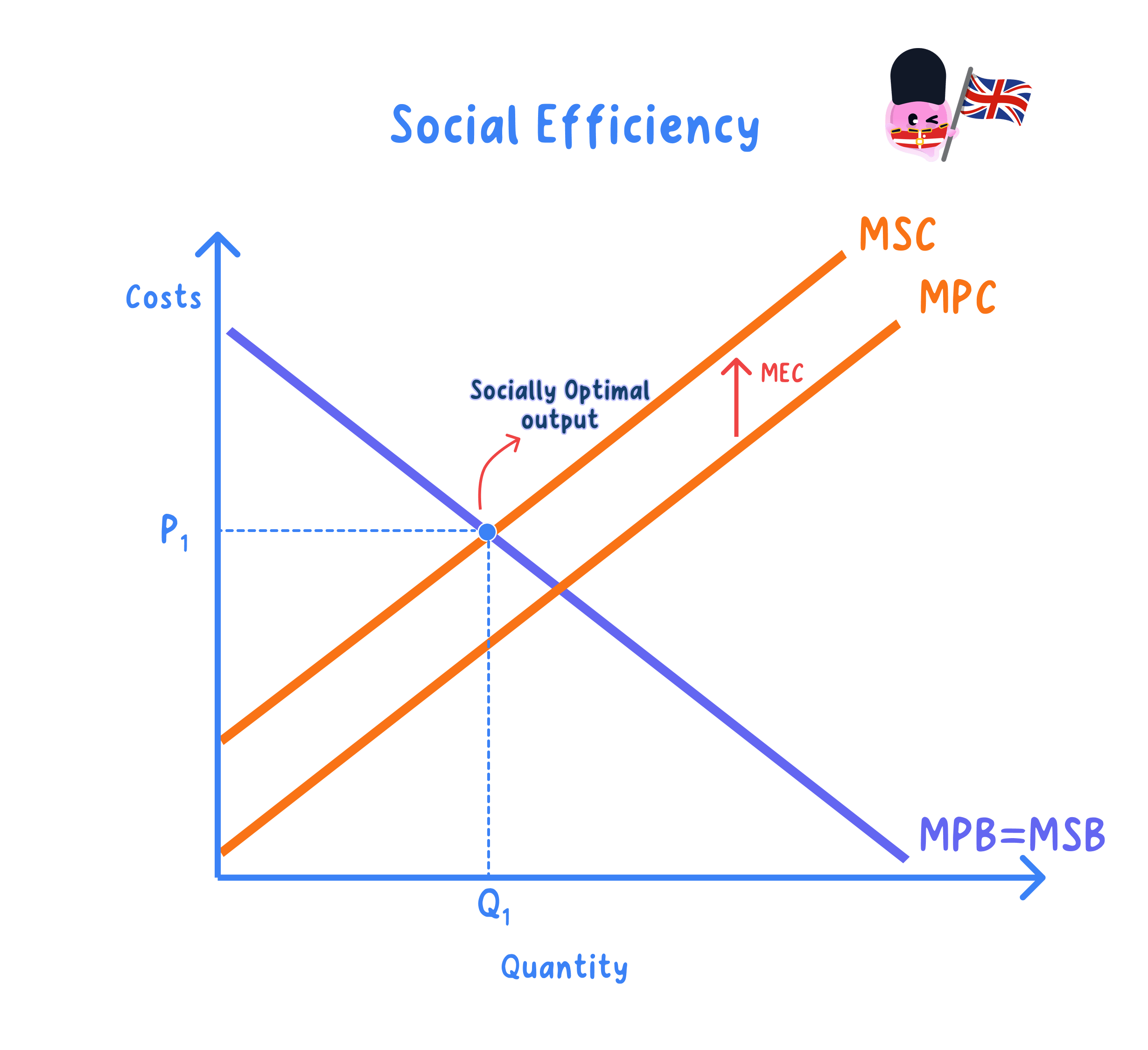
- On a diagram the MSC curve sits above the MPC curve, and the vertical gap at each output equals the MEC → dirtier production per unit widens that gap.
- It depends on whether the spillover can be valued: if MEC is hard to measure, such as long-run climate damage, the true MSC is uncertain and any correction is imprecise.
Worked calculation
Example
- A chemical plant makes 100 units; private cost = £800, and the pollution it emits imposes an external cost equal to 50% of that, so EC = £400.
- Social cost = £800 + £400 = £1,200 across the 100 units.
- On the last unit, MPC = £8 and MEC = £4, so MSC = £8 + £4 = £12.
- The firm pays only the £8 it privately bears, so £4 per unit is dumped on residents → that £4 wedge is exactly why the free market over-produces.
On a diagram
- Put costs and benefits in £ on the vertical axis and output on the horizontal axis, so every curve is read as £ per unit.
- With a negative production externality the MSC curve lies above the MPC curve, and the vertical gap at each output equals the MEC.
- If there were no external cost the two curves would coincide, so the width of the gap signals how serious the market failure is.
Note
- External costs are often diffuse and delayed, so valuing MEC precisely is difficult in practice.
Exam technique
- State SC = PC + EC and MSC = MPC + MEC explicitly to bank the knowledge marks.
- Add the external component to the private figure before comparing with the benefit side.
- Label the vertical gap between MSC and MPC as the marginal external cost.
Common Mistake
- Do not treat private cost as the full cost, because the producer ignores the external cost.
- The vertical gap on the diagram is the marginal external cost, not the total external cost.
Self review
- Define external cost.
- State the equation linking SC, PC and EC.
- If MPC is £8 and MEC is £4, what is MSC?
- On a diagram, what does the vertical gap between MSC and MPC represent?
