Social benefit
Definition
Private benefit (PB): the benefit that accrues directly to the decision-maker in a transaction.
External benefit (EB): the spillover benefit enjoyed by third parties outside the transaction.
Social benefit (SB): the total benefit of an activity to society, equal to private benefit + external benefit.
Why the divergence matters
- A consumer weighs only the benefit they personally receive, so they ignore the gains spilling onto others → they buy where private benefit just matches the price.
- Because the spillover is real but unrewarded, the true value to society (SB = PB + EB) exceeds the buyer's willingness to pay → too few resources flow to the activity.
- It depends on the size of EB: a small external benefit barely matters, whereas a large one such as herd immunity leaves market output far below the efficient level.
Key Idea
- Social benefit already contains the private benefit and then adds the external part on top.
- A positive external benefit makes social benefit exceed private benefit, so the market undervalues the good.
Working at the margin
Definition
Marginal private benefit (MPB): the benefit to the consumer of one more unit.
Marginal external benefit (MEB): the extra spillover benefit to third parties from that same unit.
Marginal social benefit (MSB): the sum of the two, so MSB = MPB + MEB on each unit.
- Consumption happens one unit at a time, so the working measure is marginal, and MEB is the value the buyer is never paid for.
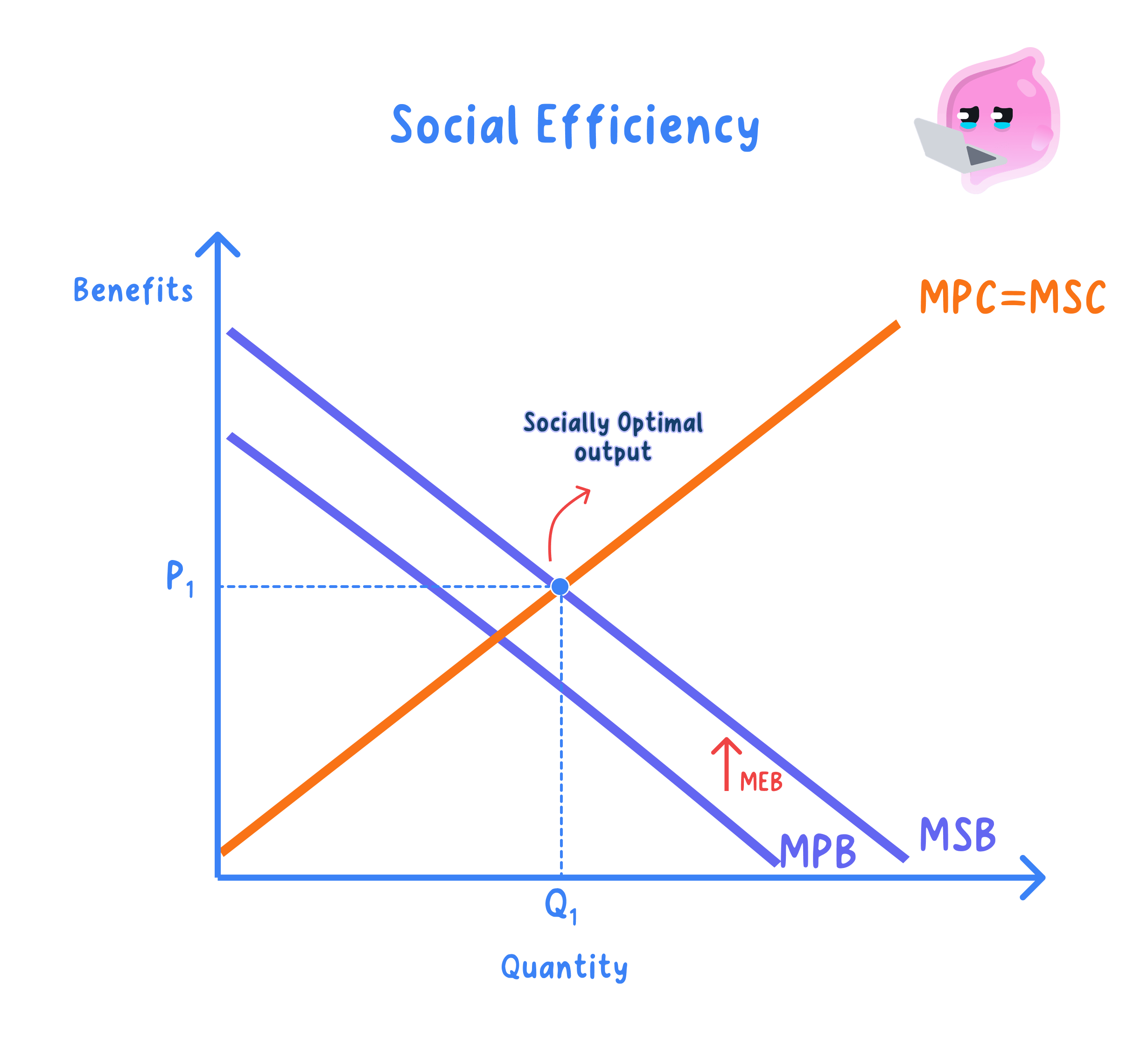
- On a diagram the MSB curve sits above the MPB curve, and the vertical gap at each output equals the MEB → a bigger spillover widens that gap.
- The socially optimal output is where MSB = MSC, but the free market settles at the smaller output where MPB = MSC, so it under-provides.
Worked calculation
Example
- A vaccination programme gives those vaccinated a private benefit of £120; the herd-immunity spillover adds an external benefit worth 25% more, so EB = £30.
- Social benefit = £120 + £30 = £150.
- On the next dose, MPB = £10 to the recipient and sparing others infection gives MEB = £4, so MSB = £10 + £4 = £14.
- The buyer values only the £10 they receive, so £4 of social value is unrewarded → the free market under-consumes vaccination.
On a diagram
- Put costs and benefits in £ on the vertical axis and output on the horizontal axis.
- With a positive consumption externality the MSB curve lies above the MPB curve, and the vertical gap at each output equals the MEB.
- The socially optimal output is where MSB = MSC, and raising output towards it increases welfare whenever a positive externality is present.
Note
- A commuter who cycles gains a cheaper, healthier journey, while cleaner air and less congestion for everyone else are the external benefit on top.
Exam technique
- Write SB = PB + EB and MSB = MPB + MEB explicitly and label every curve.
- Mark the vertical gap between MSB and MPB as the marginal external benefit to secure the analysis marks.
Common Mistake
- Do not treat social benefit as a quantity separate from private benefit.
- The vertical gap on the diagram is the marginal external benefit, not the total external benefit.
Self review
- Define external benefit.
- Write the equation linking MSB, MPB and MEB.
- If MPB is £8 and MEB is £3, what is MSB?
- At which output is society's welfare maximised?
