Consequences of growth
Benefits of growth
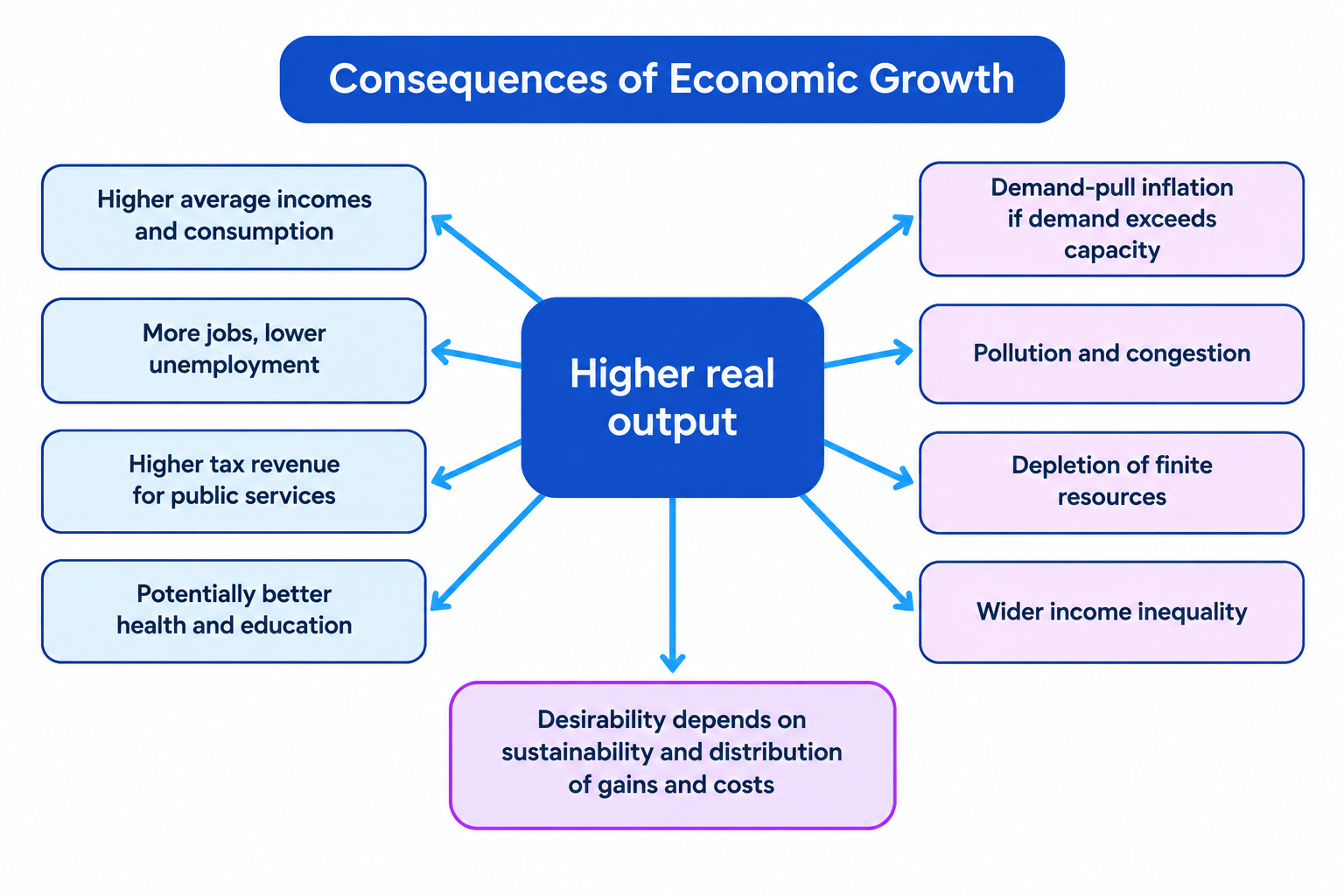
- Higher real output raises average incomes, so households can consume more goods and services.
- Growing firms take on more workers, which lowers unemployment.
- Rising incomes and profits raise tax revenue, funding public services without higher tax rates.
- Higher living standards can also improve health, education and life expectancy over time.
Example
- Suppose an economy grows about 3% a year for five years, a sustained boom.
- Employment rises, average incomes increase and the government collects, say, an extra £15bn in tax to spend on schools and hospitals.
Costs of growth
- If demand grows faster than capacity, the result can be demand-pull inflation.
- Growth often brings negative externalities such as pollution and congestion.
- It can deplete finite natural resources, threatening future output.
- The gains may be shared unevenly, widening income inequality.
Example
- Suppose rapid growth pushes demand beyond what the economy can supply, so a boom overheats.
- Firms compete for scarce resources and raise prices, so inflation climbs while heavier production adds to pollution.
Present versus future
- Faster future growth usually needs more investment today.
- Devoting resources to capital goods means fewer consumer goods now.
- So there is a trade-off between consumption today and higher output later.
Weighing it up
- Growth that is sustainable spreads gains without exhausting resources.
- Growth that relies on pollution or finite resources carries larger long-term costs.
- So it depends on the type of growth: whether it is desirable turns on how the gains and costs are shared.
Exam technique
- Set the benefits, such as higher incomes and lower unemployment, against the costs.
- Support a judgement by weighing inflation risk, inequality and environmental damage.
Common Mistake
- Do not treat growth as purely good.
- The gains can be uneven and come with real inflationary, environmental and social costs.
Self review
- Give two benefits of economic growth.
- Give two costs of economic growth.
- How can rapid growth cause inflation?
- Why might growth widen inequality?
- What is the trade-off between present and future consumption?