Causes of inflation
Definition
Demand-pull inflation: a sustained rise in the price level caused by excess aggregate demand.
Cost-push inflation: a sustained rise in the price level caused by rising costs of production.
Two main causes
- Demand-pull inflation comes from the demand side, when total spending outpaces the economy's capacity to produce.
- Cost-push inflation comes from the supply side, when the costs of producing goods rise.
- A monetary view adds that excessive growth of the money supply can also drive inflation, as too much money chases too few goods.
Key Idea
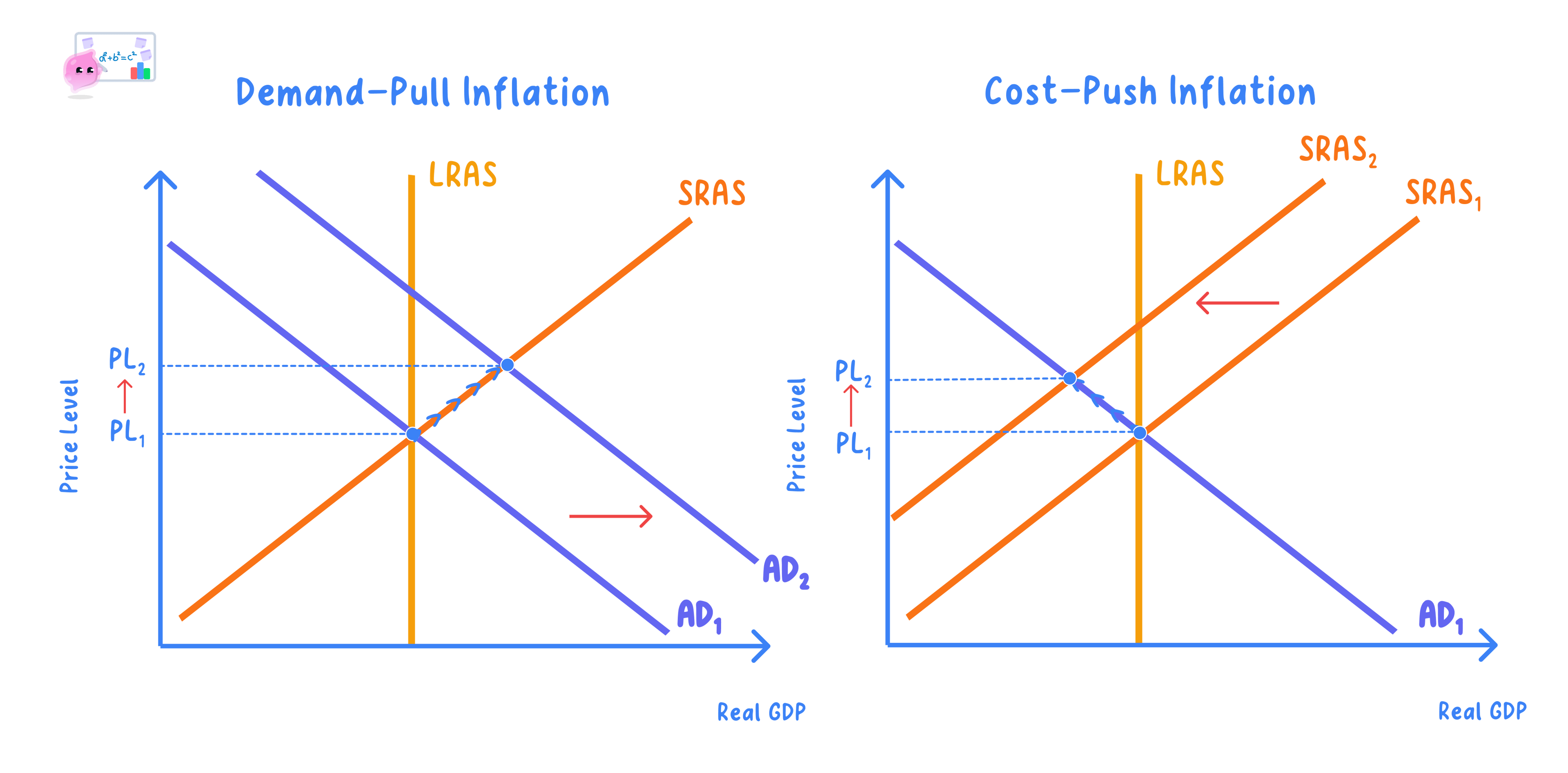
- Demand-pull inflation is shown as a rightward shift of aggregate demand (AD).
- Cost-push inflation is shown as a leftward shift of short-run aggregate supply (SRAS).
- Whether output rises or falls alongside prices signals which cause is at work.
Demand-pull chain
- In a boom, rising consumption, investment, government spending or exports lifts aggregate demand.
- As the economy nears full capacity, AD shifts right along an upward-sloping SRAS.
- Firms respond partly by raising prices, so the average price level rises and real output expands.
- If demand keeps outpacing supply, these price rises persist as sustained inflation.
Cost-push chain
- A rise in wages or dearer imported inputs, such as an oil-price spike, raises firms' costs of production.
- To protect their margins, firms pass these costs on, so SRAS shifts left.
- The average price level rises while real output falls, a mix known as stagflation.
- Higher inflation expectations can feed further wage and price rises, entrenching the problem.
Example
- A consumer and investment boom lifts AD, pulling the price level up: demand-pull inflation.
- A sharp rise in imported energy prices, say oil jumping from £60 to £90 a barrel, pushes SRAS left: cost-push inflation.
- A 10% rise in the minimum wage that raises firms' labour costs is another cost-push trigger.
Matching cause to diagram
- Label the axes average price level and real output on the AD/AS diagram.
- Show demand-pull inflation as AD shifting right, raising both the price level and output.
- Show cost-push inflation as SRAS shifting left, raising the price level while output falls.
Does the cause of inflation matter?
- The cause matters because the effective cure differs: demand-pull inflation is best tackled by contractionary demand-side policy, such as higher interest rates or tighter fiscal policy, that reins in excess aggregate demand.
- The same tools can backfire on cost-push inflation, because cutting aggregate demand when SRAS has already shifted left deepens the fall in output and raises unemployment, the stagflation trap; supply-side measures that lower costs fit better there.
- In practice the two causes often overlap and inflation expectations blur them, so diagnosis is difficult and a mistaken cause leads to the wrong policy.
- On balance, the cause matters a great deal, though how much depends on whether the pressure comes from demand or supply and on whether inflation is mild or already entrenched by expectations.
Exam technique
- Show demand-pull as an AD shift right and cost-push as an SRAS shift left.
- Name the specific driver behind the shift you draw.
Common Mistake
- Do not attribute all inflation to excess demand.
- Cost-push shocks on the supply side raise prices too.
Self review
- What causes demand-pull inflation?
- What causes cost-push inflation?
- How is each shown on an AD/AS diagram?
- How can excessive money-supply growth cause inflation?
