Shifts in the PPC
Definition
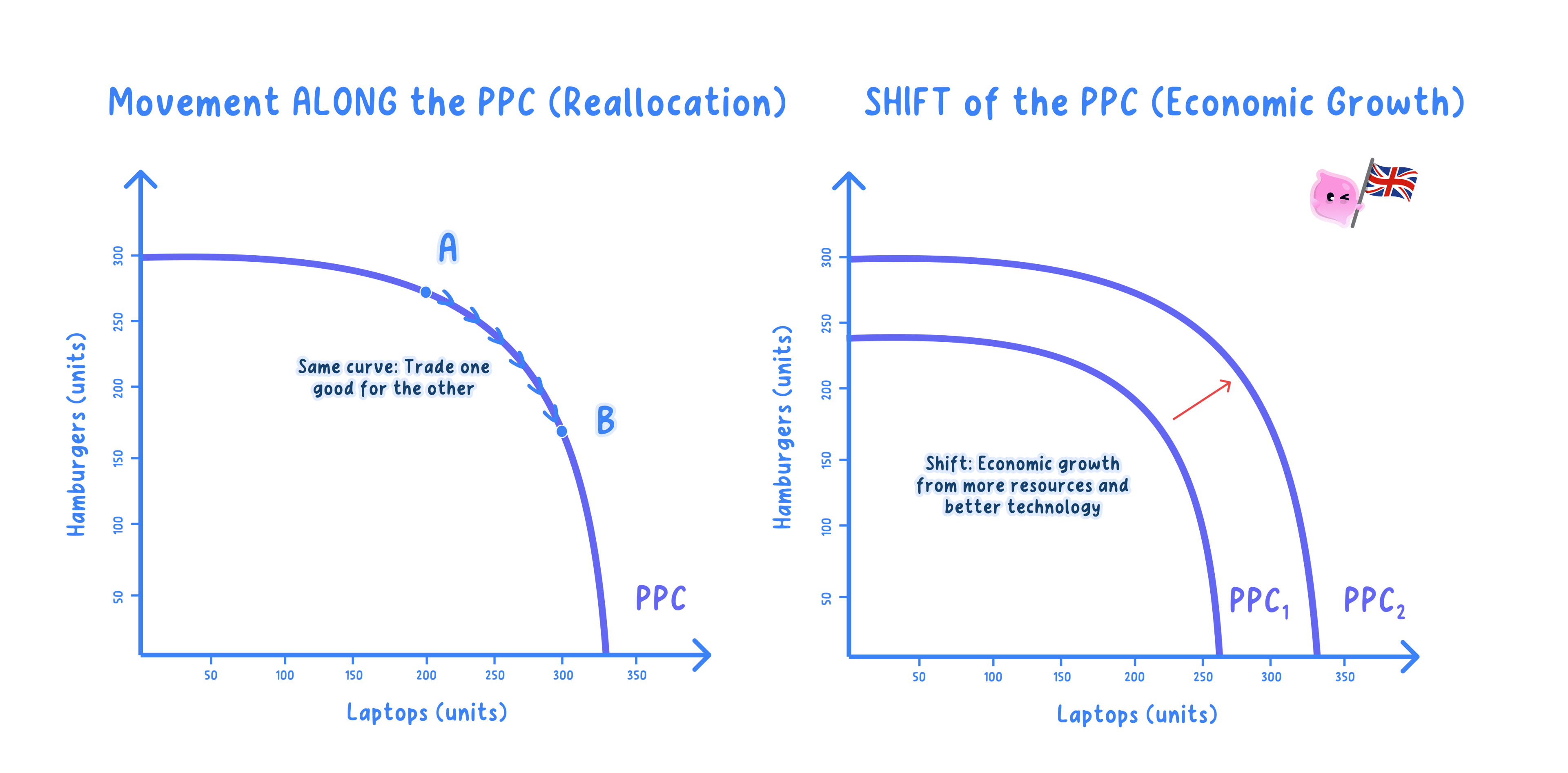
Economic growth: an increase in an economy's productive capacity, shown by an outward shift of the whole production possibility curve.
- A shift of the whole PPC changes the maximum output the economy is able to produce, unlike a movement along the curve which only reallocates existing capacity.
- An outward shift represents economic growth, while an inward shift represents economic decline.
- Shifts are caused by changes in the quantity or quality of resources and in the state of technology.
Key Idea
- An outward shift lets the economy produce more of both goods than before.
- An inward shift means the economy can now produce less of both goods.
- This happens when resources are lost or their quality falls.
Causes of outward shifts
- An increase in the quantity of resources, such as net immigration enlarging the workforce or a newly discovered oil field, raises capacity and shifts the curve outward.
- An improvement in the quality of resources, such as better schooling or a healthier workforce, raises output per worker and shifts it outward.
- Advances in technology, such as robotics on a car assembly line, allow more output from the same resources, so the curve shifts outward.
- Investment in new capital goods today adds to the stock of capital and so raises future productive capacity, though it means fewer consumer goods now.
Example
- Suppose an economy invests in new machinery and trains its workforce over several years.
- Higher productivity raises the maximum output of both goods, for example from 100 to 120 units of each, a rise of +20%.
- The whole PPC shifts outward to reflect the larger capacity.
Causes of inward shifts
- A fall in the quantity of resources, such as depletion of raw materials or a shrinking workforce, shifts the curve inward.
- A fall in the quality of resources, for example factories and roads destroyed in a war or earthquake, also shifts it inward.
- Failure to replace worn-out capital gradually erodes capacity over time, because the stock of machinery shrinks faster than it is renewed.
Uneven shifts
- A shift can be uneven if a change affects the output of one good more than the other.
- A breakthrough in farm technology alone pivots the curve outward on the food axis while the other good's maximum is unchanged.
- This changes the combinations available without raising capacity for both goods equally.
Note
- Choosing to make more capital goods rather than consumer goods today tends to shift the curve outward faster in the future.
- This is the opportunity cost of present consumption: forgone future capacity.
- An economy producing inside its curve can raise output with no shift at all, simply by employing idle resources.
Consequences of shifts
- An outward shift raises potential living standards, because more goods can be produced.
- It can reduce unemployment, but only if the extra capacity is actually put to use.
- An inward shift lowers potential output and tends to reduce living standards.
- Whether growth improves welfare also depends on how the extra output is distributed and on its environmental cost, so an outward shift is necessary but not sufficient for a better standard of living.
Exam technique
- Show a shift by redrawing the whole curve, not by moving a point along it.
- Name the specific cause, such as investment or new technology, behind the shift.
- Distinguish an increase in actual output from an increase in potential output.
Common Mistake
- Do not show economic growth as a movement along the curve.
- Growth is an outward shift of the whole curve.
- Do not assume an outward shift automatically raises actual output.
- The extra capacity must be used for actual output to rise.
Self review
- What does an outward shift of the PPC represent?
- Give two causes of an outward shift.
- Give one cause of an inward shift.
- Why might a shift be uneven rather than parallel?
- Why does an outward shift not guarantee higher living standards?
