The Trade Cycle
Definition
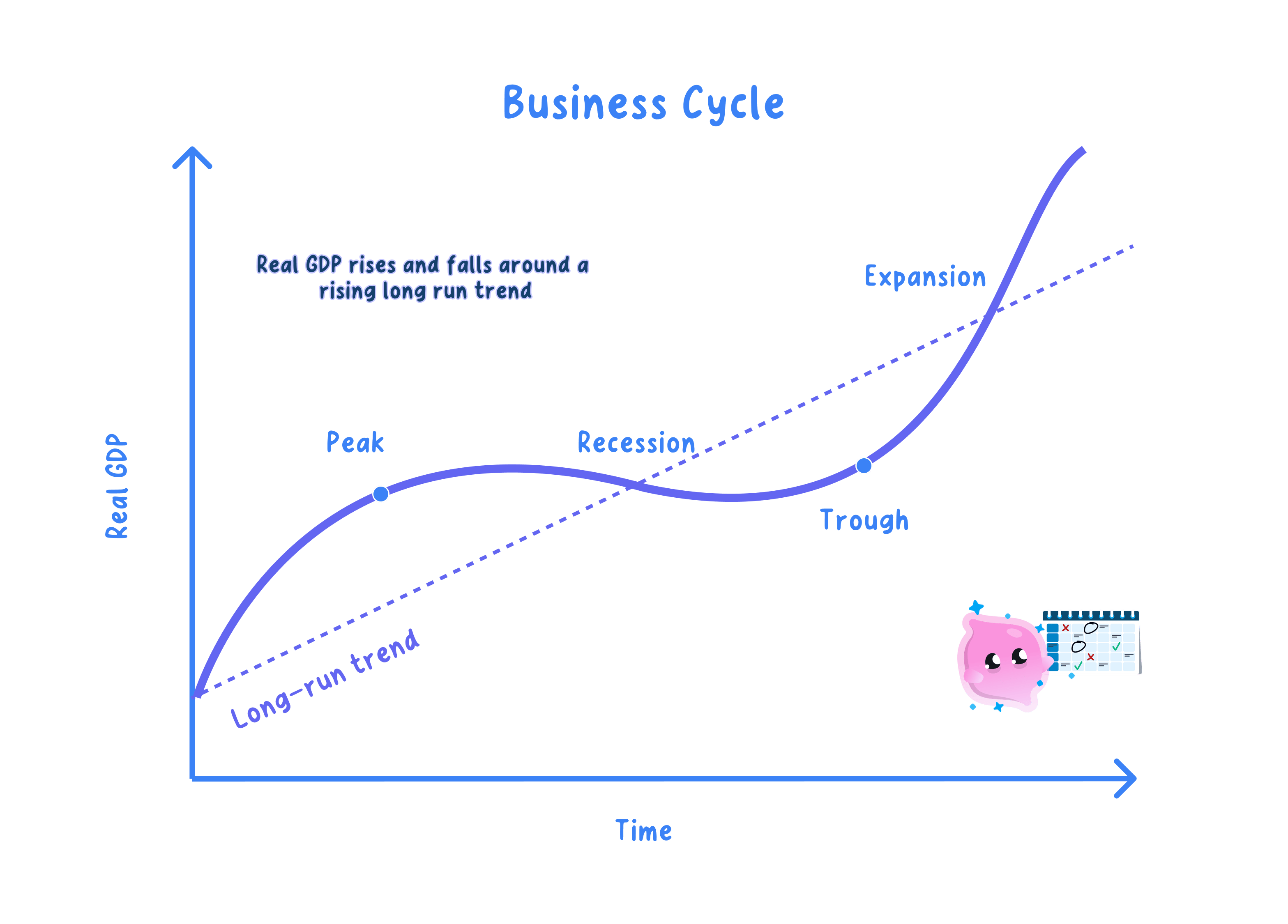
Business (trade) cycle: the recurring short-run fluctuation of real GDP around its long-run trend.
Trend growth: the average sustainable rate at which real output rises over the long run.
Output gap: the difference between actual real GDP and trend (potential) output.
- The cycle repeats through four phases, while trend output still slopes upward over the long run.
- When actual real GDP runs above the trend the output gap is positive, and when it runs below the trend the gap is negative.
Key Idea
- A boom brings rising real output, falling unemployment and building inflationary pressure.
- A recession is conventionally two consecutive quarters of negative real GDP growth.
Each Phase Has Its Signals
- In a boom, real GDP grows above trend, unemployment is low and demand-pull inflation builds as spending presses on capacity.
- In a downturn, growth slows and firms cut hiring, so unemployment begins to climb.
- In a recession, real GDP falls for two or more quarters, so incomes and tax receipts drop.
- In a slump or trough, output bottoms out, spare capacity is widest and confidence is lowest.
- In a recovery, reviving confidence and spending lift real GDP back towards trend, cutting unemployment.
Example
- Real GDP falls from £500bn to £495bn in a quarter, a fall of −1%.
- A second quarter of negative growth would confirm a recession, as the UK saw in 2008–09, so analysts watch consecutive quarters.
What Causes the Cycle
- Swings in aggregate demand drive most of the short-run cycle.
- Shifts in business and consumer confidence, Keynes's animal spirits, raise or cut C and I.
- The multiplier and accelerator interact, so an initial change in demand is amplified into larger swings in investment and output.
- Credit cycles matter, since cheap, easy lending fuels a boom while a credit crunch deepens a downturn, as the 2008 global financial crisis showed.
- External shocks, such as the 2020 pandemic collapse in global demand or a sharp oil price spike, can tip the economy into a new phase.
Note
- Demand-side shocks, such as a confidence collapse, typically drive the short-run cycle.
- Supply-side shocks, such as a sudden oil price spike, can cause falling output and rising inflation at once.
A Slowdown Is Not a Recession
- A slowdown is slower but still positive growth, so real GDP is rising more gently.
- A recession is negative growth, so real GDP is actually falling.
- Confusing the two misreads the cycle and points to the wrong policy response.
The Role of Automatic Stabilisers
Definition
Automatic stabilisers: features of government spending and taxation that dampen the cycle without any new policy decision.
Discretionary fiscal policy: deliberate changes to government spending or taxation to influence aggregate demand.
- In a boom, rising incomes push households into higher tax bands, so progressive taxes take a larger share and restrain demand.
- Fewer people claim benefits in a boom, so government spending falls and the budget tightens without any decision.
- In a recession, tax receipts fall and benefit payments rise automatically, cushioning household incomes and demand.
- Because they act instantly and without legislation, stabilisers respond faster than discretionary policy, which suffers time lags.
- Effectiveness: stabilisers only cushion the cycle, they do not prevent it. How much they dampen a downturn depends on the size of the government sector and how progressive taxes and benefits are, so they are stronger in advanced economies with large welfare states than in economies with low taxes and thin safety nets.
- On balance they are a valuable first line of defence because they act instantly and at no extra decision cost, but they only lean against the cycle, so a deep recession still needs discretionary stimulus, and the same automatic tightening can slow a recovery, a drag known as fiscal drag.
Example
- Unemployment benefit payments rise automatically in a downturn, supporting spending without new legislation.
- Income tax and VAT receipts fall automatically when incomes and spending fall.
Exam technique
- Name and sequence the four phases: boom, downturn or recession, slump or trough, and recovery.
- State whether growth is positive but slower, or actually negative.
- Describe stabilisers as built-in and self-acting, not annual decisions, and note they cushion rather than cure.
- Link causes to aggregate demand, confidence, the multiplier-accelerator and external shocks.
Common Mistake
- Do not confuse a slowdown with a recession.
- Do not describe automatic stabilisers as deliberate government actions.
- They are self-acting features of the tax and benefit system.
Self review
- Name the four phases of the trade cycle.
- What defines a recession?
- Give two causes of the trade cycle.
- What are automatic stabilisers, and what limits their effectiveness?
- How do stabilisers act in a recession?
