Definition
Barrier to entry: any obstacle that makes it difficult or costly for a new firm to start competing in a market.
Barrier to exit: a cost that makes leaving a market expensive, which in turn discourages firms from entering.
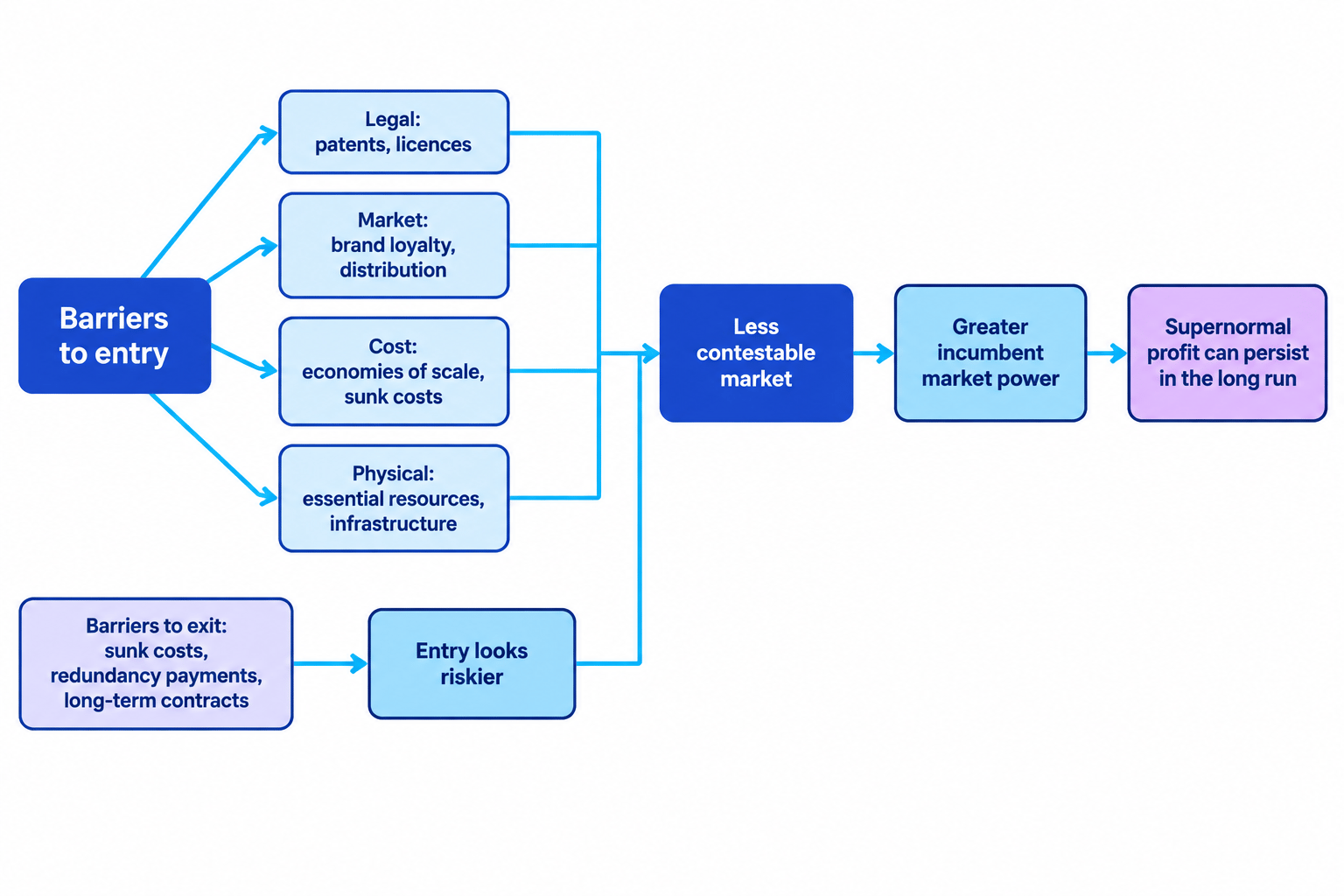
- Together these barriers decide how contestable a market is.
- The stronger the barriers, the longer incumbents can hold supernormal profit into the long run.
- Entry barriers fall into four kinds: legal, market, cost and physical.
Legal barriers
- Governments can grant an incumbent legal protection that shuts out rivals.
- Examples include patents, copyrights, licences and regulatory approval requirements.
Market barriers
- Established firms build strong brand loyalty that a newcomer struggles to overcome.
- Heavy advertising and control of distribution channels raise the cost of breaking in.
Cost barriers
Definition
Sunk costs: costs already spent that cannot be recovered if the firm leaves the market.
Predatory pricing: temporarily cutting price below cost to drive a rival out, then raising it again once they have gone.
- Large economies of scale give incumbents a lower average cost that a small entrant cannot match.
- High start-up spending and sunk costs that cannot be recovered on exit deter entry.
- Incumbents may threaten predatory pricing to drive a new rival out before it establishes itself.
Physical barriers
- Ownership or control of an essential input or resource can block rivals outright.
- Costly infrastructure, such as a national pipeline or rail network, is impractical to duplicate.
Barriers to exit
- Sunk costs, redundancy payments and long-term contracts make leaving a market expensive.
- High exit costs deter entry, because a firm fears it could not recover its outlay if the venture failed.
Worked example
Example
- While on patent, a medicine sells for £50; once the patent expires, generic entry drives the price to £10.
- The price falls by £40 from its original £50.
- So the price falls by 80%.
- The 80% drop shows the legal barrier had propped price up; removing it makes the market contestable and competes the supernormal profit away.
Key Idea
- The higher the barriers, the more market power incumbents hold and the less contestable the market.
- Low barriers keep the threat of entry alive and hold prices and profits down.
Example
- A patent on a new medicine is a legal barrier that grants the developer temporary sole supply.
- Ownership of the only viable ore deposit is a physical barrier no rival can copy.
Do barriers to entry always harm consumers?
- Barriers usually harm consumers, because by keeping rivals out they let incumbents restrict output and hold price above marginal cost, earning supernormal profit and leaving the market allocatively inefficient with less choice.
- But some barriers can benefit consumers: a patent or copyright rewards and funds innovation, so without it new medicines might never be developed, large economies of scale mean one big producer can supply at a lower average cost than many small entrants could, and licensing barriers can protect quality and safety by keeping unqualified suppliers out.
- It also matters whether a barrier is innocent or strategic: innocent, structural barriers such as genuine economies of scale or a natural monopoly arise from the technology of the industry and can lower costs, whereas strategic, deliberate barriers such as limit pricing and predatory pricing are set up on purpose to exclude rivals and are far more likely to harm consumers.
- Barriers also differ in strength: where sunk costs are low the market stays contestable, so the threat of entry alone can hold price near the competitive level even behind apparent barriers.
- On balance, barriers harm consumers most when they are high, durable and strategic, simply entrenching market power, but they can help when they are innocent or protect innovation, safety or economies of scale; so it depends on the type and height of the barrier, whether the market stays contestable, and whether the supernormal profit is reinvested in research and better products rather than pocketed.
Exam technique
- Name the type of barrier (legal, market, cost or physical) rather than just describing it.
- Link the barrier to its effect on long-run profit and competition.
Common Mistake
- Do not confuse barriers to entry with barriers to exit.
- Exit barriers act indirectly, deterring entry by raising the risk of being trapped in a loss-making market.
Self review
- Define a barrier to entry.
- Give one example each of a legal, market, cost and physical barrier.
- Why do sunk costs act as both an entry and an exit barrier?
- How do barriers to entry affect long-run profit?