Correcting Market Failure
Definition
Government intervention: action taken by the state, through taxes, subsidies, rules or direct provision, to change resource allocation when a free market fails to reach the socially optimal output.
Matching Tool To Failure
- Market failure takes different forms, so the first task is to identify whether the problem is a negative externality, a positive externality, a public good, information failure or market power.
- Each measure below targets a particular failure, and its effectiveness depends on how well it is matched and on how consumers and producers respond.
Indirect Taxes
- A specific tax is a fixed amount per unit, while an ad valorem tax is a % of the price, so the tax wedge grows as price rises.
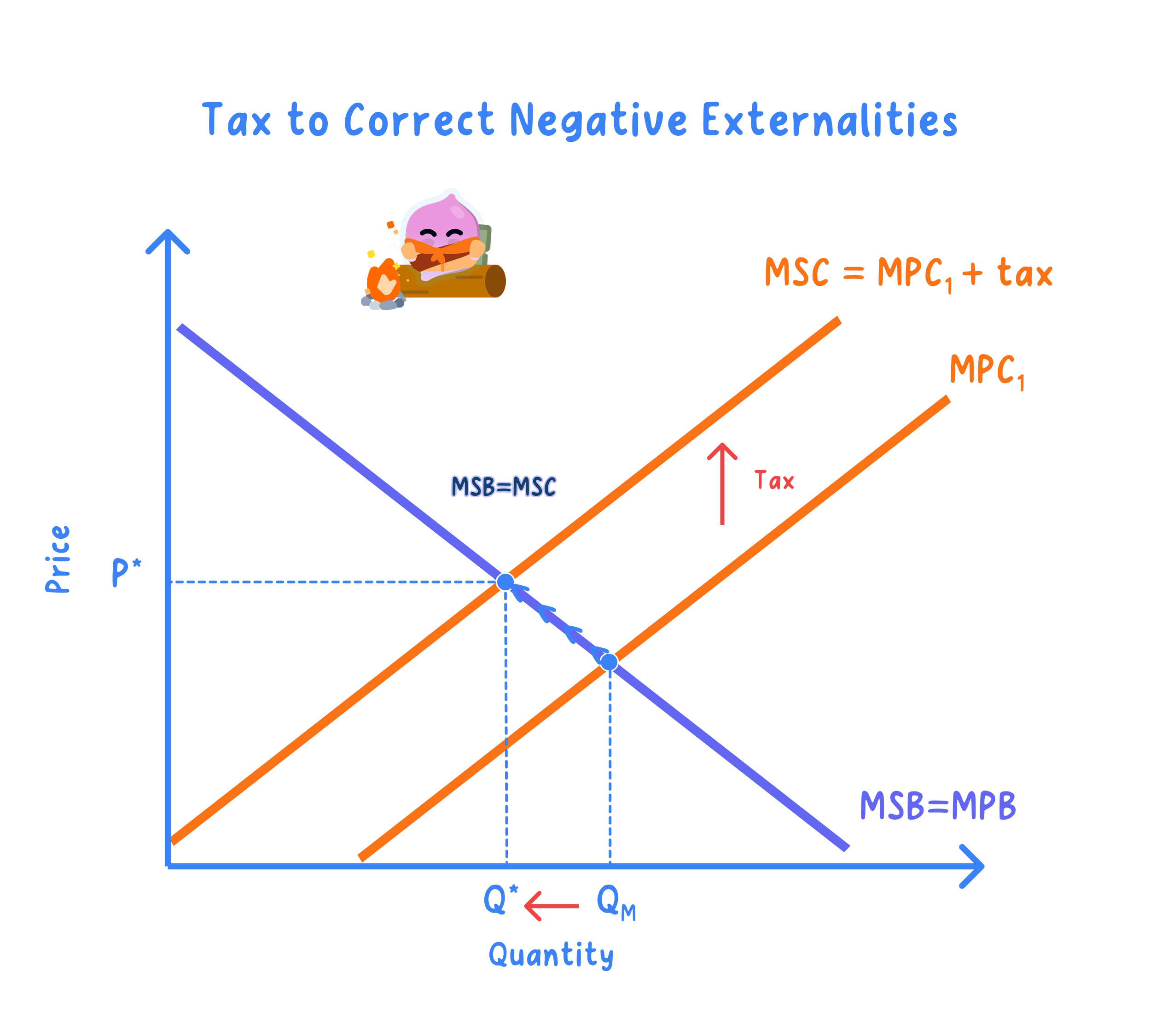
- A tax on a good with a negative externality raises the firm's marginal private cost, shifting supply left, so price rises and quantity falls towards the social optimum.
- The tax internalises the externality by making the polluter pay the external cost, closing the welfare loss.
- It is far less effective when demand is price inelastic, because quantity then falls only a little while the burden falls mainly on consumers.
Example
- A factory's pollution is valued at £2 per unit, so the government sets a specific tax of £2 per unit.
- Before the tax the price is £10 and 1,000 units sell each week.
- The £2 tax shifts supply up by £2, raising price to £11 and cutting quantity to 850 units.
- Consumers pay £1 more and producers absorb £1, so the £2 burden splits by relative elasticities.
- Weekly revenue is £2 × 850 = £1,700, which the state can spend on repairing the damage.
Subsidies
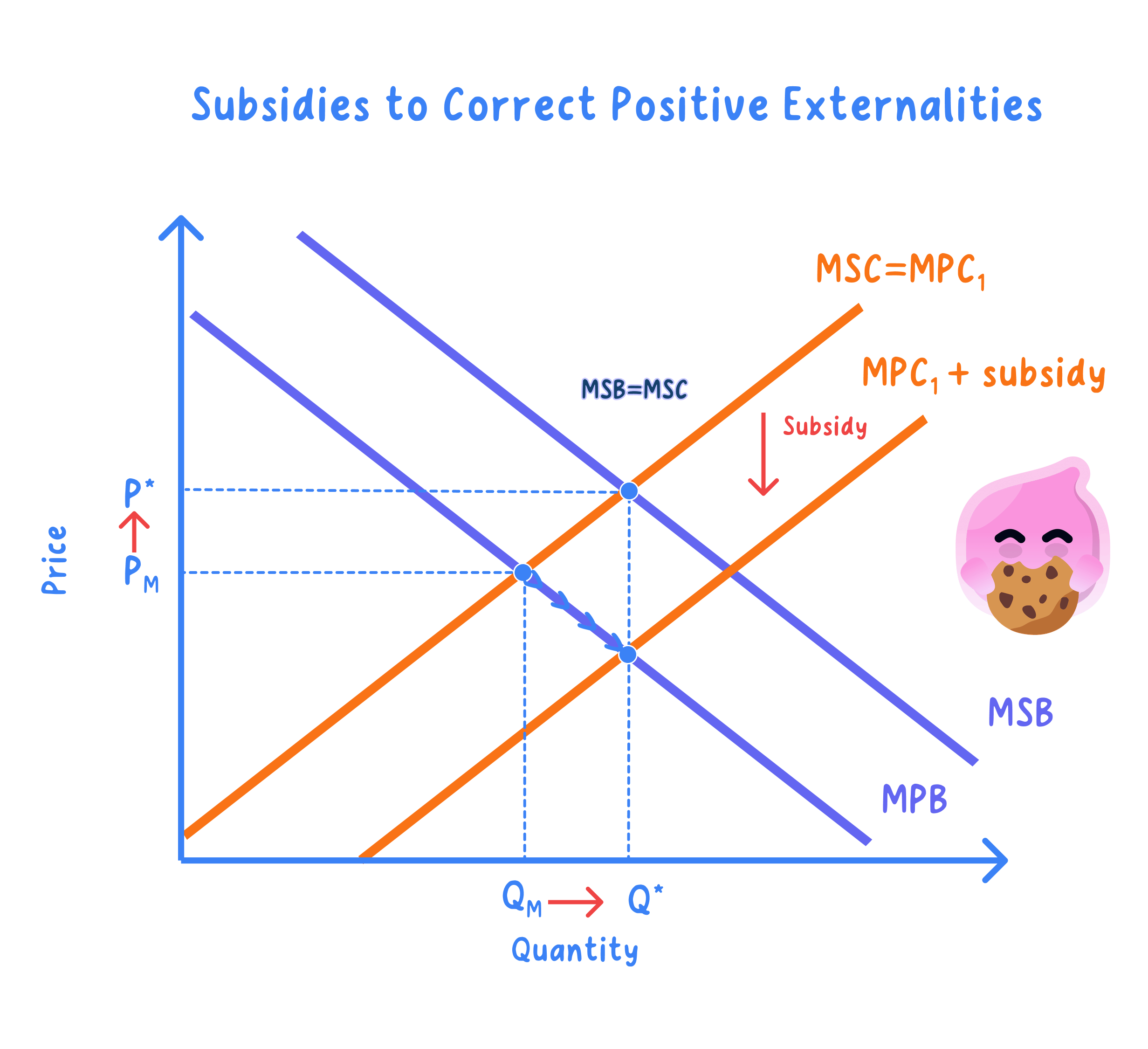
- A subsidy is a payment to producers that lowers marginal cost, shifting supply right to raise output of goods with positive externalities.
- It is used for merit goods such as vaccination, training or public transport, where the free market under-consumes; Singapore's SkillsFuture credits, for example, subsidise adult skills training.
- The opportunity cost is the government spending, which could crowd out other programmes, and if set too high it can cause wasteful over-supply.
Example
- A government grants a £500 subsidy per solar panel to encourage clean energy.
- The effective price to buyers falls from £2,000 to £1,500, raising installations from 4,000 to 6,000 a year.
- Total subsidy cost is £500 × 6,000 = £3,000,000 a year.
- The reward is lower carbon emissions, the positive externality being encouraged.
Price Controls
- A price ceiling set below equilibrium caps the price to protect consumers, but because quantity demanded exceeds quantity supplied it causes excess demand and shortages (refer to 3.2.4 for details).
- A price floor set above equilibrium supports producers or wages but causes excess supply, such as surpluses or unemployment.
- Controls often create black markets or force the state to buy up surpluses at further cost.
Quotas, Prohibitions And Licences
- A production quota caps the quantity a firm or industry may supply, raising price and restricting output of a harmful good.
- A prohibition bans a good outright, while licences allow only approved suppliers to operate.
- A ban can push activity into an unregulated illegal market that is harder to control.
Regulation And Deregulation
- Regulation uses rules and standards, such as emission limits or safety rules, enforced by penalties to change behaviour directly.
- Deregulation removes rules to raise competition and efficiency where regulation has become excessive.
- Regulation needs monitoring and enforcement, which is costly and can be evaded.
Direct Provision
- The state can directly provide public goods and merit goods free at the point of use, funded by taxation.
- This overcomes the free-rider problem for public goods such as street lighting and national defence.
- Without a price signal, provision can be inefficient or over-used.
Pollution Permits
- Tradable pollution permits cap total emissions and let firms buy and sell the right to pollute, as in the European Union Emissions Trading System and China's national carbon market, the world's two largest schemes.
- Firms that cut emissions cheaply sell spare permits, while firms that find it costly buy them, so abatement happens at least cost.
- Effectiveness hinges on the cap: if the regulator issues too many permits the price collapses and firms have little incentive to abate, as in the early phases of the European Union scheme, so a tight, credibly falling cap is the condition for success.
Example
- A regulator caps emissions at 10,000 tonnes and issues 10,000 permits, each worth one tonne.
- Firm A can cut a tonne for £30, while Firm B would pay £80 to cut a tonne.
- Firm A cuts extra and sells permits to Firm B at, say, £50, so both gain.
- The cap is met at the lowest total cost, and the permit price reveals the marginal cost of cleaning up.
Property Rights
- Assigning or enforcing property rights lets owners charge for or prevent damage to a resource, tackling externalities and the tragedy of the commons.
- With clear rights and low bargaining costs, the parties can negotiate an efficient outcome themselves.
- This works only with few parties and low transaction costs; it is impractical for a global commons such as the atmosphere, where millions of polluters make bargaining impossible, so the approach is effective for a local fishery or forest but not for climate change.
Nationalisation And Privatisation
- Nationalisation brings an industry into state ownership so social costs and benefits, not just profit, guide decisions.
- Privatisation transfers firms to the private sector to sharpen the profit incentive and productive efficiency.
- The trade-off is between social objectives and the risk of X-inefficiency in a state monopoly.
Information And Nudges
- Providing information, through labelling, health warnings or ratings, corrects information failure so consumers can choose rationally.
- Behavioural insights, or nudge theory, changes the choice architecture, such as default enrolment, to steer decisions without removing options.
- Nudges are cheap and preserve free choice but often have only modest effects.
Judging Effectiveness
- Effectiveness depends on elasticity, the accuracy of information, administrative and enforcement costs, and any unintended consequences.
- There is often an equity–efficiency trade-off: a tax on a demerit good raises efficiency by cutting the externality, yet it is regressive because it takes a larger % of a poor household's income.
- So the best response is usually a mix of measures, and whether the efficiency gain outweighs the distributional harm depends on the size of the externality and the specific context.
Exam technique
- Name the exact market failure before you name the policy, then match them explicitly.
- Support analysis with a labelled diagram showing the shift and the change in price and quantity.
- Reach a judgement on effectiveness that depends on elasticity, cost and information.
Common Mistake
- Do not say a subsidy shifts demand; it shifts supply to the right.
- Do not assume a tax always cuts output sharply, because inelastic demand blunts its effect.
- Do not treat any single measure as a guaranteed fix without weighing its costs.
Self review
- What is the difference between a specific tax and an ad valorem tax?
- How does a tradable pollution permit scheme achieve abatement at least cost?
- Why does a price ceiling cause a shortage?
- Give two factors that determine the effectiveness of an indirect tax.
- When does using property rights fail to correct an externality?
