Self-Determination Theory and Exercise
- Self-determination theory explains why some people keep exercising while others give up a few weeks after January.
- It says exercise sticks when the activity meets your needs for competence, relatedness and autonomy.
- Meet all three and your reason to train shifts from outside rewards to genuine enjoyment.
Key Idea
- Competence, relatedness and autonomy together keep people exercising.
- Exercise driven by enjoyment lasts far longer than exercise driven by a reward.
Competence
- Competence in exercise is feeling your fitness improving, such as running further or lifting heavier than last month.
- Seeing that progress tells you the effort is working, which makes you want to train again.
- If sessions are far too hard and you never seem to improve, competence collapses and you drop out.
Relatedness
- Relatedness in exercise is the bond you feel with a team, a class or a training partner.
- Turning up matters more when people expect you and train beside you, so you skip fewer sessions.
- Exercising completely alone, with no one to share it with, leaves this need empty.
Autonomy
- Autonomy in exercise is choosing what you do, whether that is netball, cycling or a gym session.
- A workout you picked yourself feels like yours, so you guard the time for it.
- Being forced onto an activity you did not choose drains the drive to keep it up.
Example
- Think about someone starting the NHS Couch to 5K app in January.
- They pick their own running days, which meets autonomy.
- The app shows them jogging a little longer each week, which meets competence.
- They run with a friend who texts to check they are coming, which meets relatedness.
- With all three needs met, they are still running in the spring, long after the New Year crowd has quit.
Extrinsic Rewards
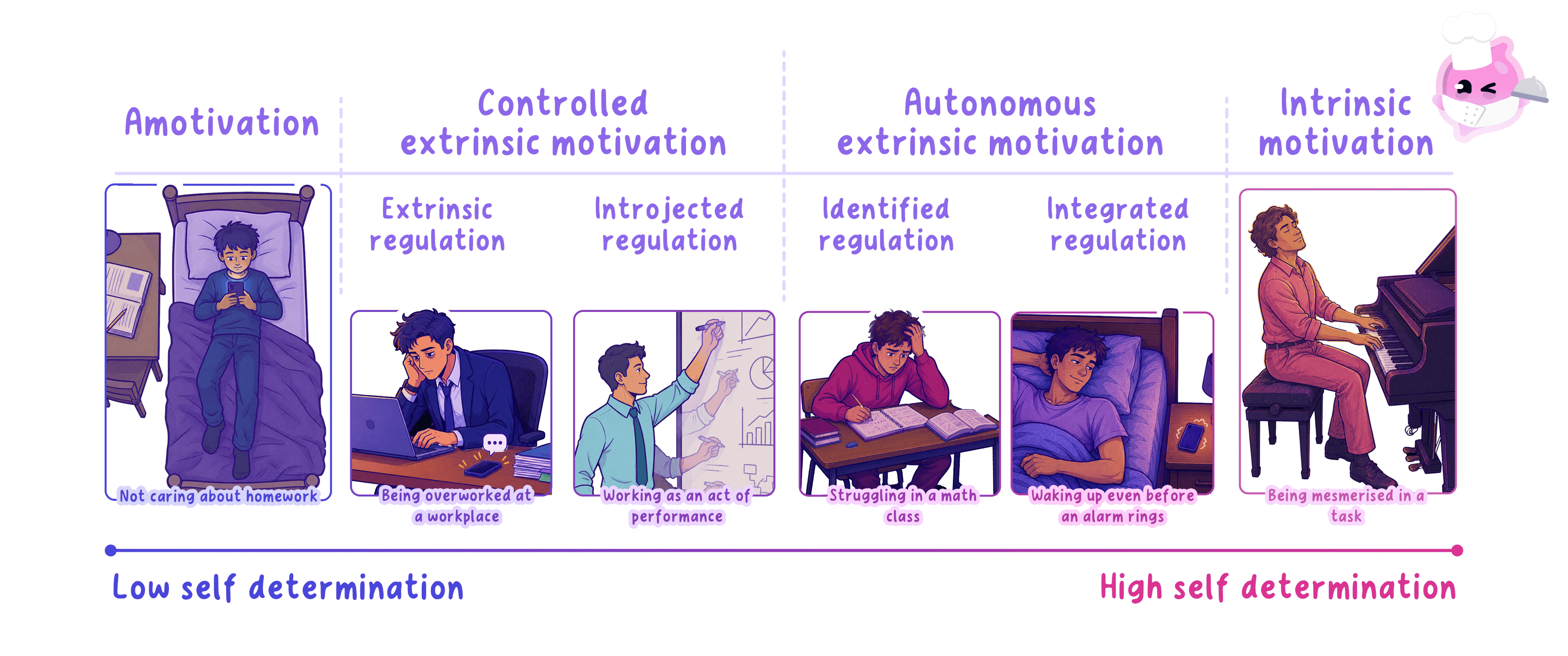
- An extrinsic reward, such as a Parkrun finish token, a fee you have already paid, or a streak on a fitness tracker, can get you through the door at the start.
- The problem is that once the reward stops, the exercise often stops with it.
Intrinsic Motivation
- Meeting the three needs turns exercise into something you do for its own sake, which is intrinsic motivation.
- Because the enjoyment is built into the training, you keep going even when no one is watching and no reward is on offer.
- This is why the theory says building competence, relatedness and autonomy matters more than piling on rewards.
Common Mistake
- Do not just say a need is met, because the mark is for explaining how that need changes exercise behaviour.
- Do not treat extrinsic rewards as the aim, since the theory says they rarely keep exercise going on their own.
Answering an Apply-to-Exercise Question
- Pick the need the scenario points to, then explain the exact way it keeps that person exercising.
- Finish by linking it to intrinsic motivation, since that is what makes the exercise last.
Self review
- How does competence support the motivation to exercise?
- How does relatedness support the motivation to exercise?
- Why does exercise driven by an extrinsic reward often stop?
- Why does meeting the three needs lead to longer-lasting exercise?
