Self-Determination Theory
Definition
Self-determination theory
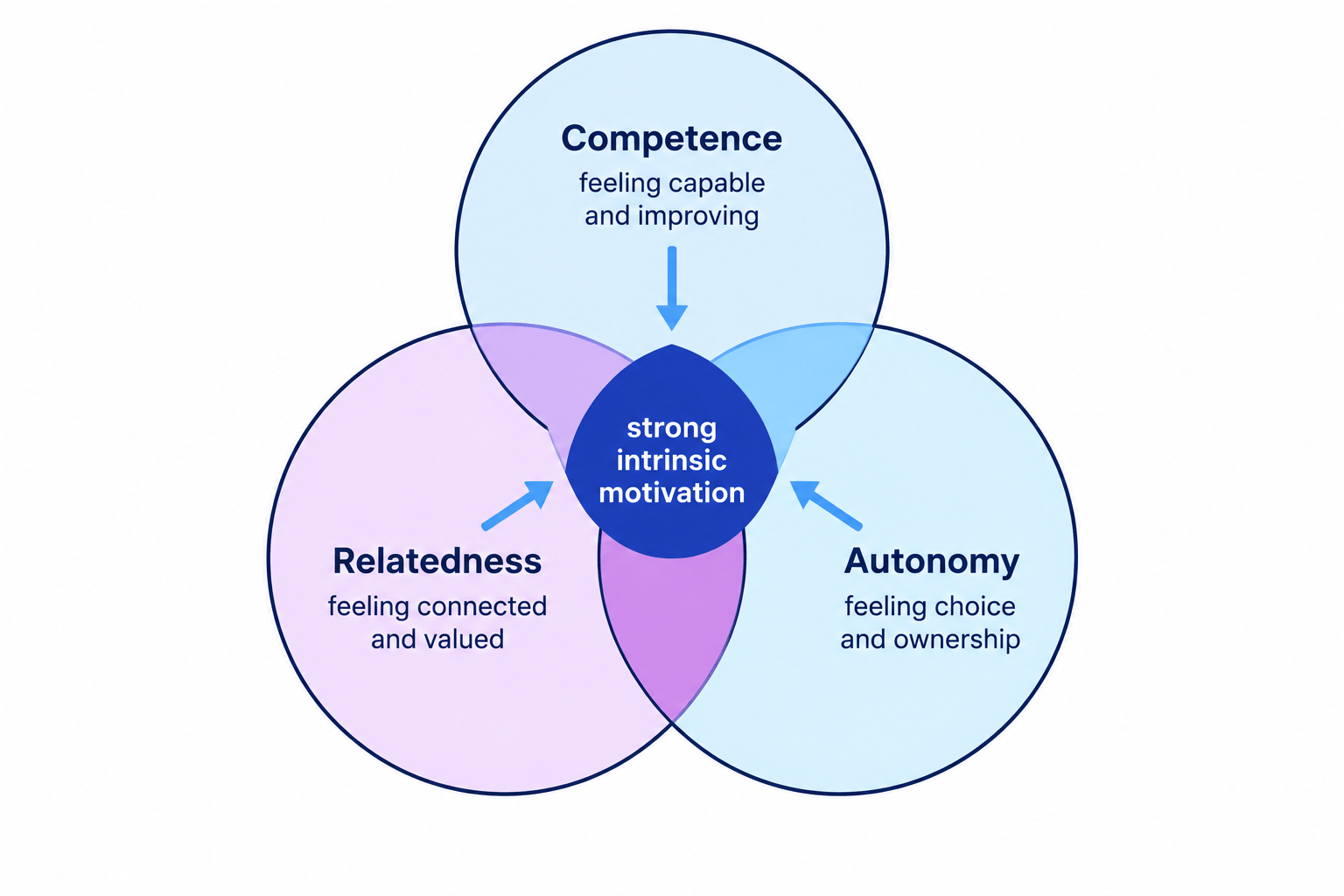
Deci and Ryan's theory that you are most motivated when three basic psychological needs are met: competence, relatedness and autonomy. It focuses on motivation that comes from inside you rather than from outside rewards.
- Deci and Ryan argue that your motivation depends on how well three basic psychological needs are met.
- Those needs are competence, relatedness and autonomy.
- Meet all three and your motivation is strong, steady and driven from within.
- Leave one unmet and the drive weakens, no matter how much you are rewarded from outside.
Key Idea
- The three needs are competence, relatedness and autonomy.
- Motivation is strongest when all three are satisfied at the same time.
- The theory is mainly about motivation that comes from inside you.
Competence
- Competence is the sense that you can meet a challenge and that you are getting better at it.
- When a task stretches you but stays within reach, each small success feeds this feeling and pulls you back for more.
- If a task is far too hard and you keep failing, you feel useless, and your motivation drains away.
Relatedness
- Relatedness is the feeling that you matter to other people and belong with them.
- Warm, supportive people around a task make you want to keep turning up to it.
- Feeling judged or shut out starves this need, so you quietly pull back.
Autonomy
- Autonomy is the sense that you are choosing to act rather than being pushed into it.
- When a choice is genuinely yours, you own the effort and stick with it for longer.
- Being ordered or bribed to do something removes that ownership and thins your motivation.
Example
- Picture two Saturday mornings.
- On the first you choose to join your local Parkrun, you feel yourself getting quicker each week, and your mates are there running alongside you.
- Autonomy, competence and relatedness are all met, so you happily go back the next week.
- On the second you are made to run laps alone in a cold PE lesson, with no say and no one beside you, and all three needs are starved.
How the Three Needs Combine to Drive Motivation
- When the three needs are met together, your motivation becomes intrinsic, so you act because the activity itself feels rewarding.
- Intrinsic motivation lasts far longer than chasing a reward, because the satisfaction is built into the task.
- Block just one of the three needs and even a keen person slowly gives up.
Common Mistake
- Do not treat the three needs as the same thing, because competence, relatedness and autonomy are separate.
- Do not assume one strong need makes up for the others, since the theory says all three have to be met.
Writing a Clear Answer on the Theory
- Name all three needs and give a one-line definition of each, since there is usually a mark for every clear definition.
- Then say why meeting the needs lifts motivation.
Self review
- What are the three needs in self-determination theory?
- What does autonomy mean?
- Which type of motivation does the theory mainly focus on?
- What happens to motivation when one of the three needs is not met?