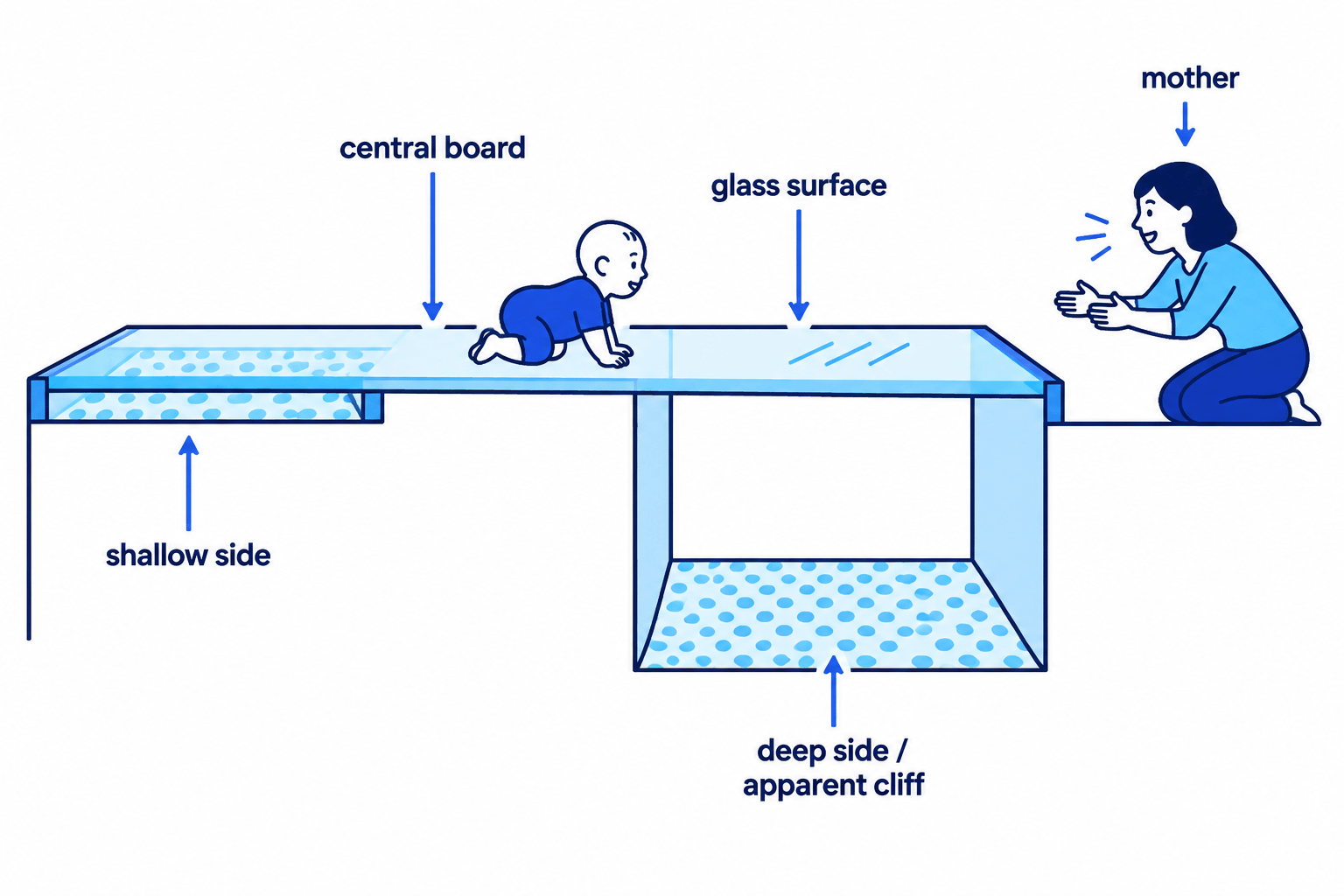
The Visual Cliff Study
- Gibson's theory says we perceive depth directly and are born able to do it, so depth perception should not need to be learned.
- If that is right, babies should avoid a drop as soon as they can crawl, before they have had time to learn about falling.
- Gibson and Walk tested this using a visual cliff, so this is the named study you use to argue for the theory.
Key Idea
- The visual cliff was a glass-covered table with a shallow side and a side that looked like a sudden drop.
- Whether crawling babies avoided the deep side is the whole point of the study.
What Gibson and Walk Found
- All the babies who moved off the central board crawled onto the shallow side at least once.
- Only three of them ventured onto the glass over the apparent cliff.
- Many cried or crawled away from their mother when she called them from the cliff side, and some touched the glass but refused to cross.
Example
- Placed at the edge of the drop, a baby would pat the solid glass with a hand but still refuse to crawl out over it.
- Even their mother calling from the far side was not enough to make most of them cross.
What It Shows
- Gibson and Walk concluded that depth perception is innate, present as soon as a baby can crawl.
- The babies had not had time to learn about depth, yet they still perceived and avoided the drop.
- This supports Gibson's direct theory: the ability to perceive depth is built in, not learned from experience.
Note
- A named study is examined on its results and its conclusion, never its aim or procedure.
- Here that means the babies avoiding the cliff (result) and depth perception being innate (conclusion).
Structuring the Argument
- State the prediction: if depth perception is direct and innate, babies should perceive depth before they could have learned it.
- Give the result: on the visual cliff, all the crawling babies who left the board went onto the shallow side and avoided the deep side.
- Land the link: perceiving depth this early supports Gibson's claim that perception is direct and built in.
Self review
- What did the crawling babies do when faced with the deep side?
- How many babies ventured onto the cliff side?
- What did Gibson and Walk conclude about depth perception?
- How does this support Gibson's direct theory?