Definition
Monocular depth cue
A cue to distance that can be picked up with only one eye, such as relative size or linear perspective, allowing depth to be judged from a flat image.
- Depth cues are clues in a scene that let your brain judge how far away things are, and these ones need only one eye.
- The image on your retina is flat, so your brain has to work out depth from patterns within it.
- Because they work on a flat image, these same cues let artists show depth in a painting or photograph.
Key Idea
- Each cue is a different way a flat image hints at how far away something is.
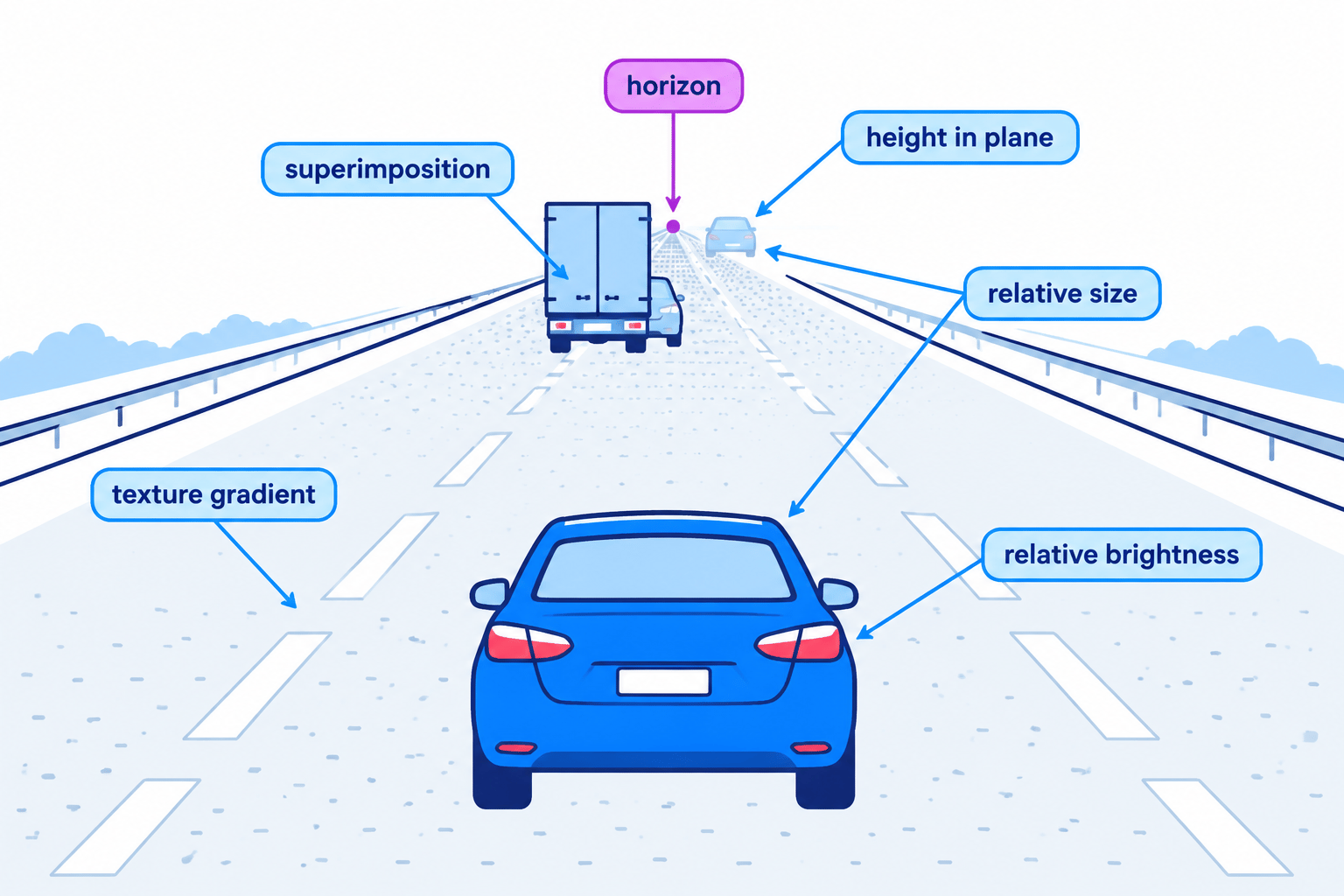
- The five to know are relative brightness, texture gradient, relative size, superimposition and height in plane.
The Five Depth Cues
- Height in plane
- Objects higher up in your visual field, closer to the horizon, are seen as further away.
- Relative size
- When two objects are known to be a similar size, the one making the smaller image is judged further away.
- Superimposition (occlusion)
- An object that partly blocks another is seen as nearer than the one it covers.
- Texture gradient
- A textured surface looks coarse and spaced out when near, but finer and more crowded as it stretches into the distance.
- Relative brightness
- Nearer objects reflect more light and look brighter and sharper, while further objects look dimmer and hazier.
Example
- Picture a photo taken looking straight down a long, straight stretch of the M1.
- Distant cars look smaller and sit higher in the picture, which is relative size and height in plane.
- A lorry partly hiding the car behind it tells you the lorry is nearer, which is superimposition.
- The tarmac looks coarse close up but fine and packed further off, which is texture gradient, and near cars look brighter than the hazy ones far away, which is relative brightness.
Why These Cues Work on a Flat Image
- Your retina only ever receives a two-dimensional image, with no direct information about distance.
- Each cue is a pattern your brain has learned to link with depth, so it can rebuild distance from the flat picture.
Common Mistake
- Do not add binocular cues here; all five of these work with just one eye.
- Do not mix up relative size and superimposition; one is about how big something looks, the other about one thing blocking another.
Identifying a Depth Cue in the Exam
- Look at how the image is suggesting distance, then match it to a named cue.
- The mark students drop is the explanation, so always say how that cue conveys depth, not just its name.
Self review
- Name the five depth cues in this topic.
- How does height in plane suggest distance?
- How does relative brightness suggest distance?
- What does superimposition tell you about which object is closer?