Perceptual Constancy
Definition
Perceptual constancy
The tendency to perceive an object as staying the same in shape, colour or size even though the image it casts on the retina keeps changing.
- The image your eyes throw onto the retina never sits still.
- Every time you or an object moves, that retinal image changes in size, shape and colour.
- Yet you go on seeing one steady object, because your brain corrects the raw image using extra information such as distance, angle and lighting.
- This correction is called perceptual constancy, and it comes in three main types.
Key Idea
- The retinal image keeps changing, but your perception of the object stays constant.
- The three constancies are size, shape and colour.
The Three Constancies
- Size constancy
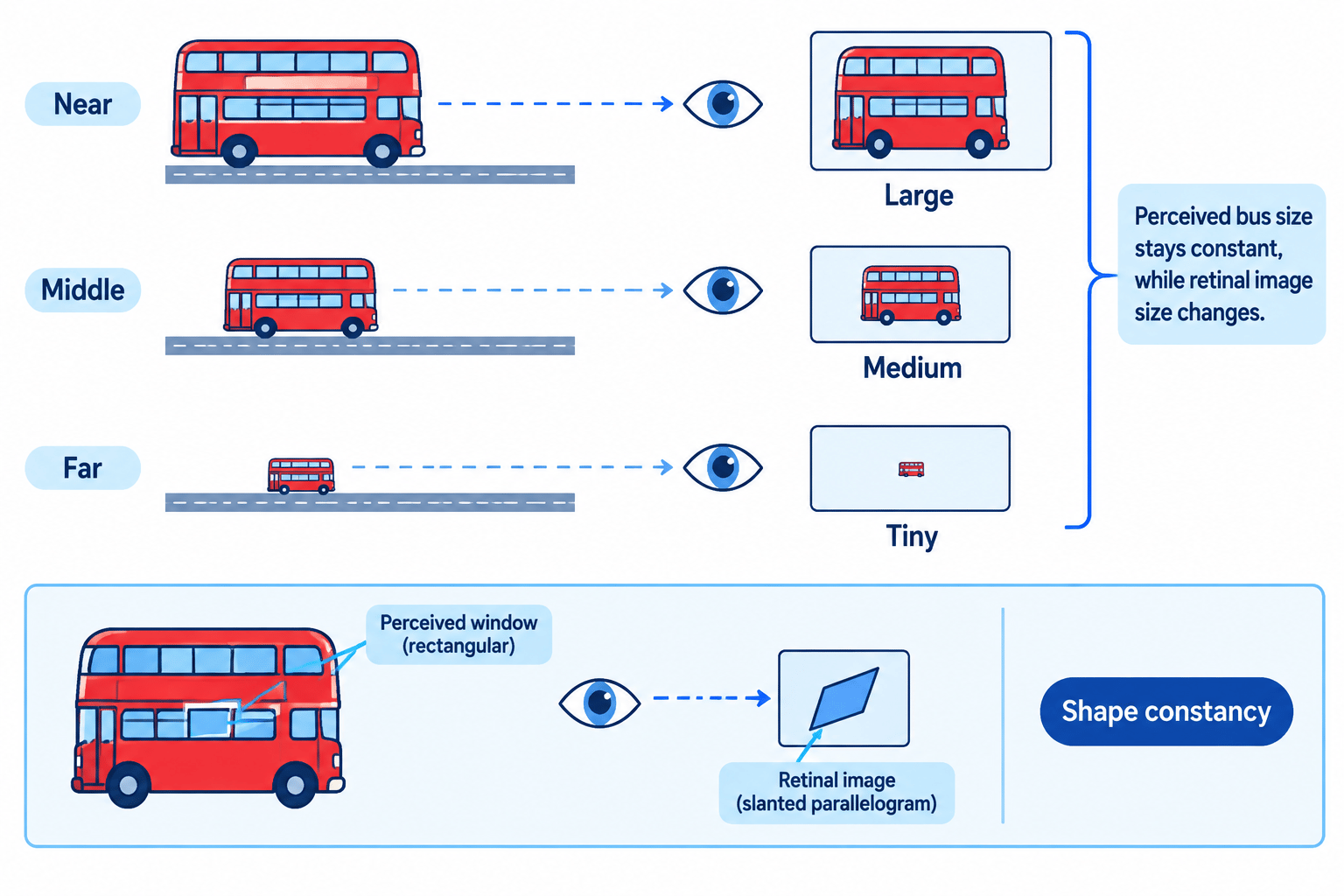
- An object looks the same size when it moves nearer or further, even though its retinal image grows or shrinks.
- Shape constancy
- An object keeps its familiar shape even when you view it from an angle that distorts the retinal image.
- Colour constancy
- An object looks the same colour under different lighting, so a red jumper still reads as red under a streetlight.
Example
- Watch a double-decker bus pull away from the stop and shrink down the road.
- Its retinal image gets tiny, yet you still see a full-size bus, not a shrinking toy: that is size constancy.
- Its windows still look rectangular even though, from the pavement, they hit your retina as slanted parallelograms: that is shape constancy.
How Constancy Works
- For size, the brain scales the shrinking retinal image back up using cues that tell it how far away the object is.
- For shape, it draws on your stored knowledge of the object's true shape and the angle you are viewing it from.
- For colour, it compares the object with its surroundings and discounts the current lighting, so the object is judged relative to everything around it.
- Without this correction, every step you took would make objects seem to swell, shrink, warp and change colour.
- You could not recognise a friend across the playground or judge whether a gap was wide enough to walk through.
- Constancy is what turns a jittery stream of retinal images into one coherent, predictable world you can act in.
Self review
- What is a perceptual constancy?
- Name the three perceptual constancies.
- How does the brain keep size constancy as an object moves away?
- Why would perception be unreliable without constancy?