Skip to content

Course home

Revision guides·3.4.2 Social learning theory in understanding prosocial behaviour
Sign up

3.4.2 Social learning theory in understanding prosocial behaviour

Learning to Help

  1. You can learn prosocial behaviour, meaning actions that help others, simply by watching someone else do it.
  2. Social learning theory explains this without you ever needing to be rewarded for helping first.
  3. You observe a helpful model, imitate them, and vicarious reinforcement supplies the motivation.
Key Idea
  • Seeing a model rewarded for helping makes you more likely to help in the same way.
  • The more often you see kindness pay off, the more often you copy it.

Observation and Imitation

  1. You watch a model behave prosocially, such as comforting a classmate who is upset.
  2. You store a memory of exactly what they did and how it turned out.
  3. You then imitate that behaviour, copying the model, when you meet a similar situation yourself.
Example
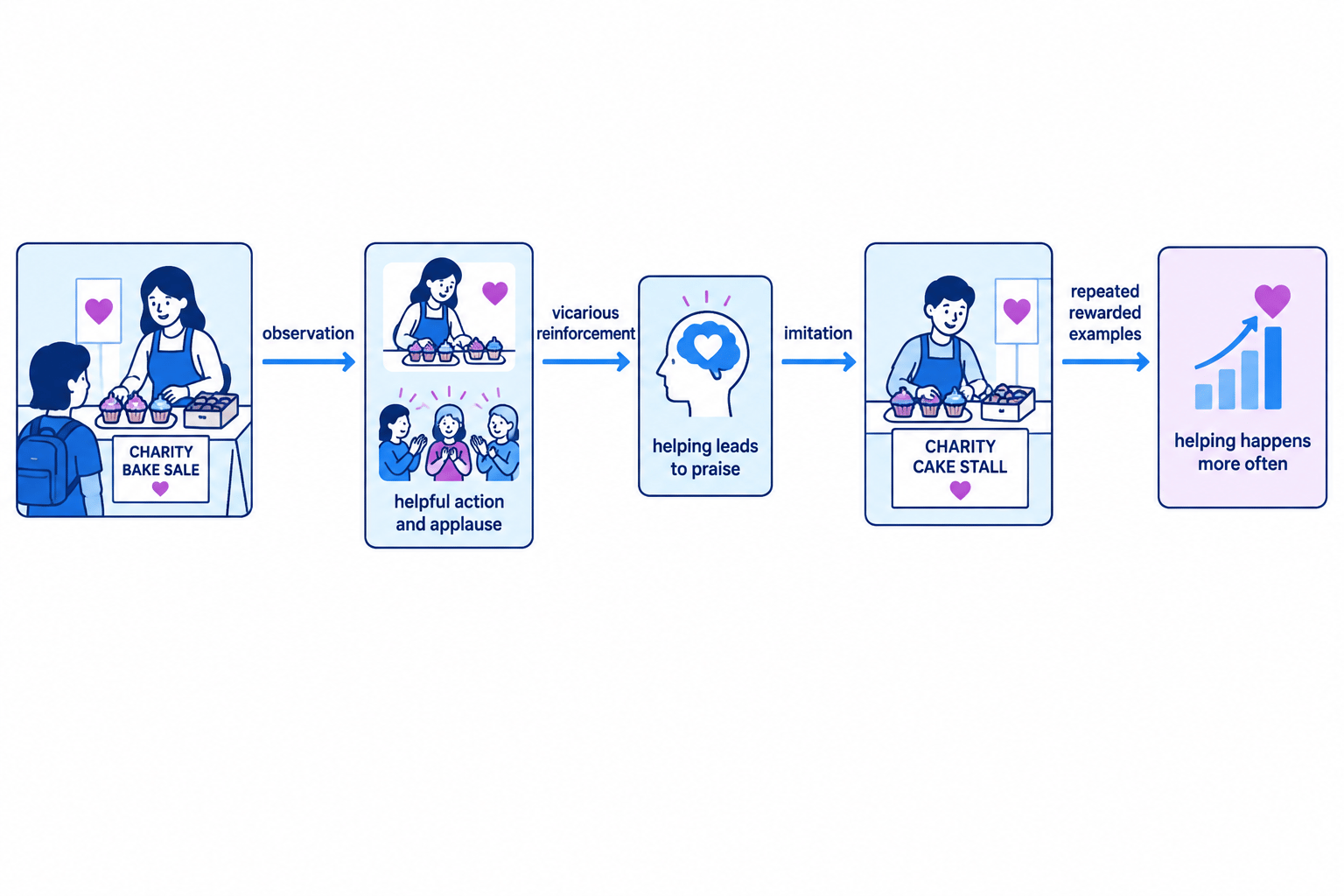
  • Your form tutor runs a bake sale for the local food bank and the whole school claps for her effort.
  • You notice the praise she gets and you remember how she organised it.
  • A term later you set up your own charity cake stall, copying the helping you saw rewarded.

Vicarious Reinforcement

  1. You see the model thanked, praised or admired for helping.
  2. This teaches you that helping leads to a reward, even though the reward went to them.
  3. That expected reward becomes your motivation to help as well.
  4. Each time you see helping rewarded again, the behaviour is reinforced and you do it more often.
Common Mistake
  • Do not just say the behaviour was copied and stop there.
  • You must explain that seeing the model rewarded, rather than punished, is what motivated you to imitate it.

Learned Helping That Lasts

  1. The reward is felt by the model and not by you, which is exactly why it is called vicarious.
  2. Helping learnt this way keeps going, because each rewarded example you see reinforces it once more.
  3. This is why generous role models at home or school tend to raise the amount of helping around them.
Self review
  • How is prosocial behaviour learned according to social learning theory?
  • Why does seeing helping rewarded increase how often you help?
  • What makes the reinforcement vicarious rather than direct?
  • Give one everyday example of learned helping.

PreviousNext

How was this guide?

Teach Genie

Review 3.4.2 Social learning theory in understanding prosocial behaviour by teaching Genie

Teach it back in your own words, spot gaps, and remember it better.

Start teaching
Genie and Baby Genie

Lesson

Recap your knowledge with an interactive lesson

7 minute activity

Start lesson

Flowchart showing observation, memory, vicarious reinforcement, imitation and repeated prosocial behaviour

Prosocial behaviour means actions intended to help or benefit other people. Social learning theory proposes that people can learn prosocial behaviour by watching a helpful model, even when they have not personally been rewarded for helping before.

The basic process is observing a model's helpful behaviour and its consequence, retaining what was observed in memory, being motivated by vicarious reinforcement, and then imitating the behaviour. Seeing a model praised or rewarded for helping makes the observer expect that helping will also lead to a positive outcome.

For example, a student may watch a tutor organise a charity bake sale and receive applause. The student remembers the helpful behaviour, expects a positive outcome, and may later organise a similar charity event.

Questions

Put it into practice with exam-style questions

29 exam-style questions

Practice questions

Question 1

4 marks

Kiran watches a classmate welcome a new pupil by saying, 'Come and sit with us.' Kiran remembers the words and could say them, but does not use them for several weeks. Then Kiran sees the teacher praise another pupil for welcoming a newcomer, and the next day Kiran welcomes a new pupil using the same words.

Explain how the four processes of social learning account for Kiran's behaviour.

Flashcards

Remember key concepts with flashcards

20 flashcards

Practice flashcards

What does prosocial behaviour mean?

3.4.2 Social learning theory in understanding prosocial behaviour Revision Guide

  1. IGCSE
  2. /Psychology
  3. /3.4.2 Social learning theory in understanding prosocial behaviour

Revision notes for CIE IGCSE Psychology 3.4.2 Social learning theory in understanding prosocial behaviour: explanations and worked examples.

More revision guides