Social Learning
- Social learning theory says you pick up new behaviour by watching other people, not only by being rewarded for it yourself.
- Bandura built the theory to explain how you can learn a behaviour without ever having tried it before.
- The person whose behaviour you watch is called the model.
Key Idea
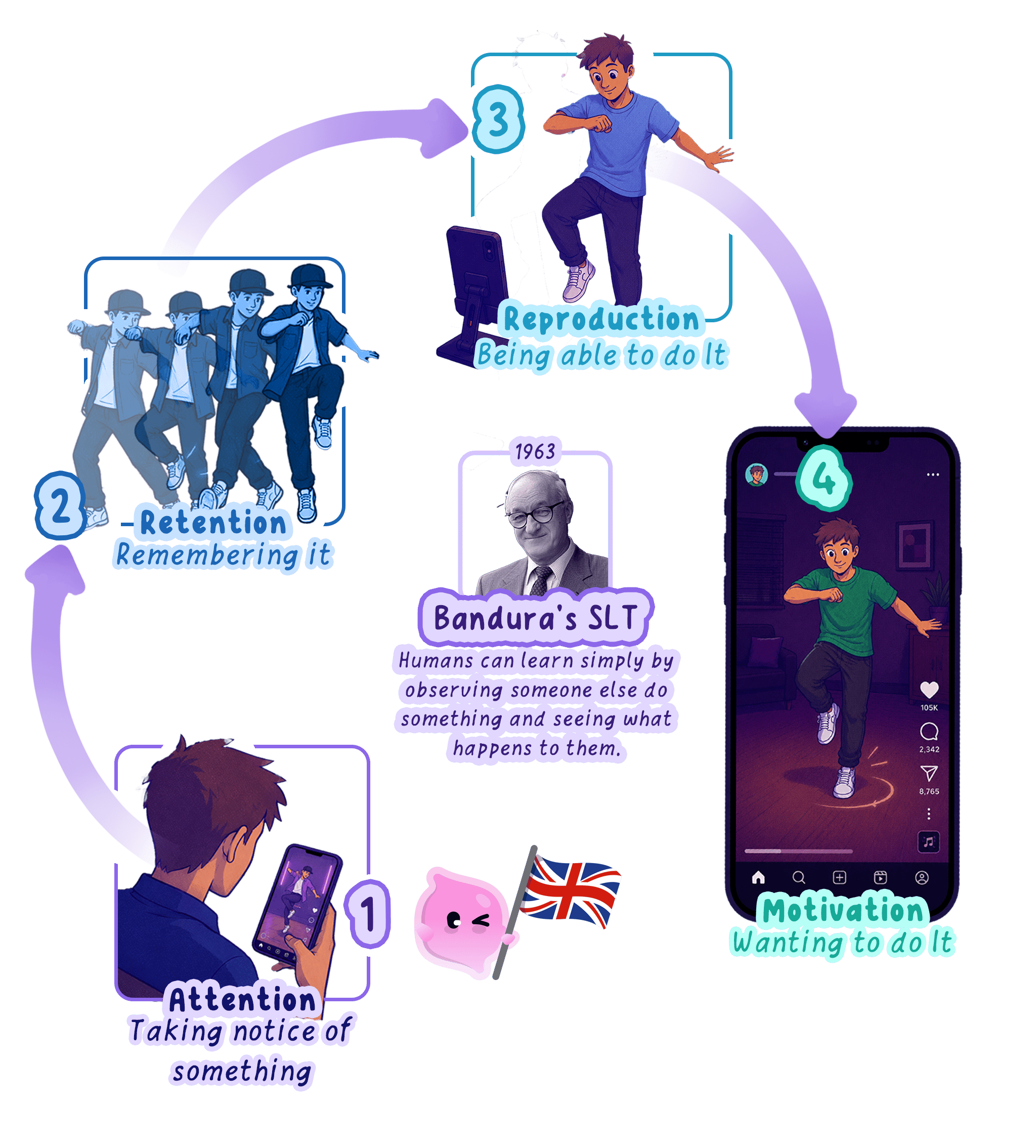
- You observe a model, store what they did, and may reproduce it later.
- When you see the model rewarded, that is vicarious reinforcement, and it makes copying them far more likely.
The Four Processes
- Attention
- You have to notice the model and focus on what they are doing.
- Retention
- You have to store a memory of the behaviour so you can recall it later.
- Reproduction
- You have to be physically able to copy the behaviour you remembered.
- Motivation
- You need a reason to copy it, and an expected reward is the strongest reason of all.
Example
- You watch your older sister give up her seat on the bus for an elderly passenger.
- The passenger thanks her warmly and the driver nods, so she is clearly rewarded.
- You paid attention, you can remember it, and you can easily copy it, so next time you offer your seat too.
Types of Model
Definition
Modelling
Demonstrating a behaviour that other people can watch and imitate; the person whose behaviour is copied is called the model.
- Live model
- A real person in front of you, such as a teacher showing you how to behave.
- Symbolic model
- Someone you see through the media, such as a character in a soap opera or a YouTuber.
- Verbal instruction
- A spoken description of how to behave, such as a coach talking you through each step.
Vicarious Reinforcement
Definition
Vicarious reinforcement
Learning to expect a reward by watching someone else be rewarded for a behaviour, which makes you more likely to copy it yourself.
- You do not need to be rewarded yourself for a behaviour to be reinforced.
- Watching the model get praised, paid or thanked teaches you that the behaviour pays off.
- The reverse also works, because seeing the model punished teaches you not to copy them.
- This is why motivation, the fourth process, so often comes from a reward you only witnessed.
Self review
- Name the four processes of social learning in order.
- What is vicarious reinforcement?
- Name the three types of model and give an example of each.
- Why can you learn a behaviour without being rewarded for it yourself?
