Rushton's Twin Study
- The biological explanation says part of your tendency to help is passed down in your genes.
- If that is right, twins who share more genes should be more alike in how socially responsible they are.
- Social responsibility here just means the willingness to help and act for other people.
Key Idea
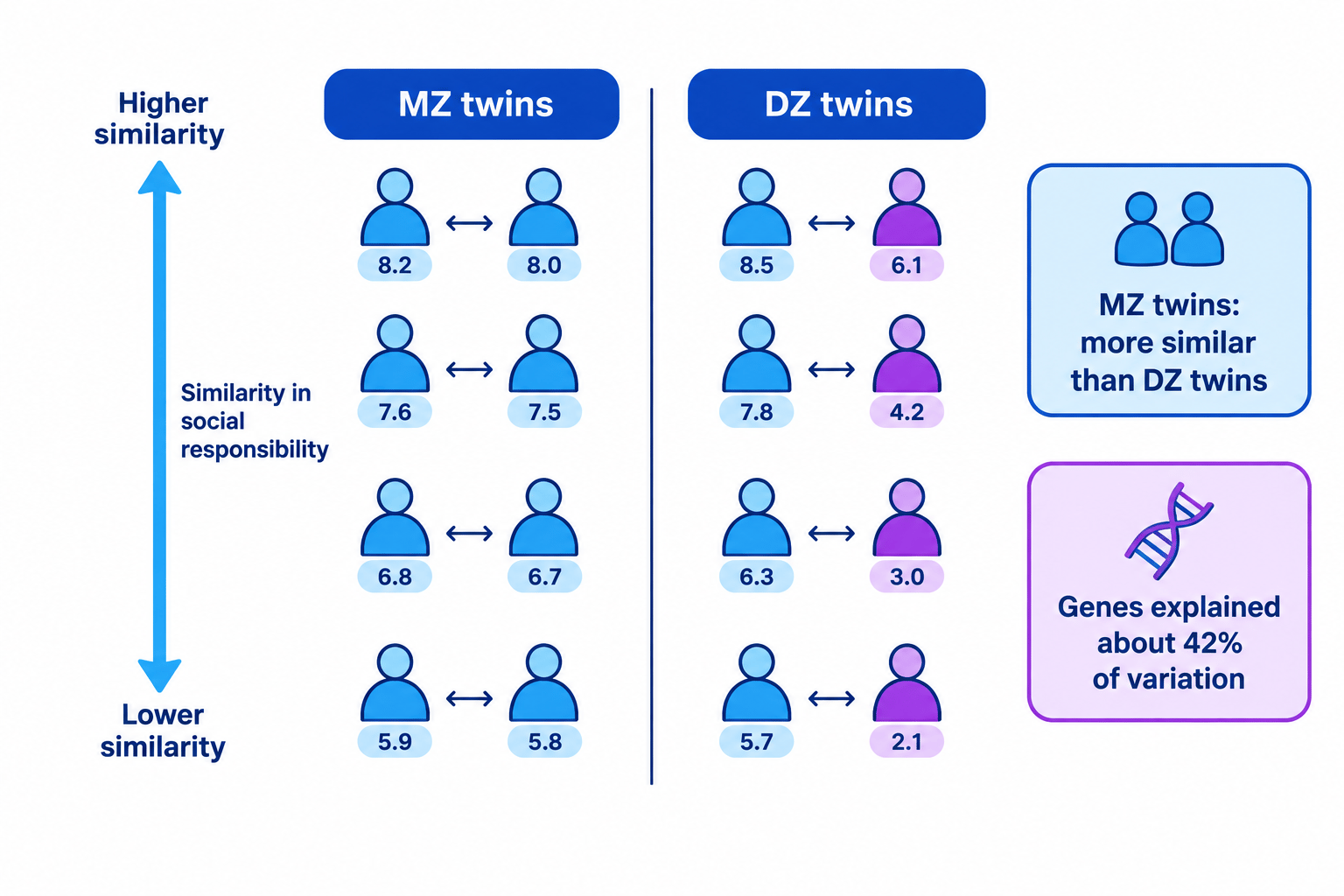
- Rushton compared identical (MZ) and non-identical (DZ) twins on social responsibility.
- You are examined on what he found and what it shows, not on how he ran the study.
What Rushton Found
- MZ twins were more similar in social responsibility than DZ twins.
- Genes accounted for about 42% of the variation in social responsibility across the sample.
- Because MZ twins share all their genes and DZ twins only about half, that greater MZ similarity points to a genetic influence.
Example
- Picture identical twin sisters who both sign up to volunteer with St John Ambulance.
- Non-identical twins match up like that far less often, and that tighter match in identical pairs is the pattern Rushton found.
What It Shows
- Rushton concluded that genetics have a strong influence on how socially responsible a person is.
- A heritability of about 42% is a substantial genetic contribution, which is direct evidence that prosocial behaviour has a biological basis.
- So the study supports the biological explanation, while the rest of the variation shows the environment still matters too.
Note
- A named study is examined on its results and its conclusion, never its aim or procedure.
- Here that means the MZ-DZ similarity and 42% figure (results) and the genetic influence on helping (conclusion).
Turning This Into an Argument
- Give the result: MZ twins were more similar in social responsibility than DZ twins, with genes explaining about 42% of the variation.
- State the conclusion it points to: a genetic influence on helping, direct evidence that prosocial behaviour has a biological basis.
- That result-to-conclusion is all that scores here; the prediction, Rushton's aim or how he ran the study earn nothing.
Self review
- How did MZ and DZ twins compare in social responsibility?
- Roughly what proportion of the variation did genes explain?
- What did Rushton conclude about genes and helping?
- How do these findings support the biological explanation?