How Sleep Is Measured
- You cannot ask a sleeping person what is happening, so researchers record the body instead.
- Each tool records one feature of sleep, from brain waves to eye movements.
- Read together, these traces reveal whether a person is in REM or deep non-REM sleep.
Key Idea
- Three machines each record one feature: brain activity, muscle tension or eye movement.
- Dream reporting adds what the sleeper actually experienced.
The Four Techniques
Definition
EEG (electroencephalogram)
A method that records the brain's electrical activity through electrodes on the scalp, used to show which stage of sleep a person is in.
- EEG (electroencephalogram)
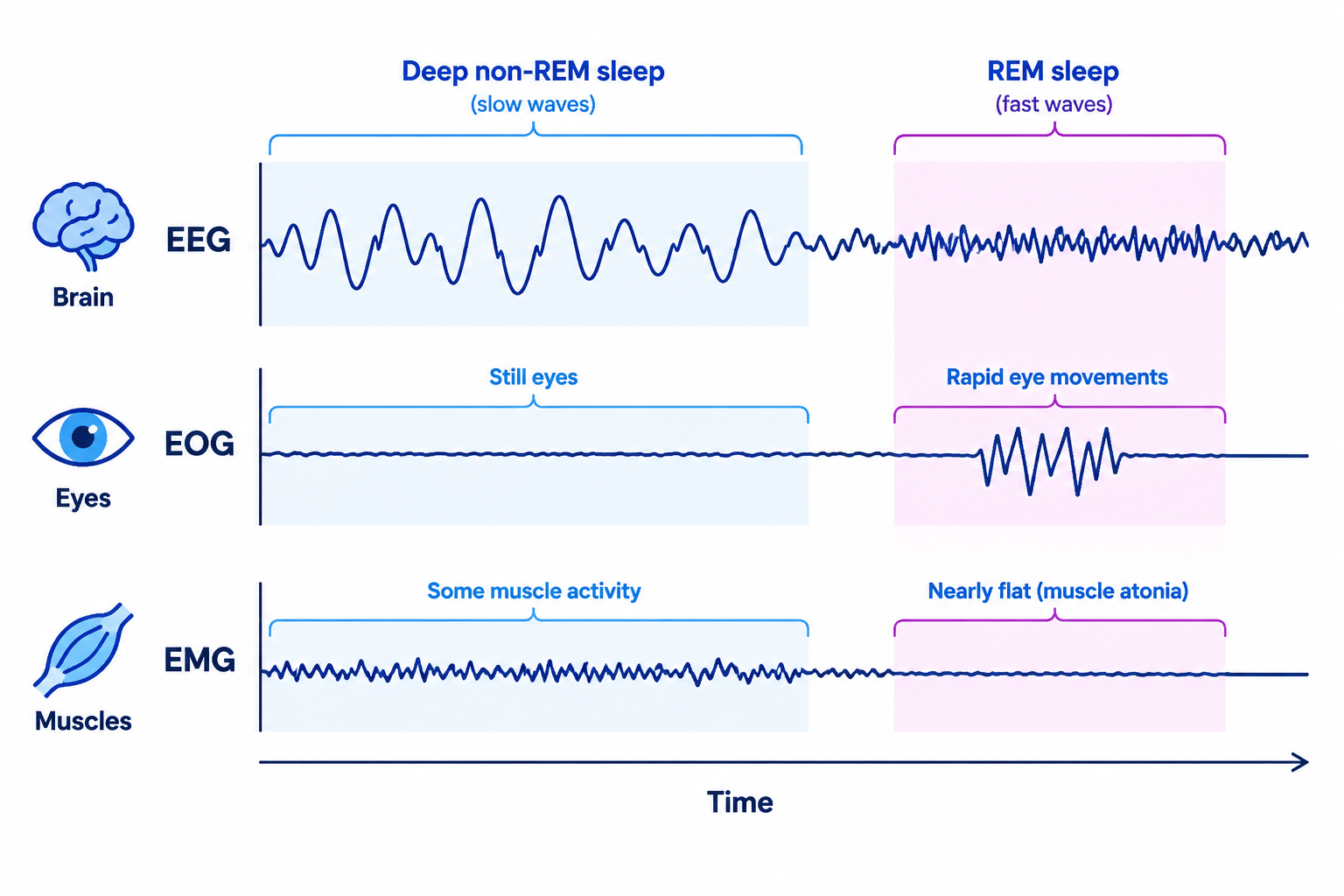
- Electrodes on the scalp record the brain's electrical activity, showing fast waves in REM and slow waves in deep sleep.
- EMG (electromyogram)
- Electrodes on the skin record muscle tension, which drops close to zero when the body goes limp in REM.
- EOG (electro-oculogram)
- Electrodes around the eyes record eye movements, picking out the darting eyes of REM sleep.
- Dream reporting
- Waking the sleeper and asking what they were dreaming captures the experience the machines cannot.
Example
- In an NHS sleep clinic you would be wired up overnight, with pads on your scalp, chin and around your eyes feeding three traces to a screen.
- When the eye trace suddenly starts darting and the muscle trace goes flat, the technician knows you have slipped into REM.
Reading the Signals Together
Definition
EOG (electro-oculogram)
A method that records eye movements using electrodes around the eyes, used to spot the darting eyes of REM sleep.
- No single tool identifies the type of sleep on its own; researchers read the traces side by side.
- Fast EEG waves, a darting EOG and a flat EMG together signal REM sleep.
- Slow EEG waves with some muscle tension and still eyes signal deep non-REM.
Common Mistake
- Keep the tools straight: EEG is brain, EMG is muscle, EOG is eyes.
- A dream report is not hard fact, since it only captures what the person actually recalls.
Matching Tool to Feature in an Answer
- Pin down the feature the question names: brain activity, muscle tension, eye movement or the dream itself.
- Give the exact tool for it: EEG (brain), EMG (muscle), EOG (eyes) or dream reporting; the right pairing is the mark.
- To show REM, pair the darting EOG with the fast EEG; one trace alone does not prove REM.
Self review
- What does an EEG record?
- Which tool records eye movements?
- Which measures together show a person is in REM sleep?
- What is one weakness of dream reporting?