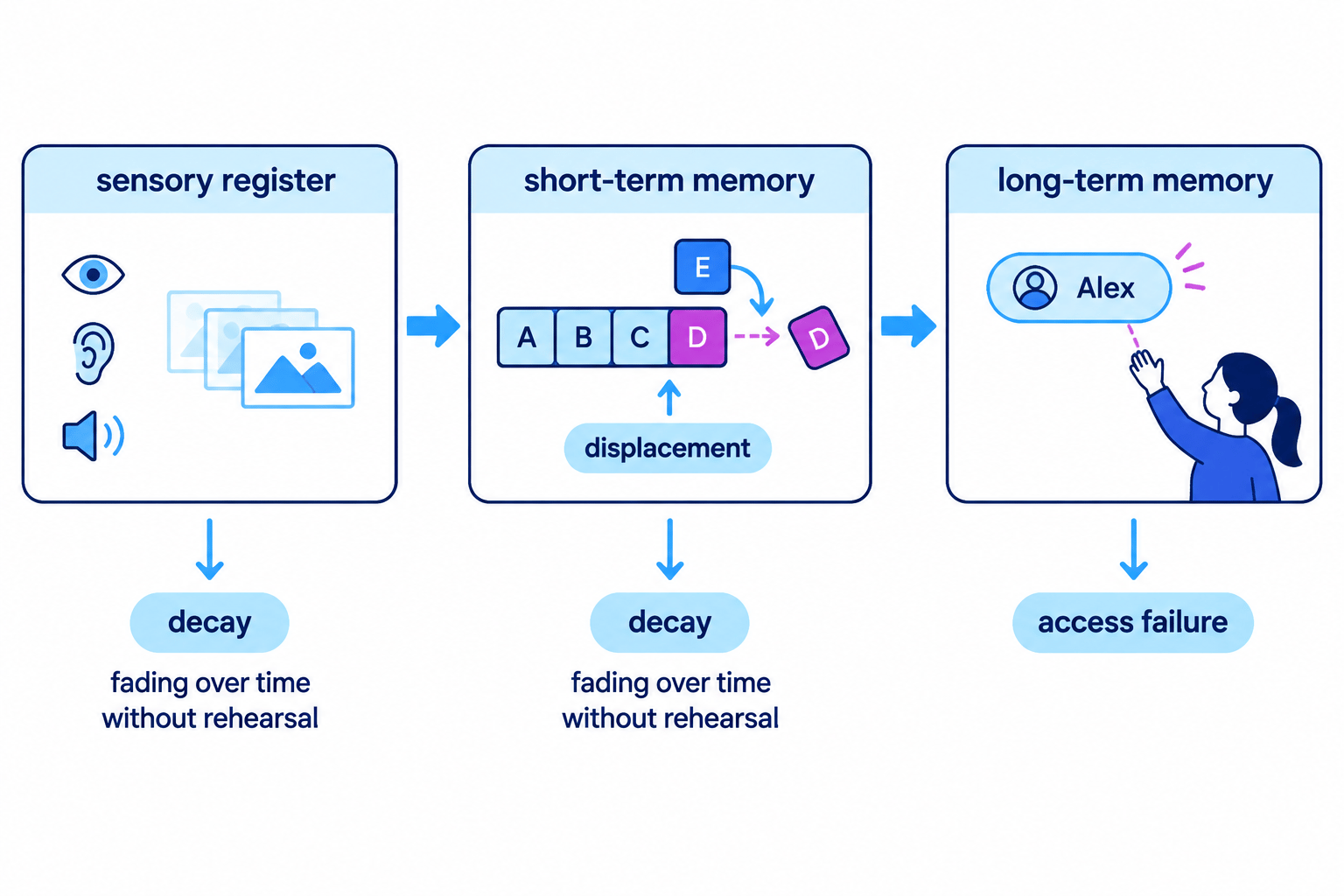
How the Model Explains Forgetting
- Because the model has three separate stores, it explains forgetting in three separate ways.
- Information can be lost inside a store, or by failing to pass on to the next one.
- The skill is to tie each case of forgetting to the store where it happens.
Key Idea
- The three explanations are displacement, decay and access failure.
- Picture short-term memory as a shelf with only a few slots: when a new item arrives and every slot is full, one gets shoved off the end, and that is displacement.
Displacement, Decay and Access Failure
Definition
Displacement
Forgetting from short-term memory that happens when it is full and a new item arriving pushes an older one out.
Displacement happens in short-term memory: when it is full, a new item shoves an older one out.
Definition
Decay
Forgetting from the sensory register or short-term memory when information fades over time because it is not rehearsed.
Decay affects the sensory register and short-term memory, where information fades over time unless it is rehearsed.
Access failure is a long-term memory problem: the memory is still there, but you cannot get to it right now.
Common Mistake
- Long-term memories are not displaced, so keep displacement to short-term memory only.
- Decay is fading over time, while displacement is being pushed out by new items, so do not treat them as the same thing.
The Three in Everyday Life
Example
- You are holding a locker code in your head when a friend blurts out their new number, and the code vanishes: that is displacement in short-term memory.
- A spoken instruction you never repeated slips away within seconds: that is decay.
- A classmate's name sits on the tip of your tongue even though you know it: that is access failure in long-term memory.
Linking a Case of Forgetting to Its Store
- From the scenario, decide which store held the information: sensory register, short-term or long-term memory.
- Name the matching process: displacement or decay in short-term memory, decay in the sensory register, or access failure in long-term memory, and do not swap decay (fading) for displacement (pushed out).
- Explain how that process lost the information, quoting the detail you are given, since the link to the scenario is scored separately from naming the process.
Self review
- What is displacement, and in which store does it happen?
- Where does decay occur?
- What is access failure?
- Which type of forgetting explains a name on the tip of your tongue?