The Levels of Processing Model
Definition
Levels of processing model
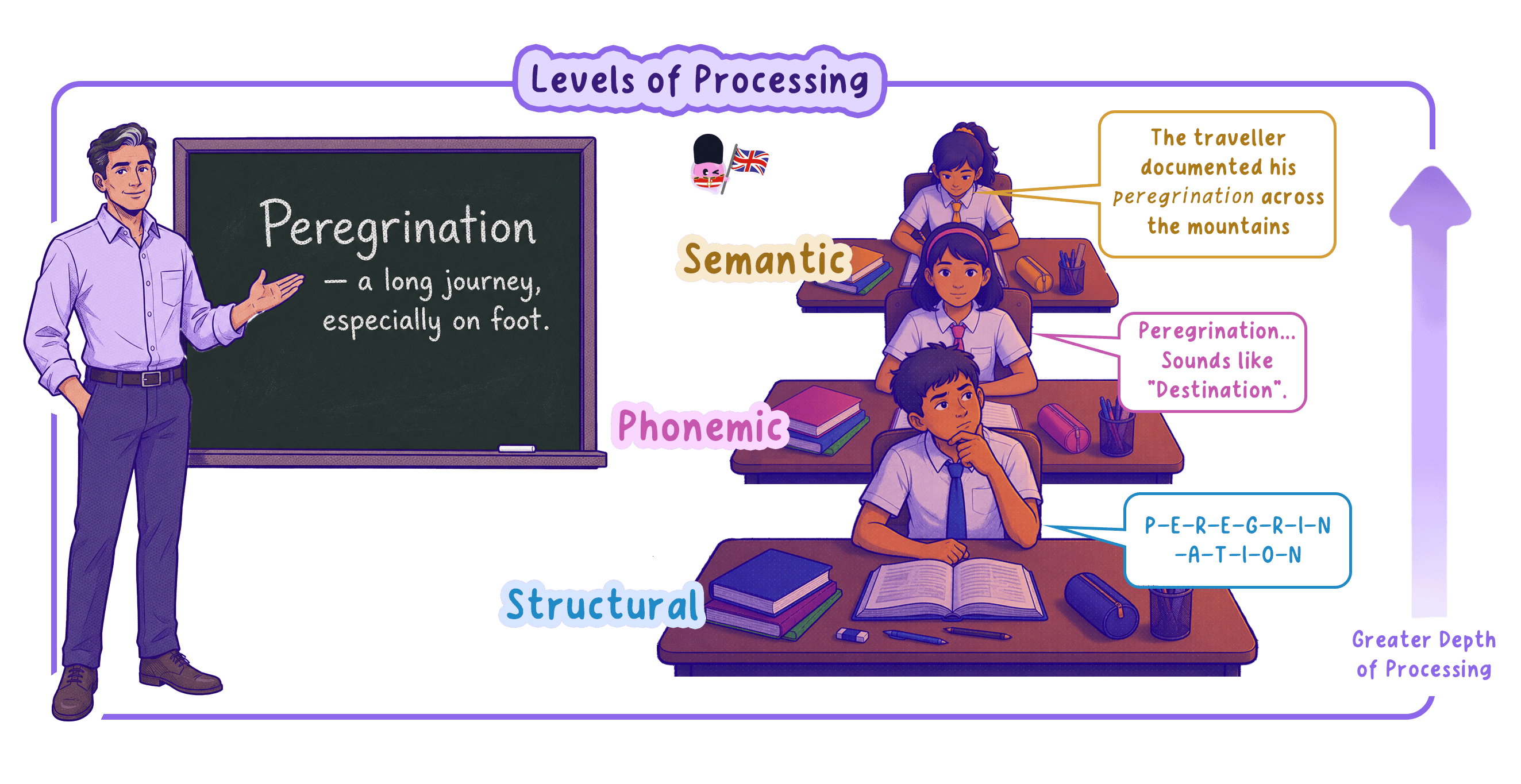
A model of memory that says how well you remember something depends on how deeply you process it, not on which store it is held in. Deeper processing produces stronger, longer-lasting memories.
- The levels of processing model, put forward by Craik and Lockhart, turns the usual question about memory on its head.
- Instead of asking which store a memory sits in, it asks how deeply you thought about the information in the first place.
- The deeper you process something, the stronger and longer-lasting the memory of it.
- Storage is treated as a by-product of that thinking, not as a separate step you deliberately set out to carry out.
Key Idea
- Deeper processing leaves a stronger, longer-lasting memory.
- It is how you handle information, not where you keep it, that matters most.
How the Model Treats Input, Capacity, Duration and Access
- Input is the information coming in, and it can be processed shallowly or deeply.
- Capacity and duration are not fixed by a store, but set by how deeply you process each item.
- Access is easier for anything you processed deeply, so meaningful material comes back to you readily.
- None of these is decided by a container, because the model does away with separate stores altogether.
Example
- Skim-reading a revision term barely leaves a trace, like a word written in sand.
- Thinking hard about what that term actually means carves it in, like cutting the word into wood.
How It Differs From the Multi-Store Model
- The multi-store model, which explains memory as information passing between separate stores, leans on rehearsal to move things along.
- The levels of processing model drops that idea and puts depth of processing at the centre instead.
- It argues that meaning, not simple repetition, is what really fixes a memory in place.
Common Mistake
- The commonest slip is describing this model with separate stores, when its whole point is that depth, not location, drives memory.
- It is also wrong to say rehearsal on its own builds a strong memory here, because repeating something without thinking about its meaning does little.
Summary
- Depth of processing decides how well something is remembered.
- Storage then happens as a result of that processing, never as a separate aim.
Self review
- Who put forward the levels of processing model?
- According to this model, what decides how well something is remembered?
- What does it mean to say storage is a by-product of processing?
- How does this model differ from the multi-store model?
