Gap size decides how much a wave spreads out
Definition
Diffraction
The spreading out of a wave as it passes through a gap or travels past the edge of an obstacle, with no change to its speed, frequency or wavelength.
- The amount of spreading is not fixed: it depends on the size of the gap compared with the wavelength, not on the gap width on its own.
- Keep the wavelength fixed in a ripple tank and change only the gap, and a clear pattern appears.
- With a gap much wider than one wavelength, the wave carries straight on as a beam roughly the width of the gap, and only the two ends of each wavefront curl slightly.
- Narrow the gap and the curled ends take up more of each wavefront, so the beam fans out over a wider angle.
- When the gap is about the same size as one wavelength, the wavefronts emerge as almost complete semicircles and fill the region beyond the barriers.
- Narrowing the gap further does not increase the spreading much, but it does cut down how much of the wave gets through, so the waves beyond are weaker.
- Throughout all of this the wavefronts stay the same distance apart, because the water depth is unchanged and so the wavelength itself is unchanged; diffraction alters only the shape and direction of the wavefronts.
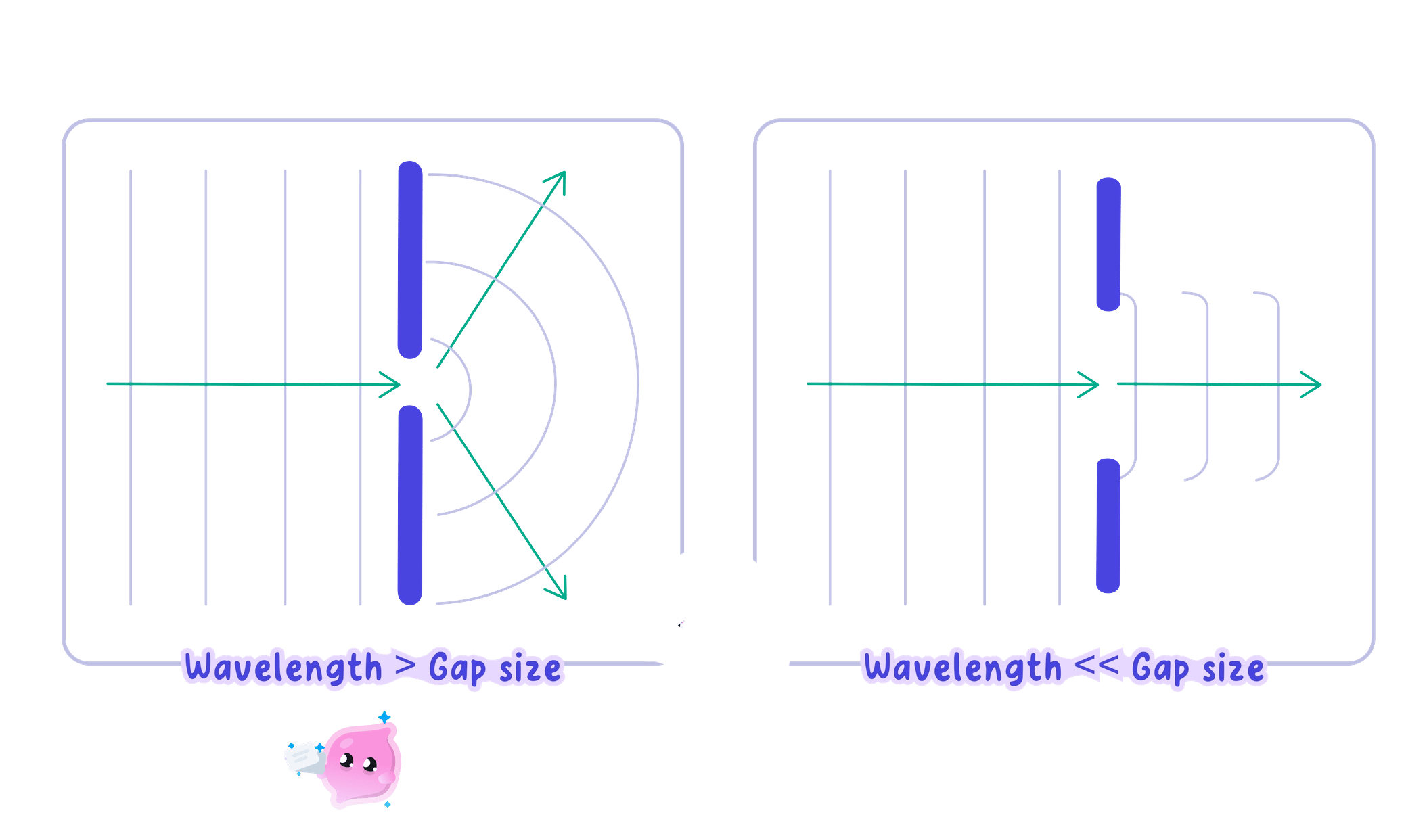
Longer waves spread more through the same gap
- Now run the experiment the other way round: fix the gap and change the wavelength by changing the frequency of the vibrating bar.
- Lowering the frequency gives a longer wavelength, since the speed is set by the water depth and λ=v/f\lambda = v/fλ=v/f.
- Those longer waves are now closer in size to the gap, so they spread out more beyond it.
- Raising the frequency gives a shorter wavelength, which is now small compared with the gap, so the wave carries straight on with much less spreading.
- Both experiments are really the same rule seen from two sides: what matters is the ratio of wavelength to gap width, and the spreading grows as that ratio grows towards one.
- This is why "narrow" and "wide" have no meaning on their own: a 1 cm1\ \text{cm}1 cm gap is enormous for light and tiny for long-wave radio.
At an edge, longer waves curl further into the shadow
- Take away one barrier so a single straight edge is left, and the wavefronts that pass it bend round the end of the barrier into the shadow region.
- There is no gap width to compare with now, so the wavelength alone decides how far the wave curls round.
- A longer wavelength curls further behind the edge, so the shadow region is smaller and the waves reaching into it are stronger.
- A shorter wavelength barely bends at all, leaving a sharp-edged shadow with almost undisturbed water behind the barrier.
- The wavefronts in the shadow are curved because they have pivoted about the tip of the barrier, and they are still the same distance apart as the ones that went straight past.
Example
- Drive into a Welsh valley and long-wave radio keeps playing while FM and digital signals drop out.
- Long-wave radio has a wavelength of over a kilometre, comparable with the hills themselves, so it diffracts strongly round them.
- FM radio has a wavelength of about 3 m3\ \text{m}3 m, far smaller than a hill, so it barely bends and leaves a radio shadow in the valley.
- The same rule explains why you hear a conversation through an open doorway before you see the speaker.
- Speech has a wavelength of roughly a metre, close to the width of the door, while light has a wavelength under a millionth of a metre and travels straight on.
Common Mistake
- Do not say a narrow gap always gives the most diffraction; it gives the most only when it is comparable with the wavelength.
- Do not judge the gap as "small" or "large" in everyday terms, since the only meaningful comparison is with the wavelength.
- Do not draw the diffracted wavefronts closer together, because the wavelength does not change.
- Do not bring gap size into an answer about an edge, where only the wavelength decides how far the wave curls round.
Exam technique
- Working out how much a wave will spread:
- Pull the wavelength and the gap width out of the question and compare them, rather than judging either one on its own.
- Roughly equal means strong spreading, with semicircular wavefronts filling the space beyond.
- A gap many wavelengths wide means a straight-through beam with only the edges curling.
- For an obstacle, drop the gap from your reasoning and ask only whether the wavelength is large or small compared with the obstacle.
- Whatever you conclude, add that the wavelength itself is unchanged.
- Answers here are almost always comparative, so use "more than" and "less than" rather than "a lot", and name what you are comparing with.
- If a question changes the frequency, add the middle step: the frequency changes, so the wavelength changes, so the spreading changes.
- When you sketch a strongly diffracted pattern, draw the wavefronts as arcs centred on the gap and keep them equally spaced.
- The mark most often dropped is the reference point, so write "the gap is about the same size as the wavelength" rather than "the gap is small".
Self review
- Under what condition is diffraction through a gap greatest?
- The gap is kept the same and the frequency of the source is increased. Describe and explain the effect on the diffraction.
- Sketch the wavefronts beyond a gap that is many wavelengths wide.
- How does wavelength affect how far a wave diffracts round the edge of an obstacle?
- Explain why long-wave radio reaches into a valley when FM radio does not.
