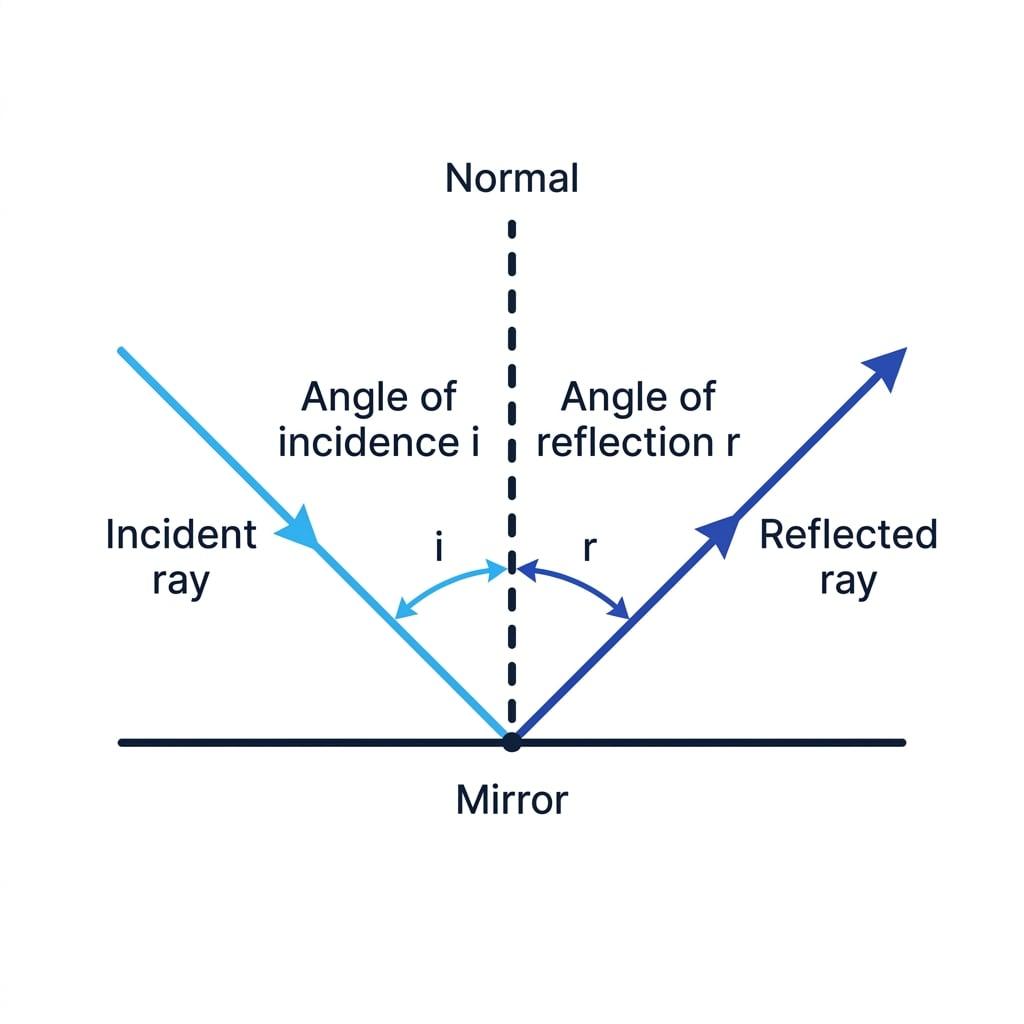
The normal is the reference line every optics angle is measured from
Normal
A construction line drawn at right angles (90∘90^\circ90∘) to a surface, at the exact point where a ray strikes it.
- The normal is not part of the apparatus and it is not a ray of light; it is a line you draw yourself so that angles can be defined consistently.
- It is always drawn as a dashed line so that nobody mistakes it for a light ray, and it is labelled where it meets the surface.
- It must be drawn at the point of incidence, the exact spot the ray hits, because a normal drawn anywhere else gives the wrong angles.
- Defining angles from the normal rather than from the surface means the same rule works for a flat mirror, a curved mirror and a glass block, whatever their shape.
Angles of incidence and reflection sit on opposite sides of the normal
Angle of incidence
The angle between the incident ray and the normal at the point where the ray meets the surface. Symbol iii.
Angle of reflection
The angle between the reflected ray and the normal at the same point. Symbol rrr.
- The incident ray is the ray arriving at the mirror and the reflected ray is the one leaving it, and both are drawn with arrowheads showing the direction the light travels.
- The incident ray, the reflected ray and the normal all lie in the same plane, which is why the whole thing can be drawn flat on a sheet of paper.
- The two rays sit on opposite sides of the normal, so a ray coming in from the left leaves to the right.
- A ray travelling straight along the normal has i=0∘i = 0^\circi=0∘, so it is reflected straight back the way it came.
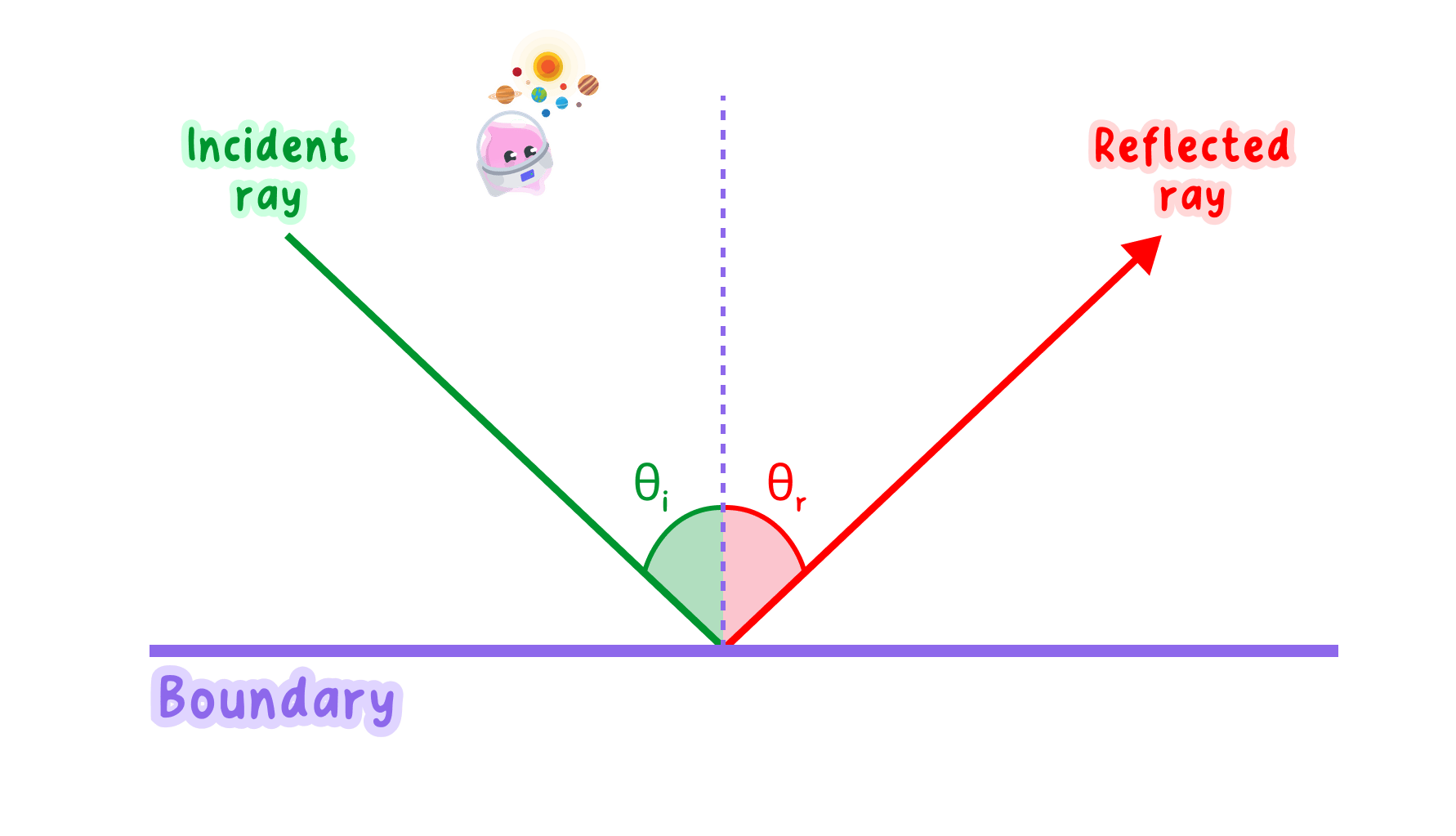
The law of reflection: the two angles are always equal
-
For reflection at any surface, the angle of incidence is equal to the angle of reflection.
i=r i = r i=r -
The relationship holds for every angle you try, which is what makes reflection predictable enough to design mirrors, periscopes and reflectors around it.
-
A smooth surface such as a plane mirror reflects a parallel beam as a parallel beam, which is why you get a clear image in it.
-
A rough surface such as paper still obeys i=ri = ri=r at every point, but the normals point in all directions, so the light scatters and you see no image.
Investigation: the law of reflection in a plane mirror
- Aim: to test whether the angle of incidence equals the angle of reflection for a plane mirror.
- Apparatus: a ray box or lamp fitted with a single narrow slit, a plane mirror on a stand, a protractor, a 30 cm30\ \text{cm}30 cm ruler, a sharp pencil and a sheet of plain paper.
- Method:
- Rule a straight base line across the middle of the paper and mark a point O\text{O}O on it, then draw the normal as a dashed line at 90∘90^\circ90∘ to the base line through O\text{O}O.
- Use the protractor to draw incidence lines to O\text{O}O at 20∘20^\circ20∘, 30∘30^\circ30∘, 40∘40^\circ40∘, 50∘50^\circ50∘ and 60∘60^\circ60∘ from the normal, and label each one.
- Stand the mirror on the base line with its silvered back surface exactly on the line, since that is the surface that actually reflects.
- Darken the room, shine the ray along the 20∘20^\circ20∘ line so it strikes the mirror at O\text{O}O, and mark two pencil crosses far apart along the middle of the reflected ray.
- Repeat for each incidence line, then lift the mirror away and join each pair of crosses back to O\text{O}O with a ruler.
- Measure each angle of reflection from the normal with the protractor.
- Measure and plot: tabulate the readings under the headings i / degrees and r / degrees, then plot rrr against iii and draw one thin best-fit line.
- Result: the graph is a straight line through the origin of gradient 111, confirming i=ri = ri=r at every angle tested.
- Watch out:
- A fat ray is the biggest source of error, so narrow the slit and mark the centre of the beam with a sharp pencil.
- Put your two crosses as far apart as the paper allows, because a short line magnifies any marking error when you extend it.
- If the mirror slips off the base line the reflected ray no longer passes through O\text{O}O, so check it before every reading.
- Safety: the ray box lamp gets hot, so let it cool before moving it, and handle the mirror by its edges in case the glass is chipped.
Angles from the surface, and the total turn of the light
- Because the normal is perpendicular to the surface, the angle a ray makes with the mirror surface and the angle it makes with the normal always add to 90∘90^\circ90∘.
- So a single subtraction converts between them: a ray making 25∘25^\circ25∘ with the surface has an angle of incidence of 65∘65^\circ65∘.
- The total angle turned by the light between the incident and reflected rays is i+ri + ri+r, which equals 2i2i2i because the two angles are equal.
- Rotating a mirror through an angle therefore swings the reflected ray through twice that angle, which is how a mirror galvanometer turns a tiny movement into a big one.
- Do not measure either angle from the mirror surface; every angle in reflection is measured from the normal.
- Do not draw the normal as a solid line, because it will be read as a ray of light.
- Do not draw the reflected ray on the same side of the normal as the incident ray.
- Do not use rrr for the angle of refraction in a reflection question; here it means the angle of reflection.
- Do not say a rough surface breaks the law of reflection; it obeys i=ri = ri=r at every point, but its normals point in different directions.
- Working out which angle you have actually been given:
- Read carefully whether the angle is measured from the mirror surface or from the normal, because quoting it from the surface is a deliberate trap.
- If it is from the surface, subtract from 90∘90^\circ90∘ and write that line out so the examiner can follow it.
- Only then apply i=ri = ri=r, and check your answer against the diagram to see it looks sensible.
- Draw the normal first on any ray diagram, before you draw a single ray, because every later angle depends on it.
- Put an arrowhead on every ray you draw, since an unarrowed line does not count as a ray.
- A definition mark needs both objects named, so write "the angle between the incident ray and the normal" rather than "the angle the light comes in at".
- In a drawing question the tolerance is usually about ±2∘\pm 2^\circ±2∘, so use a protractor and a sharp pencil rather than judging by eye.
- What is the normal, and where exactly must it be drawn?
- Define the angle of incidence and the angle of reflection.
- State the law of reflection as an equation.
- A ray hits a plane mirror at 32∘32^\circ32∘ to the mirror surface. Find the angle of reflection.
- Describe how you would use a ray box, a plane mirror and a protractor to show that i=ri = ri=r.