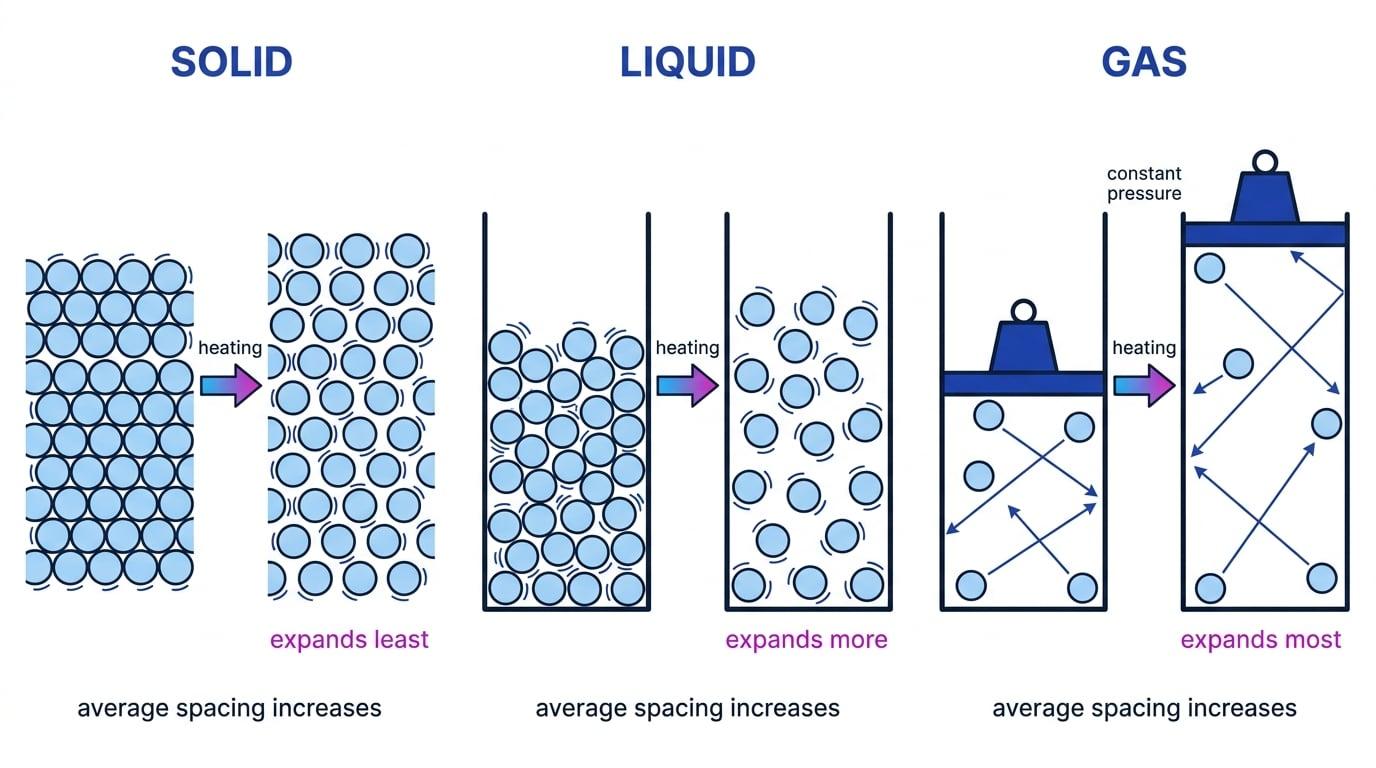
Heating makes solids, liquids and gases take up more room
Definition
Thermal expansion
The increase in the volume of a substance when its temperature rises, measured at constant pressure.
- Raising the temperature gives the particles more kinetic energy, so they vibrate or move further and faster than before.
- Moving further apart on average increases the separation of the particles, and that is what makes the substance occupy a larger volume.
- A solid expands only a little, because its particles stay in the same fixed positions and simply vibrate over a slightly wider distance.
- A liquid expands more than a solid for the same temperature rise, which is why the thread in a thermometer creeps visibly up the tube.
- A gas expands by far the most, provided it is free to push its container outwards so the pressure stays constant.
- Expansion does not change the mass, because no particles have been added or lost, so the same mass now fills a bigger volume and the density falls.
- Cooling reverses the whole process, so the substance contracts and its density rises again.
Expansion is designed for, and designed around, in everyday engineering
- A bimetallic strip is two different metals bonded together, and because one expands more than the other when heated, the strip bends towards the metal that expands less.
- In a thermostat the bending strip breaks a circuit once the room is warm enough, switching the heater off until the strip cools and straightens.
- In a fire alarm the same bending is used the other way round, closing a circuit and sounding the bell when the air gets hot.
- A liquid-in-glass thermometer works only because the liquid expands more than the glass around it, pushing the thread along a narrow bore where a small volume change shows as a long movement.
- Bridges are built with expansion joints, the metal combs you feel the car bump over, so the deck can lengthen on a hot day without buckling.
- Railway lines are laid with small gaps or angled joints for the same reason, because rails pressed hard against each other in summer would bow sideways.
- Overhead power cables are hung with a deliberate sag in summer, so that when they contract on a cold winter night they tighten rather than snap.
- Expansion can also be put to work in shrink fitting, where a metal ring is heated so it slips over an axle and then grips tightly as it cools and contracts.
Gases expand most and solids least
- The order is always the same for the same temperature rise: gases expand most, liquids expand less, and solids expand least.
- In a solid the particles are held in a fixed regular arrangement by strong forces, so extra energy only widens the vibration slightly and the particles cannot escape their positions.
- In a liquid the particles are just as close but not locked into positions, so the same energy pushes them a little further apart than it can in a solid and the volume change is larger.
- In a gas the forces between particles are negligible, so there is nothing holding the gas together and the faster particles simply spread out until the container gives way or moves.
- The size of the effect is striking: heating air by 100 ∘C100\ ^\circ\text{C}100 ∘C swells it by roughly a third of its volume, while heating a steel rail by the same amount lengthens it by about one part in a thousand.
Example
- A jam jar with a stubborn metal lid is held under the hot tap for a few seconds and then opens easily.
- The hot water warms the metal lid quickly, and the metal expands.
- The glass underneath warms more slowly and expands less anyway, so the lid ends up slightly the larger of the two.
- The grip between lid and jar is released and the lid turns.
Common Mistake
- Do not write that the particles themselves get bigger, because a particle is the same size hot or cold and it is the spacing between them that grows.
- Do not say the mass increases when something expands, because the mass is unchanged and it is the density that falls.
- Do not say a bimetallic strip bends towards the metal that expands more, because the longer metal ends up on the outside of the curve.
- Do not forget that a hole in a heated metal plate gets bigger, not smaller, because every part of the plate expands outwards together.
Exam technique
- An explanation of expansion needs the full chain, so write that the particles gain energy, vibrate or move faster and further, their average separation increases, and so the volume increases.
- Applications questions want a named example plus the consequence, so "bridges have expansion joints so the deck can lengthen without buckling" scores where "bridges expand" does not.
- When comparing two materials, say which expands more rather than describing one as "expanding" and the other as "not expanding".
- Add the phrase at constant pressure when the question is about a gas, since a gas in a sealed rigid can raises its pressure instead of expanding.
Self review
- Explain, in terms of particles, why a metal rod gets longer when it is heated.
- Put solids, liquids and gases in order of how much they expand for the same temperature rise.
- Why does a bimetallic strip bend when it is heated?
- Give one reason why expansion joints are built into a bridge.
- What happens to the density of a substance as it expands, and why?