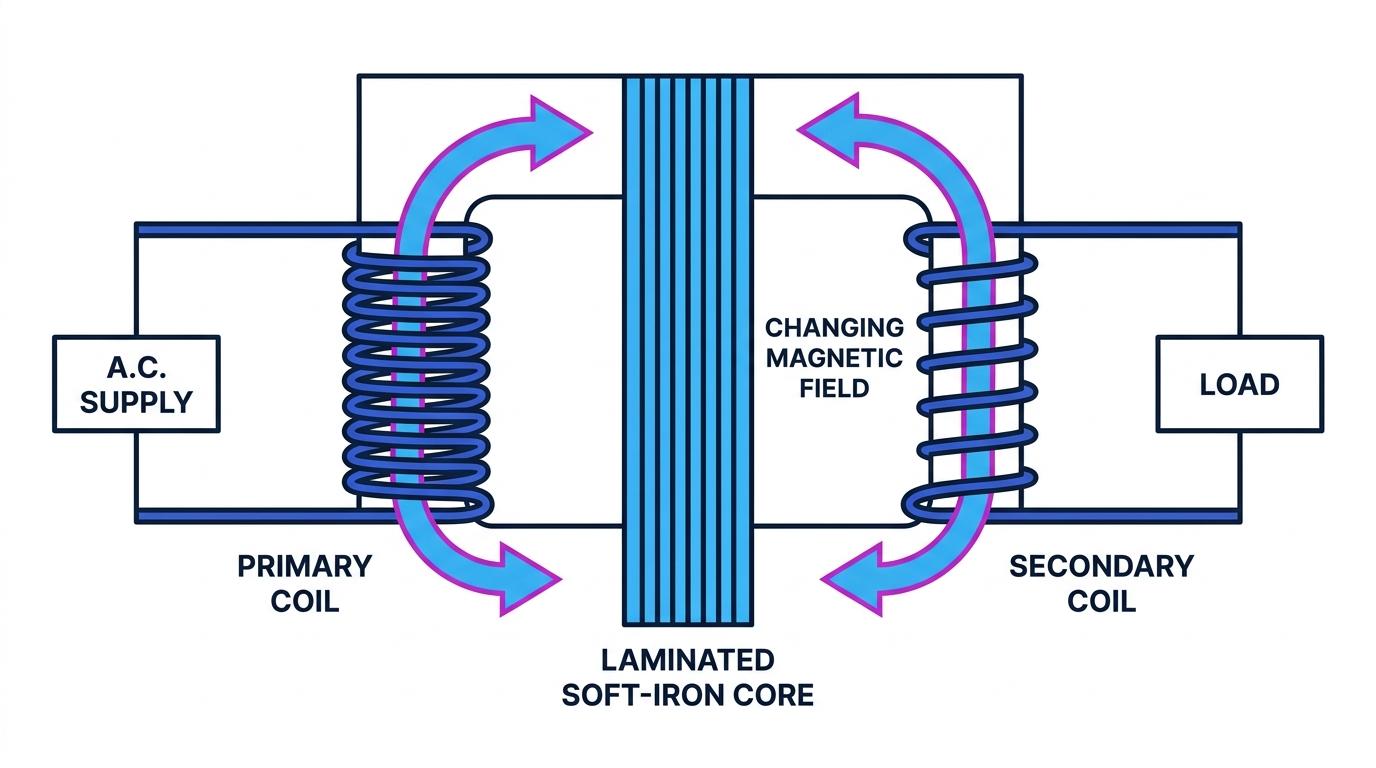
A transformer is two coils sharing one soft-iron core
Definition
Transformer
A device consisting of two coils wound on a soft-iron core, used to change the size of an alternating voltage.
- The primary coil is the input coil, connected to the alternating supply.
- The secondary coil is the output coil, connected to whatever is being powered.
- Both coils are wound on the same soft-iron core, yet they are not electrically joined to one another at any point.
- The core is usually a closed rectangular loop, so that the magnetic field is guided round from one coil to the other with very little escaping.
- Soft iron is chosen because it magnetises and demagnetises easily, which it has to do fifty times a second on a mains supply.
- The coils are wound with insulated wire, and the core is built from thin sheets rather than one solid block, which cuts down the energy wasted inside it.
Step-up and step-down describe what happens to the voltage
- A step-up transformer has more turns on the secondary than on the primary, so its output voltage is larger than its input.
- A step-down transformer has fewer turns on the secondary, so its output voltage is smaller than its input.
- The names always describe the voltage, so a step-up transformer raises the voltage while lowering the current, and a step-down transformer does the reverse.
- A phone charger contains a step-down transformer, taking the 230 V230\ \text{V}230 V mains down to a few volts.
- Transformers at a power station step the voltage up for transmission, and those at a local substation step it back down again for houses.
How a transformer actually works
- An alternating current in the primary coil produces a magnetic field in the core that keeps changing size and direction.
- The soft-iron core carries that changing field round the loop to the secondary coil.
- A changing magnetic field linking the secondary coil induces an alternating e.m.f. in it, by electromagnetic induction.
- The output has the same frequency as the input, because the field changes in step with the primary current.
- The size of the output depends on the ratio of the turns, since every turn on the secondary contributes its own share of the induced e.m.f.
- A transformer therefore works on a.c. only: a steady direct current would give a steady field, nothing would be changing, and no e.m.f. would be induced.
- Connect a transformer to a d.c. supply and the only output comes at the instants of switching on and off, when the field is briefly changing.
Common Mistake
- The two coils are not connected to each other, so no current passes from the primary to the secondary; only the changing field crosses over.
- The core must be soft iron rather than steel, since it has to reverse its magnetism fifty times a second.
- A transformer cannot change the frequency, and it cannot turn a.c. into d.c.; it only changes the size of the voltage.
- "Step-up" refers to the voltage going up, which means the current comes down, so do not assume both rise together.
Exam technique
- An explanation of the operation needs four links in order: alternating current, changing field in the core, field links the secondary, e.m.f. induced.
- The word changing carries a mark of its own, so make sure it appears in your answer.
- When asked why a transformer does not work on d.c., say the field would be constant and so no e.m.f. could be induced.
- Label a transformer diagram with primary, secondary and soft-iron core, and show which coil has more turns.
Self review
- Describe the construction of a simple transformer.
- What is the difference between a step-up and a step-down transformer?
- Explain how an e.m.f. is induced in the secondary coil.
- Why is the core made of soft iron?
- Why does a transformer produce no steady output when connected to a d.c. supply?