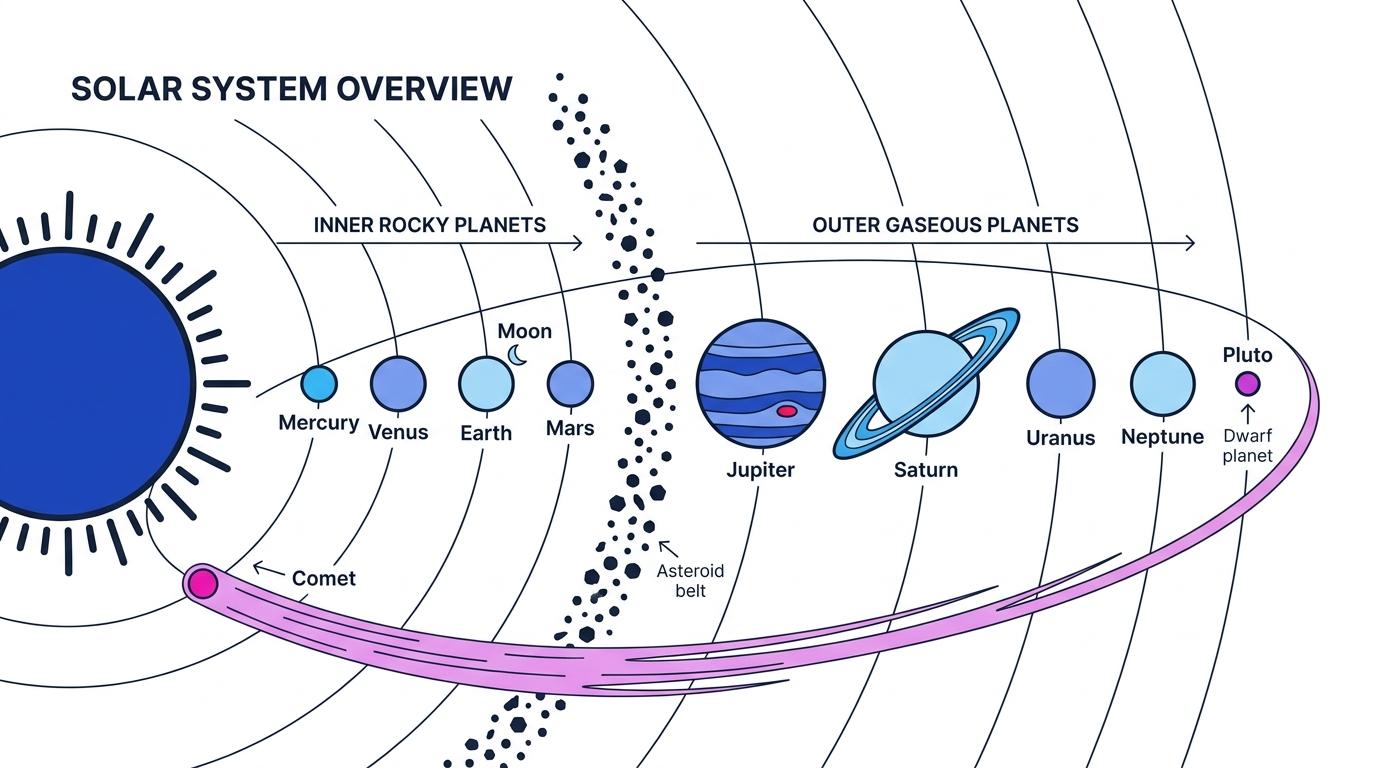
The Solar System: one star, and everything its gravity holds on to
Solar System
The Sun together with all the objects held in orbit around it by its gravitational attraction.
- There are five kinds of object you are expected to name, and a full description has to reach all five.
- One star, the Sun, which sits at the centre and contains almost all the mass of the whole system.
- Eight planets, the large bodies that orbit the Sun directly.
- Minor planets, which also orbit the Sun but are far smaller.
- These include dwarf planets such as Pluto, which orbits beyond Neptune.
- They also include the asteroids of the asteroid belt, a band of rocky lumps orbiting between Mars and Jupiter.
Moons and comets: the two categories most answers forget
Natural satellite
Any object that orbits another body in space without having been put there by people, which is what makes a moon different from an artificial satellite.
- Moons orbit the planets rather than the Sun, so they travel round the Sun indirectly, carried along by the planet they belong to.
- Smaller Solar System bodies make up the fifth category, including comets and other natural satellites.
- Every one of these objects stays where it is for the same reason: the gravitational pull of the much more massive body it orbits.
The eight planets in order: four small and rocky, then four large and gaseous
- Working outwards from the Sun, the eight planets run Mercury, Venus, Earth, Mars, Jupiter, Saturn, Uranus, Neptune.
- The first four, Mercury to Mars, are small and rocky, with solid surfaces you could in principle stand on.
- The last four, Jupiter to Neptune, are large and gaseous, with no solid surface to land on.
- The asteroid belt marks the boundary between the two groups, sitting between Mars and Jupiter.
- Distances grow very fast as you go out: Neptune orbits roughly thirty times further from the Sun than the Earth does, which is why a spacecraft to the outer planets takes years rather than months.
Pluto is a dwarf planet, counted among the minor planets rather than as a ninth planet, so a list of eight planets that ends at Neptune is the complete list.
Light takes real time to cross the Solar System
-
Light travels at a finite speed of about 3.0×10⁸ m/s3.0 \times 10^{8}\ \text{m/s}3.0×108 m/s in a vacuum, so it does not arrive instantly.
-
Over everyday distances that delay is far too small to notice, but Solar System distances are so large that the travel time becomes minutes or hours.
-
The calculation uses nothing more than the speed equation, rearranged for time.
v=dt⇒t=dv v = \frac{d}{t} \qquad \Rightarrow \qquad t = \frac{d}{v} v=td⇒t=vd -
Keep the units consistent: a distance in metres with a speed in m/s\text{m/s}m/s gives a time in seconds, which you can convert to minutes afterwards if the question asks.
-
The same delay applies to radio signals, because radio waves are part of the same electromagnetic spectrum and travel at the same speed in a vacuum.
Orbits are ellipses, and the Sun sits off to one side
Elliptical orbit
An orbit whose path is a stretched circle, an oval, rather than a perfect circle.
- Planets, minor planets and comets all follow elliptical orbits around the Sun.
- The Sun is not at the centre of the ellipse; it sits nearer one end, so the orbiting object is closer to the Sun at one point in its year and further away half an orbit later.
- The one exception to that off-centre rule is an orbit that happens to be almost circular, in which case the Sun is very close to the centre.
- Most planetary orbits are only slightly stretched, which is why treating them as circles works well enough for a speed calculation.
- Comet orbits are the extreme case, so long and thin that a comet spends most of its orbit far beyond the outer planets and only sweeps close to the Sun briefly.
- Do not list Pluto as a planet, because it belongs with the minor planets and including it turns a correct list of eight into a wrong list of nine.
- Do not draw or describe the Sun at the centre of an elliptical orbit, since it sits off to one side.
- Do not call a moon a planet: a moon orbits a planet, while a planet orbits the Sun.
- When asked to describe the Solar System, tick off all five categories as you write, because the marks are split across them and most answers stop after the Sun and the planets.
- Learn the planet order well enough to write it without hesitating, since a single swap of Uranus and Neptune can cost the mark.
- In a light-travel calculation, write t=d/vt = d/vt=d/v first, then substitute, because the rearranged equation is usually worth a mark by itself.
- If a question asks about a signal going out and back, double the distance before dividing, which is the single most common slip in these questions.
- Name the five types of object the Solar System contains.
- List the eight planets in order of increasing distance from the Sun.
- Where is the asteroid belt, and how is Pluto classified?
- Light from the Sun reaches the Earth across 1.5×10¹¹ m1.5 \times 10^{11}\ \text{m}1.5×10¹¹ m. How long does it take?
- What shape are the orbits of planets and comets, and where is the Sun in that shape?