A constant temperature means energy is arriving as fast as it leaves
Definition
Thermal equilibrium
The state in which an object transfers energy away at exactly the same rate as it receives energy, so its temperature does not change.
- Every object is emitting and absorbing radiation at the same time, so what matters is never one of those alone but the comparison between the two rates.
- For an object to sit at a constant temperature, it must transfer energy away at exactly the rate it receives it.
- Steady does not mean nothing is happening: a mug of tea holding at room temperature is exchanging energy with the room busily in both directions, and simply breaking even.
Unequal rates make the temperature move until balance returns
- If an object receives energy faster than it transfers it away, its internal energy rises and its temperature rises.
- If it transfers energy away faster than it receives it, its internal energy falls and its temperature falls.
- Neither runs away without limit, because the rate at which an object emits rises as it gets hotter and falls as it gets colder.
- A warming object therefore emits more and more until emission catches up with absorption, and it settles at a new, higher steady temperature rather than heating forever.
- The same self-correction explains the shape of a cooling curve: a hot drink cools quickly at first, when the difference from room temperature is largest, and then more and more slowly as it approaches the temperature of the room.
Practical
Investigation: what affects the rate of cooling of a liquid
- Aim: to plot cooling curves and find how the rate of cooling depends on the temperature difference and on the surface area.
- Apparatus: eye protection, two beakers of different diameter, insulation, a thermometer, a stopwatch, a measuring cylinder and hot water.
- Method:
- Wrap insulation round the sides of the first beaker so that energy leaves mainly through the open top surface.
- Measure out a fixed volume of hot water with the measuring cylinder, pour it in, and start the stopwatch as you do.
- Record the temperature every 30 s30\ \text{s}30 s for about ten minutes, stirring gently before each reading.
- Repeat with the wider beaker, which gives a larger surface area, using the same volume and the same starting temperature.
- Measure and plot: tabulate time / s against temperature / °C, then plot both cooling curves on the same axes with temperature on the yyy-axis and time on the xxx-axis.
- Result: each curve is steepest at the start and flattens as the water approaches room temperature, and the wider beaker cools faster throughout.
- Watch out:
- Control the volume and the starting temperature tightly, or you are testing more than one factor at once.
- Lag both beakers equally and shield them from draughts, so the only difference between the runs is the one you meant to change.
- Read the thermometer at eye level and take the reading on the tick of the stopwatch, since a lagging reading distorts the shape of the curve.
- Safety: wear eye protection, and stand the beakers of hot water well back from the bench edge where they cannot be knocked over.
Hotter surfaces and bigger surfaces emit faster
- The higher the surface temperature, the greater the rate at which an object emits radiation, and the effect is steep rather than gentle.
- The larger the surface area, the greater the rate as well, because radiation leaves from every part of the surface and a bigger surface offers more of it.
- Engineers who want to lose energy quickly therefore go for large surface area, which is why a car radiator and the heat sink on a computer chip are both built from thin closely spaced fins.
- Anything that wants to keep energy in does the opposite, which is why a cat curls into a tight ball on a cold night and cuts down its exposed surface.
- The nature of the surface matters alongside these two, so a large, hot, dull black surface is the fastest emitter of all.
The Earth's temperature is set by the same balance
- The Earth absorbs radiation from the Sun during the day and emits infrared out to space day and night alike.
- Its average temperature settles wherever those two rates match, so anything that changes either rate shifts the whole balance point.
- Some of the incoming radiation never gets absorbed at all, because clouds, snow, ice and pale desert sand reflect it straight back, while dark oceans and forests absorb most of what reaches them.
- Losing more ice therefore exposes darker ground and sea, which absorb more, raising the temperature further, so the change feeds on itself.
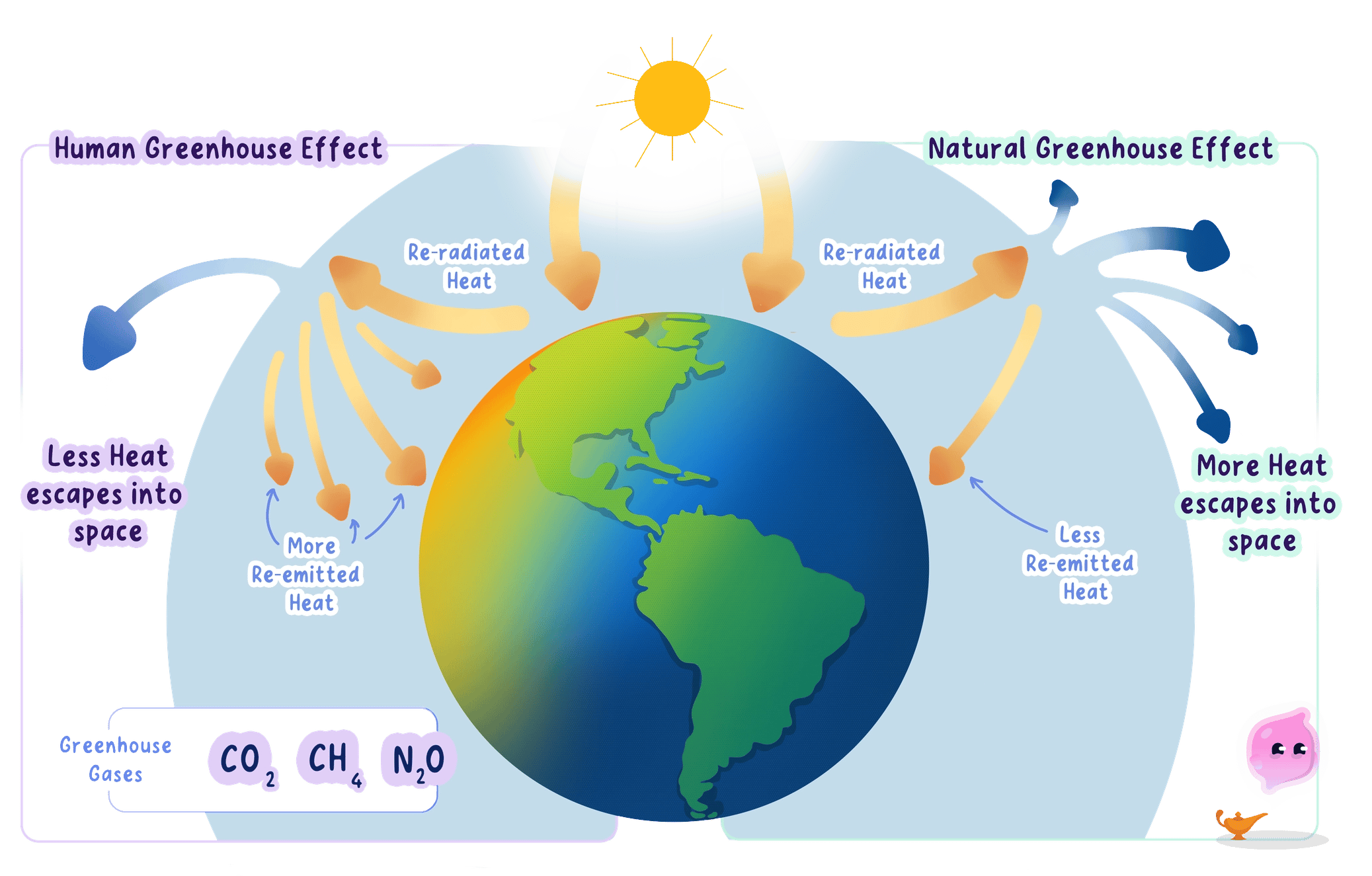
- Gases in the atmosphere such as carbon dioxide, methane and water vapour let the Sun's radiation through but absorb the infrared emitted from the surface.
- Those gases then re-emit that infrared in all directions, and the share sent back downwards slows the rate at which energy escapes to space.
- With energy leaving more slowly than it arrives, the surface warms until it emits enough to balance the books again, and it does so at a higher temperature than before.
- Some of this effect is entirely natural and keeps the planet habitable, and it is the increase in the concentration of these gases that shifts the balance to a warmer setting.
Example
- A storage heater is switched on overnight and reaches a steady temperature well before morning.
- While it is warming, energy is arriving from the electrical supply faster than it is escaping into the room.
- As the heater gets hotter, the rate at which it transfers energy to the room climbs.
- Once the two rates match the temperature stops rising, and the heater sits at that steady value until the supply is switched off.
Common Mistake
- Do not say an object at constant temperature has "stopped" emitting, because it is emitting and absorbing at equal rates.
- Do not write about the amount of energy when the question is about the rate, because balance is about energy per second.
- Do not say greenhouse gases "trap heat" and leave it there, because the mark is for them absorbing and re-emitting infrared so that less escapes.
- Do not confuse the greenhouse effect with a hole in an ozone layer, because they are separate ideas with separate causes.
Exam technique
- Use the word rate throughout any answer on this topic, since a comparison of rates is what earns the marks.
- For a warming or cooling question, end the answer at the new steady temperature rather than stopping at "it gets hotter".
- On a cooling curve, explain the flattening by the shrinking temperature difference with the surroundings.
- When the Earth is the object in the question, name both sides of the balance, the radiation coming in from the Sun and the infrared going out, before you discuss what changes it.
Self review
- What condition must hold for an object to stay at a constant temperature?
- What happens to an object that receives energy faster than it transfers it away?
- State two properties of a surface that increase the rate at which it emits radiation.
- Why does a hot drink cool quickly at first and then more slowly?
- Explain how greenhouse gases raise the temperature at which the Earth's energy balance settles.
