Three ways of moving energy, each with its own job
- Conduction moves energy through a material while the material stays put, and it dominates in solids, especially metals.
- Convection moves energy by carrying warmed fluid from one place to another, and it dominates in liquids and gases.
- Radiation carries energy as infrared and is the only one that crosses empty space, so it reaches you across a room without waiting for anything to arrive.
- Most real situations use more than one at once, and the skill being tested is picking out which process is doing what at each stage.
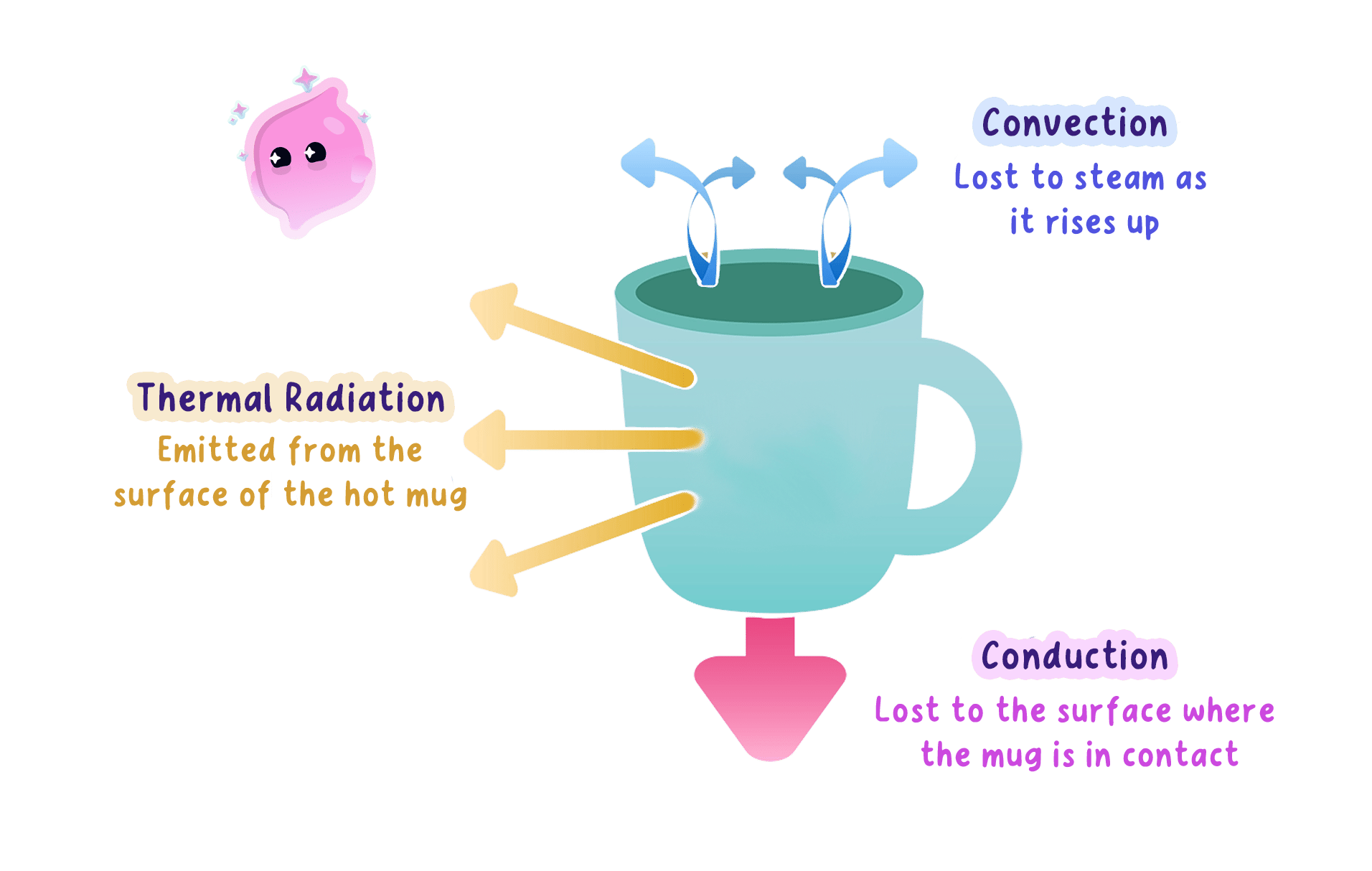
A saucepan is a deliberate mix of conductors and insulators
- The base is metal, usually copper, aluminium or steel, because a good thermal conductor carries energy from the hob into the food quickly.
- The base is also thin where it can be, because energy has less material to cross, and wide and flat so that a large area is in contact with the hob.
- Once energy is in the water, convection takes over: warmed water at the base expands, becomes less dense and rises, and cooler denser water sinks to replace it.
- That circulation is why the whole pan of water heats evenly even though only the bottom is in contact with the hob, and it is also why the element is at the bottom rather than the side.
- The handle is plastic or wood, both thermal insulators, so very little energy is conducted to your hand.
- Putting a lid on cuts the losses sharply, because it blocks the convection current of hot air above the pan and stops energetic particles escaping by evaporation.
A room is heated by a convection current, not by radiation
- Hot water from the boiler passes through the panel, and the metal conducts energy from the water to the outer surface.
- Air touching that surface is warmed, expands, becomes less dense and rises towards the ceiling.
- Cooler, denser air sinks to take its place at the bottom of the panel and is warmed in turn.
- A convection current is set up that circles the room, so the whole volume of air is warmed rather than just the strip beside the panel.
- Panels are fitted low on the wall so the warmed air has the whole room to rise through, and blocking one with a sofa spoils the current.
- Despite the everyday name, most of the energy leaves a household panel by convection rather than by radiation, which is why closing the curtains at dusk and blocking draughts both make a noticeable difference.
An open fire uses all three processes, and wastes most of its energy
- Burning wood or coal releases energy, and the glowing fuel emits a great deal of infrared radiation because its surface is both very hot and dull black.
- That radiation travels in straight lines and needs no medium, so it warms the people sitting in front of the fire directly and does nothing for anyone behind a chair.
- Air in contact with the fire is warmed by conduction, expands, becomes less dense and rises straight up the chimney by convection.
- That rising air carries much of the energy out of the house, and it also draws cold air in through gaps around doors and windows to replace it.
- Energy is conducted into the hearth and the surrounding brickwork as well, which is why a chimney breast stays warm long after the fire has died down.
- The combination explains the familiar complaint about an open fire: it is excellent at making the people in front of it feel warm by radiation, and poor at heating the room as a whole, because convection sends so much of the energy up the chimney.
A car radiator hands energy from the engine to the air in stages
- The engine block gets very hot, and water pumped through channels inside it takes up energy by conduction from the hot metal.
- Water is used because its large specific heat capacity lets it carry a great deal of energy for only a modest rise in its own temperature.
- The pump moves that hot water to the radiator at the front of the car, which is forced convection: the fluid is made to circulate rather than being left to rise on its own.
- The radiator is built from thin metal tubes and closely spaced fins, which give an enormous surface area in a small space and conduct energy out to the metal surface quickly.
- That large, hot, usually dull black surface emits infrared radiation at a high rate, and it also warms the air touching it by conduction.
- Air driven through the fins by the car's motion, or by a fan when it is stationary in traffic, carries that energy away by convection so cooler water returns to the engine.
Example
- A vacuum flask keeps soup hot by shutting down all three processes at once.
- The vacuum between the double walls has no particles, so neither conduction nor convection can cross it.
- The silvered walls are poor emitters and good reflectors, so very little energy crosses by radiation either.
- The plastic stopper is an insulator and blocks the convection current of hot air that would otherwise escape from the top.
Common Mistake
- Do not assume a household heating panel works mainly by radiation just because of what it is called, because most of its output goes into the room by convection.
- Do not name only one process in an application question, because these questions are written so that more than one is worth marks.
- Do not say the fire "heats the air which heats you", because the warmth you feel from a fire arrives as radiation while the warmed air goes up the chimney.
- Do not describe the fins on a car radiator as being there to look neat, because their purpose is the large surface area.
Exam technique
- Work through an application in the order the energy actually travels, naming the process at each step, because that structure picks up the marks in sequence.
- Say why each material was chosen, such as metal for its conduction or a dull black finish for its emission, since the design reason is usually where the second mark sits.
- For anything involving a fluid, give the full density chain rather than writing "the hot air rises".
- Check how many marks are on offer and name that many distinct points, since a six-mark application question is asking for six separate ideas, not one idea written at length.
Self review
- Why is the base of a saucepan metal but the handle plastic?
- Explain how a convection current heats a whole room.
- Why does an open fire warm the people in front of it but heat the room poorly?
- Name the three processes at work in a car's cooling system, and say where each acts.
- Why are the fins of a car radiator thin, closely spaced and dull black?
