At balance, clockwise and anticlockwise moments are equal
Definition
Principle of moments
For an object in equilibrium, the sum of the clockwise moments about a pivot equals the sum of the anticlockwise moments about the same pivot.
- For a balanced beam, the total clockwise moment about the pivot equals the total anticlockwise moment about it.
- There can be more than one force on each side of the pivot; you add up the moments on each side before comparing them.
- Because the two totals are equal, you can find an unknown force or distance by setting clockwise moments equal to anticlockwise moments.
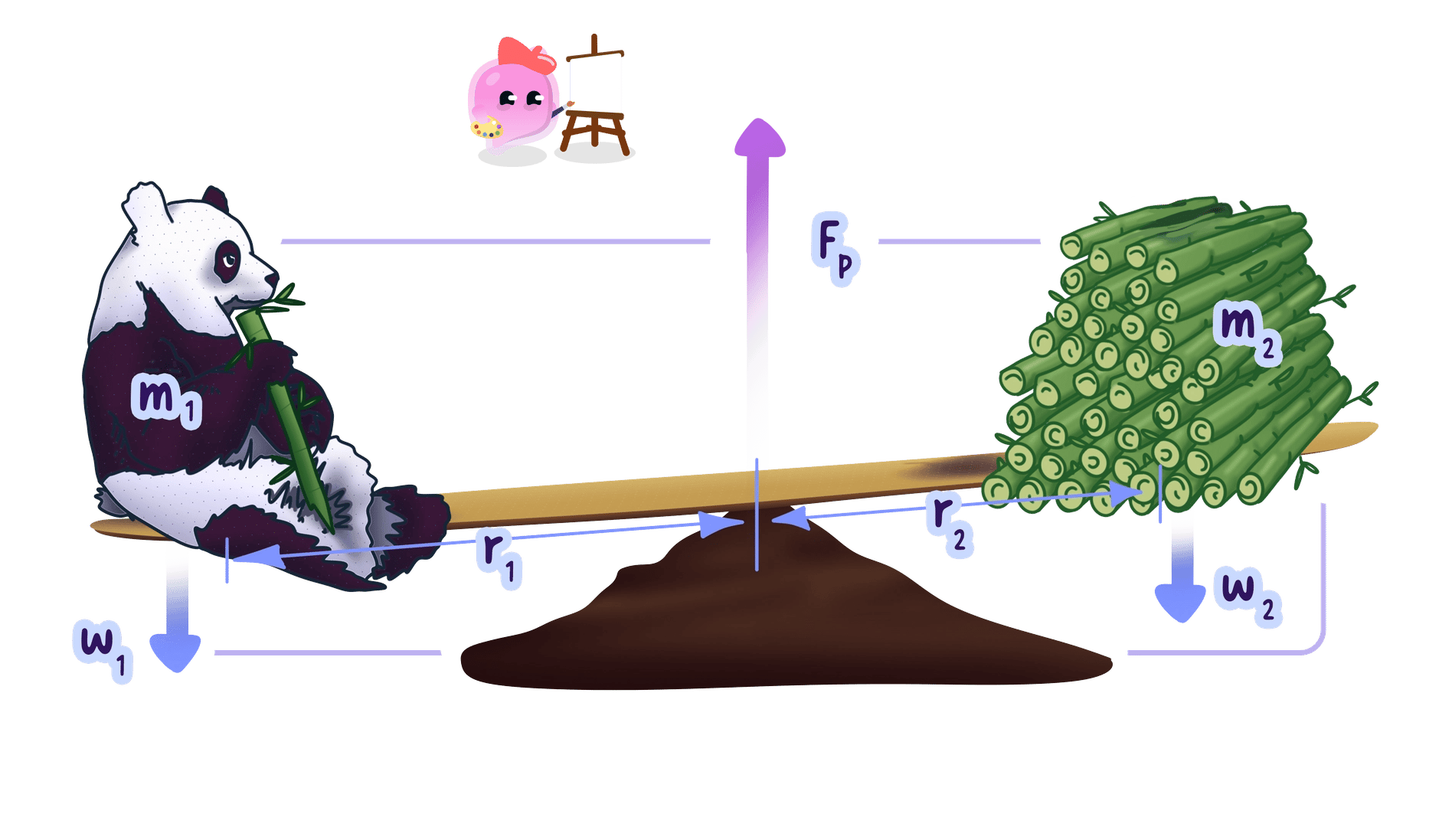
Equilibrium means no resultant force and no resultant moment
Definition
Equilibrium
The state of an object when there is no resultant force and no resultant moment acting on it, so it does not start to move off or to turn.
- The first condition is that the forces balance: the total upward force equals the total downward force.
- The second condition is that the moments balance: the total clockwise moment equals the total anticlockwise moment about any point.
- A beam resting balanced on its pivot meets both conditions, so it stays still and does not rotate.
Practical
Investigation: balancing a ruler
- Aim: to measure moments about a pivot and show that a balanced beam has no resultant moment.
- Apparatus: a half-metre ruler pivoted at its central hole on a nail, a stand and clamp, and three hangers carrying 10 g10\ \text{g}10 g and 20 g20\ \text{g}20 g masses.
- Method:
- Pivot the ruler at its centre and check that it balances empty and swings freely.
- Hang a known mass at a measured distance on one side of the pivot.
- Hang a different mass on the other side and slide it until the ruler balances again, then record both distances.
- Repeat for several pairs of masses.
- Work out the moment as force ×\times× distance on each side, taking weight as 0.10 N0.10\ \text{N}0.10 N per 10 g10\ \text{g}10 g at g=10 N/kgg = 10\ \text{N/kg}g=10 N/kg.
- Measure and plot: record each mass and its distance from the pivot and calculate F×dF \times dF×d on each side, in a table with no graph needed.
- Result: At balance the total anticlockwise moment equals the total clockwise moment, so there is no resultant moment.
- Watch out:
- Balance the empty ruler first so that its own weight has no turning effect.
- Let the ruler settle before reading, and stop the masses sliding along it.
- Safety: Take care that the masses do not fall onto the bench or your feet.
Common Mistake
- Take all moments about the same pivot, and use the perpendicular distance from that pivot each time.
- Include every force that has a turning effect; forgetting one side's second mass is a common slip.
- Balanced does not only mean the forces are equal; for no turning, the moments must balance as well.
Exam technique
- Set out the calculation as clockwise moments = anticlockwise moments, then substitute, so the method mark is clear.
- Keep distances in the same unit on both sides, and give the final force or distance with its unit.
- To show equilibrium, state both conditions: no resultant force and no resultant moment.
Self review
- State the principle of moments.
- What two conditions must be met for an object to be in equilibrium?
- A 4.0 N4.0\ \text{N}4.0 N weight sits 0.15 m0.15\ \text{m}0.15 m from a pivot. How far from the pivot must a 3.0 N3.0\ \text{N}3.0 N weight hang on the other side to balance it?
- Why is a balanced beam an example of equilibrium?
- In the balancing experiment, why is the ruler balanced empty before adding masses?
