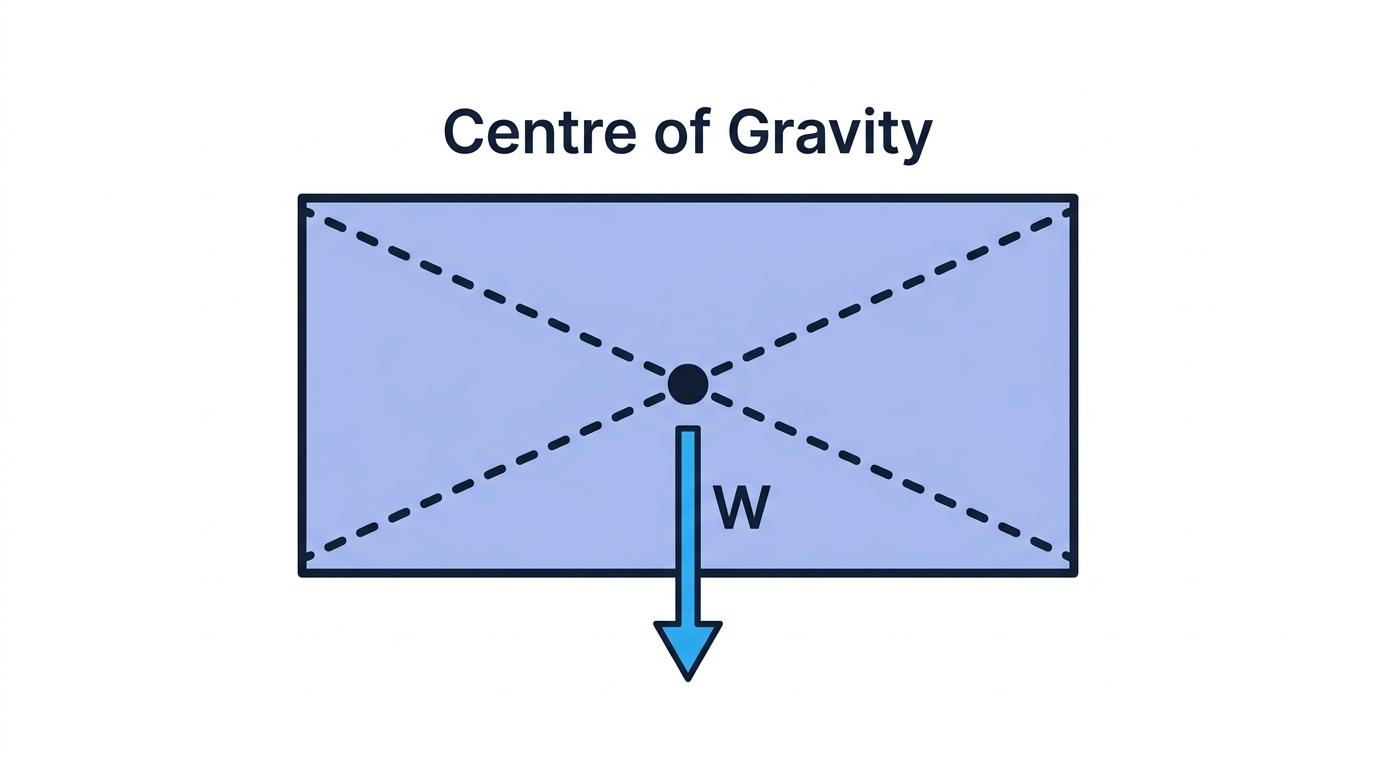
Weight acts at the centre of gravity
Definition
Centre of gravity
The single point at which the whole weight of an object can be taken to act.
- The whole weight can be drawn as one arrow pointing straight down from the centre of gravity.
- For a uniform, symmetrical object, such as a metre rule or a rectangular sheet, the centre of gravity is at its centre.
- For an irregular shape the centre of gravity is not obvious, so it has to be found by experiment.
Practical
Investigation: finding the centre of gravity of a lamina
- Aim: to find the centre of gravity of an irregular plane lamina (a flat sheet).
- Apparatus: a cardboard lamina, a stand and clamp with a nail, a plumb line (a weight on a thread) and a ruler.
- Method:
- Make a small hole near the edge and hang the lamina on the nail so that it can swing freely.
- Hang the plumb line from the same nail and, once it is still, draw its vertical line on the card.
- Repeat from a second hole, and ideally a third, in a different position.
- Mark where the lines cross, and check by balancing the card at that point on a fingertip.
- Measure and plot: draw the intersecting vertical lines from each suspension point, whose crossing point is the centre of gravity.
- Result: The lines meet at a single point, the centre of gravity, where the whole weight of the lamina can be taken to act.
- Watch out:
- Let the lamina settle before drawing each line, and use a sharp pencil.
- Take three or more lines so that any error shows up.
- Safety: minimal risk.
Stability depends on the centre of gravity and the base
- An object topples when the vertical line down from its centre of gravity, the line of action of its weight, falls outside its base.
- While that line stays inside the base, the object's weight provides a moment that rights it again.
- A low centre of gravity and a wide base make an object more stable, because it must be tilted much further before the weight line leaves the base.
- This is why a racing car is low and wide, and a Bunsen burner has a heavy, broad base.
Example
Tilt a tall drinks can and a wide biscuit tin by the same angle: the weight line leaves the narrow base of the can first, so the can topples while the tin settles back.
Common Mistake
- An object topples when the line of action of its weight passes outside the base, not simply when it is pushed.
- Stability is improved by a lower centre of gravity and a wider base, not just by being heavier.
- The centre of gravity can lie outside the material of an object, for example at the centre of a ring.
Exam technique
- To explain toppling, refer to the line of action of the weight and whether it lies inside or outside the base.
- When comparing two objects, mention both the height of the centre of gravity and the width of the base.
Self review
- What is meant by the centre of gravity of an object?
- Describe how to find the centre of gravity of an irregular lamina.
- When does an object topple over?
- Give two features that make an object more stable.
- Where is the centre of gravity of a uniform metre rule?