A parallel circuit gives the charge more than one route
Definition
Parallel circuit
A circuit in which components are connected across the same two junctions, so each one sits in its own branch with its own path for the current.
- The branches split apart at one junction and rejoin at another, so each coulomb takes one route or the other but never both.
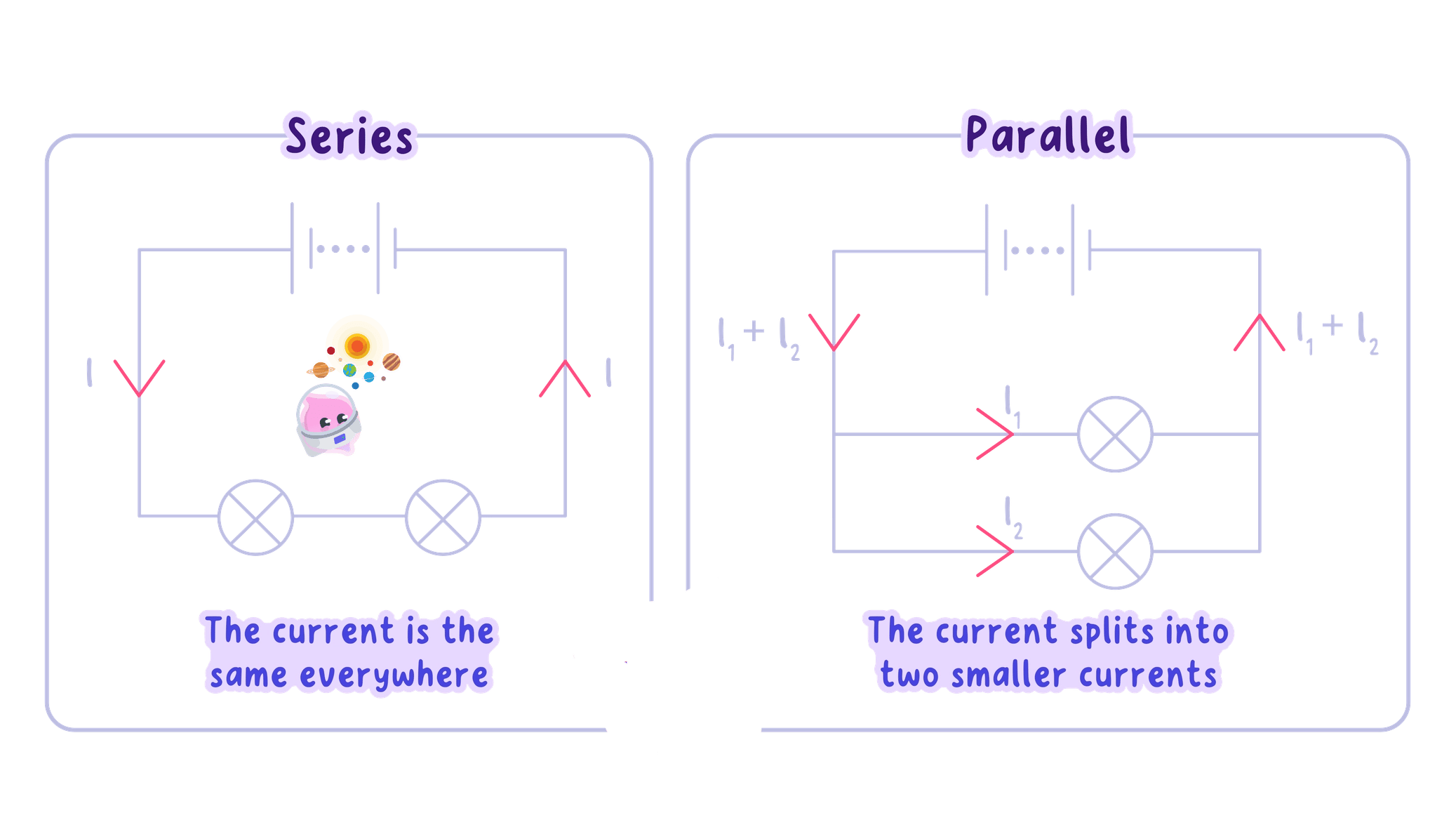
- Because there are several routes, the current from the source splits between the branches.
- That makes the current from the source larger than the current in any one branch, and equal to the branch currents added together.
- Every branch is joined straight across the supply, so every branch has the same p.d. across it.
- Adding another branch draws more current from the source without changing the p.d. across the branches that were already there.
Adding a parallel branch lowers the total resistance
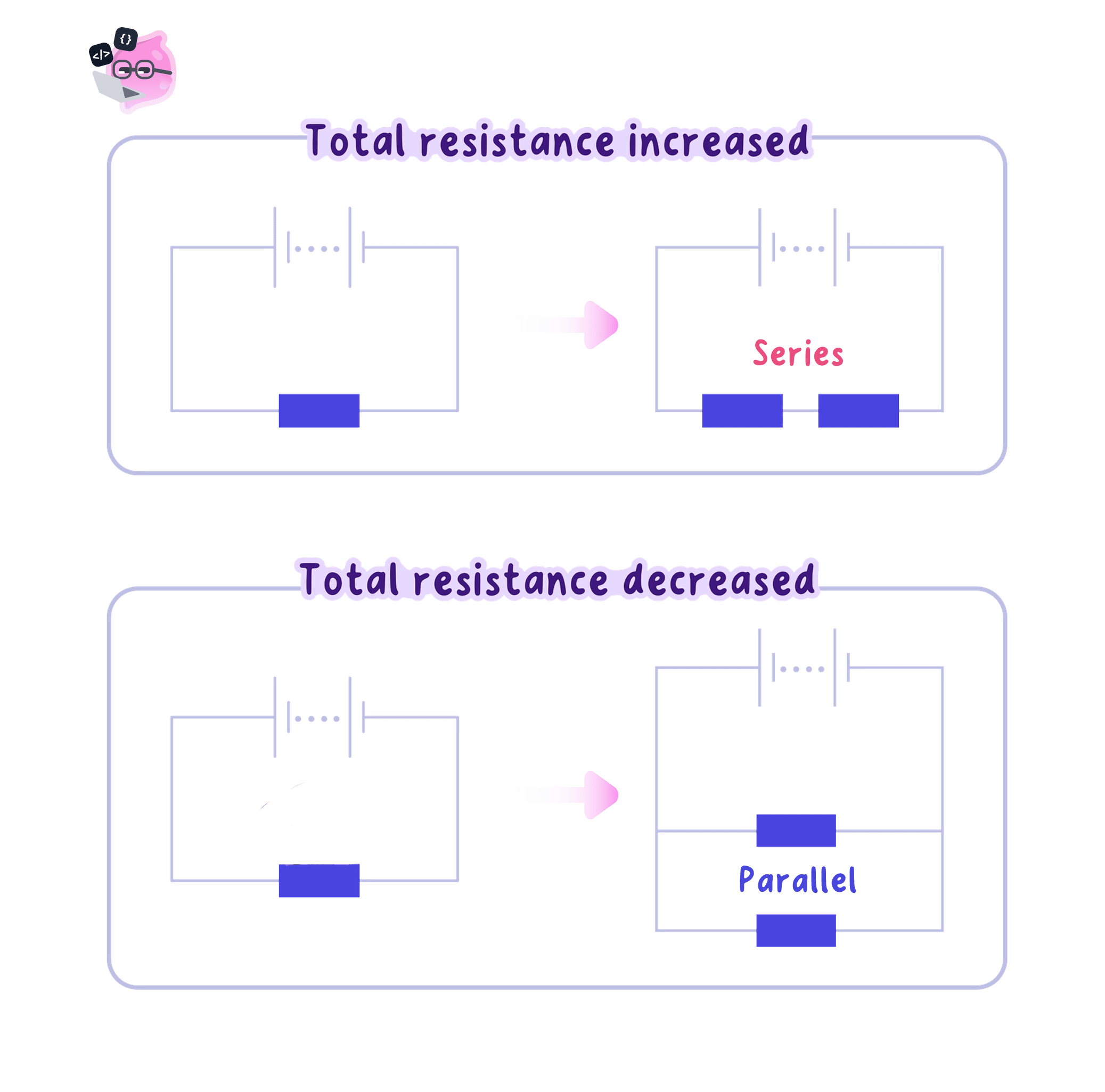
- The combined resistance of two resistors in parallel is less than either resistor on its own.
- That sounds wrong until you think in terms of routes: an extra branch gives the charge an extra way through, so more current flows in total for the same p.d.
- More current for the same p.d. means less resistance, which follows straight from R=VIR = \dfrac{V}{I}R=IV.
- Two identical resistors in parallel give exactly half the resistance of one of them.
- Each new branch keeps pulling the total down and the current up, which is why loading one extension lead with several heaters can draw a dangerous current.
Lighting circuits are wired in parallel for three reasons
- Each lamp gets the full supply p.d., so every lamp runs at its proper brightness instead of sharing the supply.
- If one lamp fails the others stay lit, because the remaining branches are still complete loops.
- Each lamp can have its own switch in its own branch, so rooms are controlled independently.
- A series string fails on all three counts, which is why older fairy lights all went out when a single bulb blew.
- The trade-off is that parallel lamps together draw a larger total current from the supply than the same lamps in series would.
Building the two kinds of circuit on the bench
- Start at the cell and work round in one direction, adding one component at a time so you do not lose track of the loop.
- For a series circuit make one continuous loop with no branches, keeping the ammeter in the loop itself.
- For a parallel circuit connect both ends of each branch to the same two junction points on the main loop.
- Leave a switch in the main loop so that the circuit can be broken while it is being changed.
- Check the loop is complete before switching on, then use an ammeter to confirm that the current stays the same or splits as you expected.
Common Mistake
- Adding a resistor in parallel lowers the total resistance, which is the opposite of what happens in series.
- The branches do not share the p.d.; each one gets the full supply p.d. across it.
- Two components drawn side by side on a diagram are only in parallel if both ends meet at the same two junctions, so trace the wires before deciding.
- Do not claim parallel wiring saves energy; it draws a larger total current than the same lamps in series.
Exam technique
- A question on the advantages of parallel lighting usually wants two of the three points, so give full brightness and independent operation, each with its reason.
- Say "the current from the source is larger than the current in each branch" rather than the vaguer "the current splits".
- When you are asked to draw a parallel circuit, mark the two junctions clearly with blobs so the branches are unmistakable.
- If a question asks what happens when a branch is switched off, answer for the other branches and for the supply current separately.
Self review
- How does the current from the source compare with the current in each branch of a parallel circuit?
- How does the combined resistance of two resistors in parallel compare with each resistor on its own?
- Give two advantages of connecting lamps in parallel in a lighting circuit.
- Why does adding an extra branch increase the current drawn from the supply?
- Describe how you would connect two lamps in parallel with a cell and a switch.
