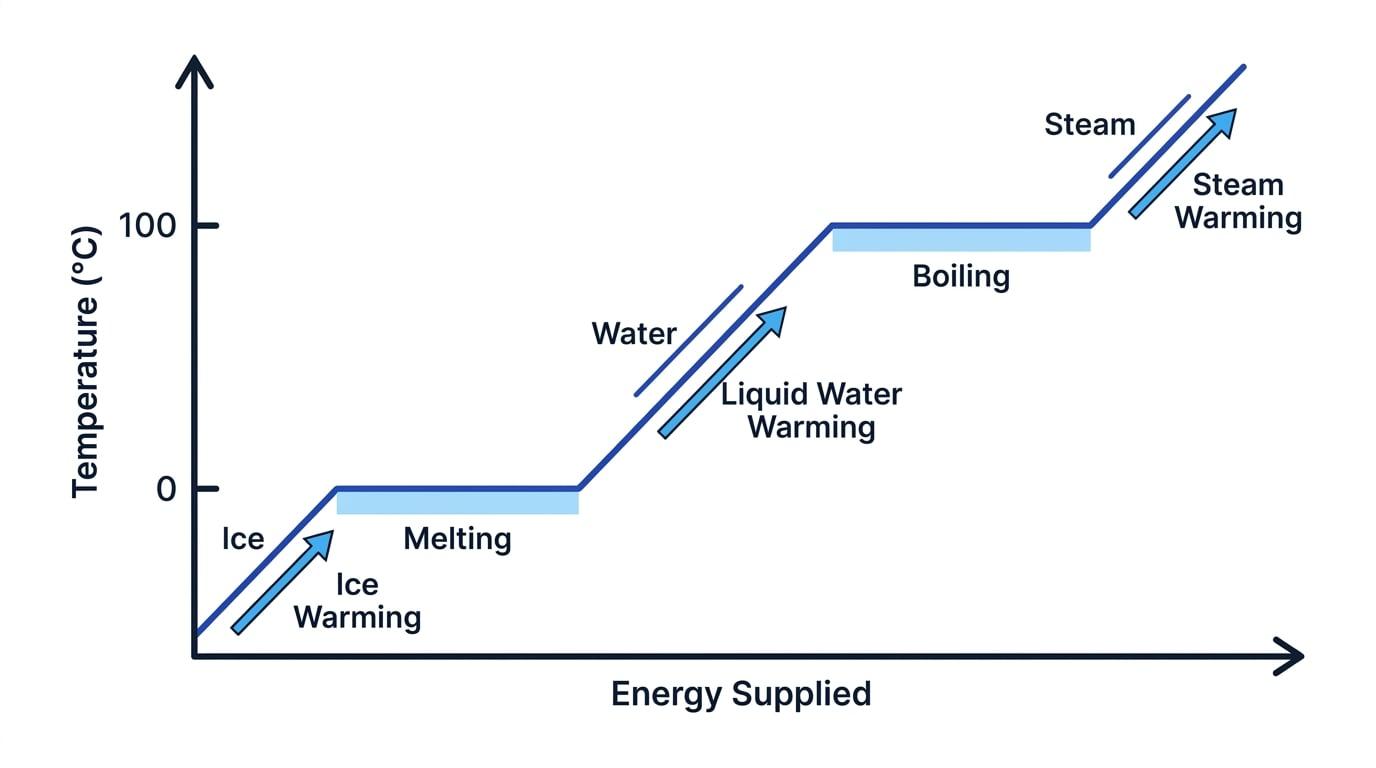
Melting takes energy in while the temperature stays put
Definition
Melting
The change from solid to liquid that happens at the melting point, while energy is supplied and the temperature stays constant.
- Warm a solid and its temperature climbs steadily, because the incoming energy makes the particles vibrate faster about their fixed positions.
- At the melting point the climbing stops, and the thermometer holds the same reading even though the heater is still on.
- The energy has not vanished, and it is not making the particles faster: it is being used to break the particles free of their fixed positions by working against the forces holding them there.
- Because the average kinetic energy of the particles is unchanged, the temperature is unchanged throughout the melting.
- On a graph of temperature against time this shows as a flat section, lasting until the last of the solid has gone.
- Once everything is liquid the temperature starts rising again, because the energy can go back into speeding the particles up.
- For water at standard atmospheric pressure the melting point is 0 ∘C0\ ^\circ\text{C}0 ∘C.
Boiling turns liquid into gas throughout the liquid
Definition
Boiling
The change from liquid to gas throughout the whole liquid, happening at the boiling point while energy is supplied and the temperature stays constant.
- The same pattern repeats higher up the graph: the liquid warms steadily until it reaches its boiling point, then the temperature holds still.
- This time the energy is being used to pull the particles completely apart, so that they escape the liquid entirely rather than merely sliding past each other.
- Bubbles of gas form all through the liquid, including at the bottom of the pan, and rise to the surface, which is what makes boiling look so different from a liquid quietly drying out.
- Boiling needs far more energy than melting the same mass, because separating the particles completely is a much bigger job than loosening them.
- For water at standard atmospheric pressure the boiling point is 100 ∘C100\ ^\circ\text{C}100 ∘C, and the two fixed points of 0 ∘C0\ ^\circ\text{C}0 ∘C and 100 ∘C100\ ^\circ\text{C}100 ∘C are worth knowing without looking them up.
Condensation: gas particles slow down and are captured
Definition
Condensation
The change from gas to liquid that happens when the particles of the gas lose enough energy for the forces between them to hold them together.
- Cool a gas and its particles lose kinetic energy, so they travel more slowly.
- Slow-moving particles that come close together can no longer break away from one another, because the forces of attraction between them are now strong enough to hold them.
- The particles gather into a much closer, disordered arrangement, and a liquid forms.
- The energy the particles had to be given during boiling is released again into the surroundings, which is why steam scalds far worse than water at the same temperature.
- Condensation happens most readily on a cold surface, because that is where the gas particles lose energy fastest.
Solidification: liquid particles lock into fixed positions
Definition
Solidification
The change from liquid to solid, also called freezing, that happens when the particles lose enough energy to settle into fixed positions.
- Cool a liquid and its particles slow down until they no longer have enough energy to slide past their neighbours.
- The forces between the particles then pull them into a regular arrangement of fixed positions, and all they can do is vibrate.
- Energy is given out to the surroundings as this happens, and the temperature stays at the melting point until the last of the liquid has solidified.
- Melting and solidification happen at the same temperature for a pure substance, so ice melts at 0 ∘C0\ ^\circ\text{C}0 ∘C and water solidifies at 0 ∘C0\ ^\circ\text{C}0 ∘C.
Example
- A beaker of crushed ice is heated steadily on a hob and the temperature is recorded every half minute.
- The temperature climbs from −10 ∘C-10\ ^\circ\text{C}−10 ∘C up to 0 ∘C0\ ^\circ\text{C}0 ∘C, then holds flat while the ice melts even though the hob is still on.
- Once the last piece of ice has gone the temperature climbs again, up to 100 ∘C100\ ^\circ\text{C}100 ∘C.
- There it holds flat for much longer while the water boils, because separating the particles completely needs far more energy than melting did.
Common Mistake
- Do not say the energy "disappears" or "is not supplied" during a flat section, because it is still going in and is being used to separate the particles.
- Do not write that the particles "get more energy so the temperature stays the same", because the kinetic energy is exactly what does not change.
- Do not put bubbles only at the surface when you describe boiling, because they form throughout the liquid.
- Do not quote 0 ∘C0\ ^\circ\text{C}0 ∘C and 100 ∘C100\ ^\circ\text{C}100 ∘C without the condition, because those are the values at standard atmospheric pressure.
Exam technique
- When a question points at a flat section of a heating graph, answer with both halves: the energy is still being supplied, and it is being used to separate the particles rather than speed them up.
- Describe condensation and solidification in terms of the particles slowing down and moving closer or into fixed positions, since that is the wording the question is asking for.
- Label a heating or cooling graph with which state exists in each region, because that turns a description question into a quick read-off.
- Name the change of state precisely when a question asks for it, and keep the everyday word "freezing" for when the question itself uses it.
Self review
- Why does the temperature stay constant while a solid is melting?
- Give the melting and boiling temperatures of water at standard atmospheric pressure.
- Describe condensation in terms of the particles.
- Describe solidification in terms of the particles.
- Where do bubbles form in a liquid that is boiling?