A magnetic field is the region where a magnetic pole would feel a force
Definition
Magnetic field
A region in which a magnetic pole experiences a force.
- The field itself is invisible, so it is mapped by what it does: put a small magnetic pole anywhere in the region and it is pushed or pulled.
- The field around a bar magnet fills the space in every direction, is strongest close to the poles and gets weaker as you move away.
- Anything magnetic inside that region feels the force, which is why a paper clip is dragged towards a magnet across a gap of air.
- The field has no sharp edge; it simply becomes too weak to detect, so "outside the field" really means far enough away that nothing measurable happens.
Field lines leave the N pole and enter the S pole
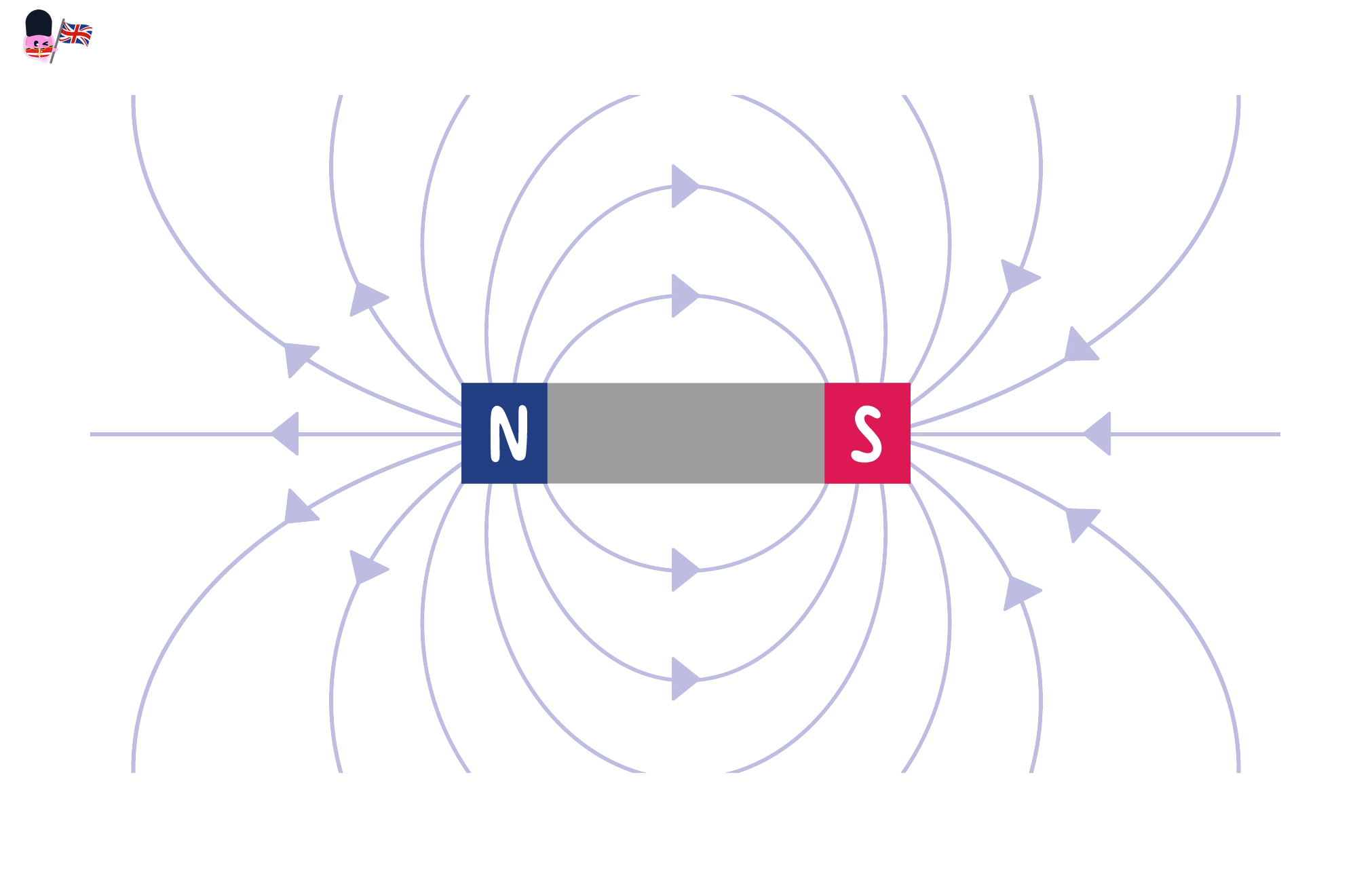
- A magnetic field line is drawn so that it shows the shape of the field and, through its arrowhead, the direction of the field at every point along it.
- Outside the magnet the lines come out of the N pole and go into the S pole, and every line carries an arrowhead pointing that way.
- The lines are complete loops, continuing inside the magnet from S back round to N, although a sketch usually shows only the part outside.
- They are packed tightly at the poles and spread widely at the sides, because the field is strongest at the poles.
- Field lines never cross, because a single point cannot have the field pointing in two directions at once.
- Draw them as smooth curves that start on one pole and finish on the other, rather than as straight spokes or as lines that stop in mid-air.
Field direction is defined by the force on an N pole
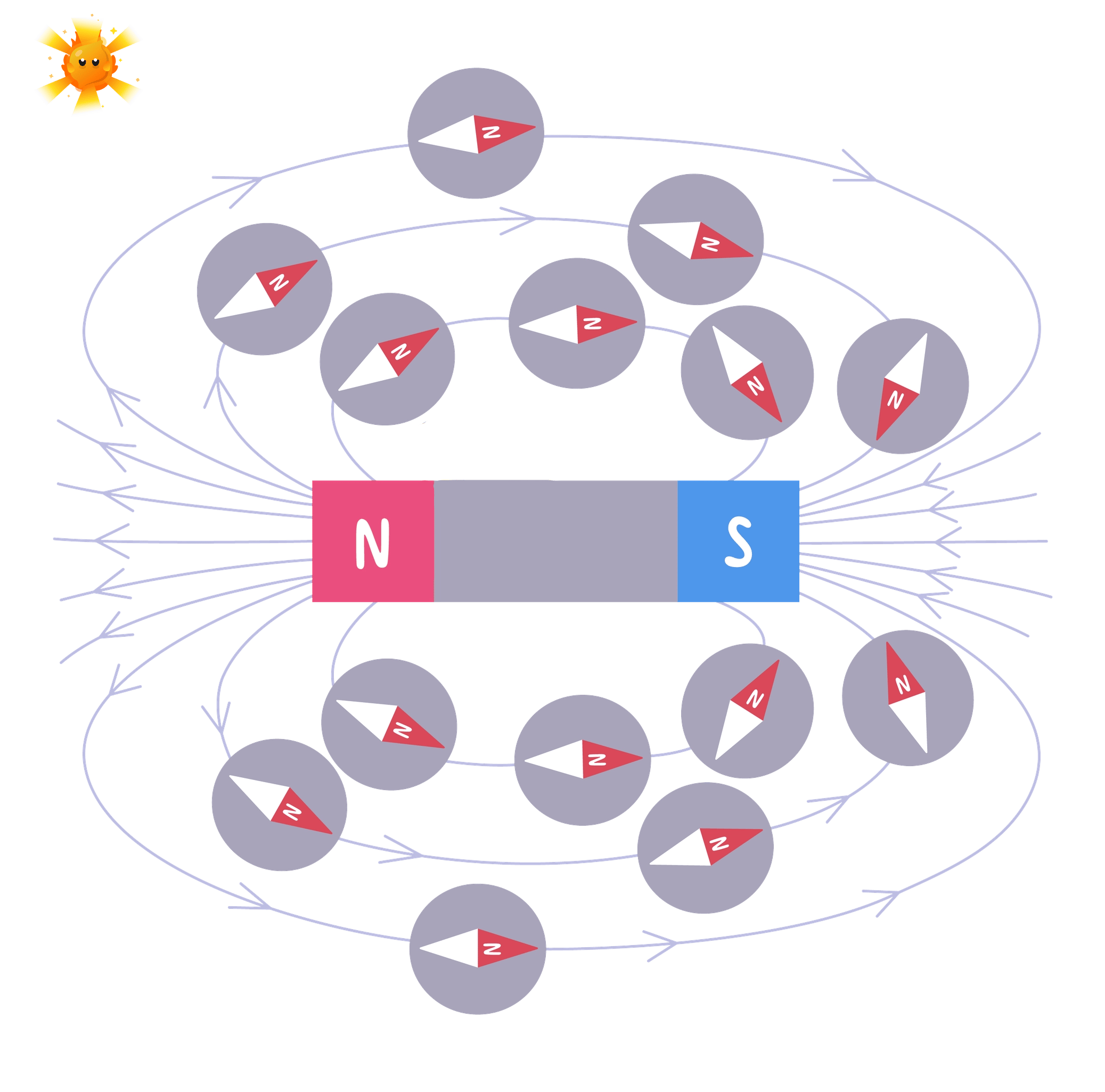
- The direction of a magnetic field at a point is the direction of the force on the N pole of a magnet placed at that point.
- A plotting compass is a tiny bar magnet on a low-friction pivot, so its N-seeking end swings until it lies along the field line and points the way the field points.
- Set several compasses round a bar magnet and the needles fan out from the N pole and converge on the S pole, matching the arrows on the field lines exactly.
- The Earth produces its own magnetic field, and that is what makes a compass needle settle pointing roughly north wherever you stand.
Magnetic forces come from two fields interacting
- Two magnets never touch, so the force between them is carried by their magnetic fields.
- Each magnet sits inside the field of the other, and the force it feels comes from that field.
- Between unlike poles the two fields point the same way, so the lines join into continuous lines running straight from one magnet to the other and the magnets are pulled together.
- Between like poles the two fields point against each other, so the lines are pushed apart and bulge outwards, and the magnets are pushed apart.
- Midway between two like poles the two fields cancel exactly, giving a neutral point where the resultant field is zero and a plotting compass has no direction to settle in.
Closely spaced lines mean a strong field
- The spacing of the lines carries information as well as their shape: the closer the lines, the stronger the field.
- Near the poles of a bar magnet the lines are bunched together, so the field there is strong.
- Level with the middle of the magnet the lines are far apart, so the field there is weak.
- That gives you a quick check on any sketch: evenly spaced lines all over the diagram cannot be right for a bar magnet.
Common Mistake
- Field lines must never cross, so redraw any sketch in which two lines meet.
- Arrows run from N to S outside the magnet, and an arrow the other way throws away the direction mark.
- A magnetic field is a region, not a line, so define it as a region in which a magnetic pole experiences a force.
- A neutral point is a point of zero resultant field, not a point where the two magnets happen to be equally strong.
Exam technique
- A "draw the field pattern" question is marked on three things: smoothly curved lines, arrows in the right direction, and lines that are closer together at the poles.
- Draw at least four or five lines, starting each one on the N pole and finishing it on the S pole, rather than leaving lines hanging in space.
- Check the pole labels before you draw when two magnets are shown, because like and unlike poles give completely different patterns.
- If asked to compare the field strength at two points, quote the line spacing at each point as your reason.
Self review
- Define a magnetic field.
- In which direction do field lines point outside a bar magnet?
- How is the direction of a magnetic field at a point defined?
- What does the spacing of the field lines tell you?
- Two N poles face each other. Describe what happens to the field lines between them, and what is found at the midpoint.
