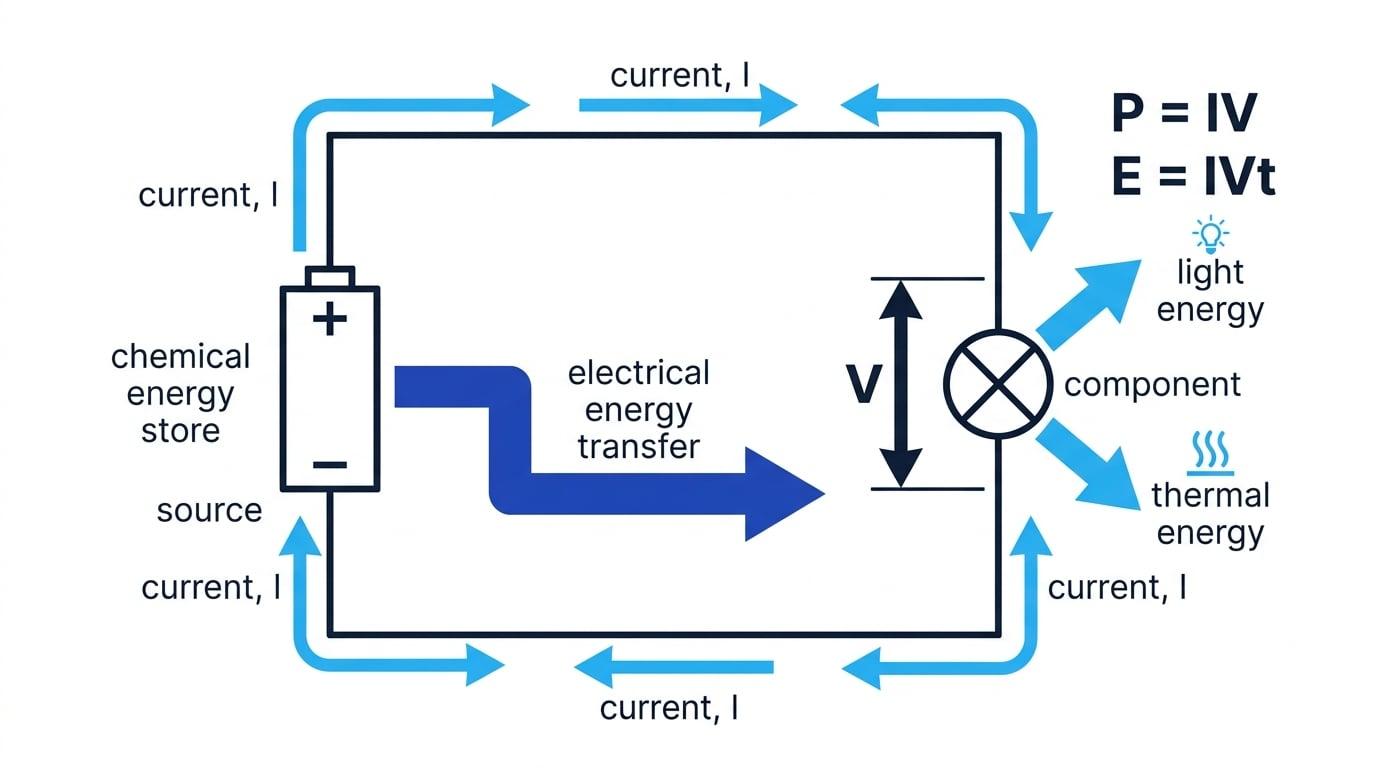
A circuit is an energy delivery system, not a supply of charge
- A cell or the mains is the source of electrical energy, transferring energy to the charge that passes through it.
- That charge carries the energy round the circuit and delivers it to the components, which turn it into whatever the device is for.
- A lamp produces mostly thermal energy and a little light, a motor produces kinetic energy, and a heater produces thermal energy almost entirely.
- Whatever the component, the energy ends up dissipated into the surroundings, warming the room and spreading out until it is too thinly shared to be useful.
- Energy is conserved at every stage, so the energy supplied by the source equals the energy delivered to the components, which equals the energy passed on to the surroundings.
Electrical power is the energy transferred each second
Definition
Electrical power
The rate at which a component transfers electrical energy, equal to the current through it multiplied by the p.d. across it.
P=IV P = IV P=IV- The unit is the watt, symbol W\text{W}W, and 1 W1\ \text{W}1 W is 1 J1\ \text{J}1 J transferred every second.
- The equation follows from what the two quantities mean: each coulomb delivers VVV joules, and III coulombs pass every second.
- Household ratings are worth knowing: an LED lamp about 8 W8\ \text{W}8 W, a laptop about 60 W60\ \text{W}60 W, and a kettle about 3000 W3000\ \text{W}3000 W.
- The rearranged forms are I=PVI = \dfrac{P}{V}I=VP and V=PIV = \dfrac{P}{I}V=IP, and the first is what you use to work out the fuse an appliance needs.
- A 3000 W3000\ \text{W}3000 W kettle on the 230 V230\ \text{V}230 V mains draws I=3000÷230≈13 AI = 3000 \div 230 \approx 13\ \text{A}I=3000÷230≈13 A, which is why it needs a 13 A13\ \text{A}13 A fuse and a thick flex of its own.
Electrical energy is power multiplied by the time it runs for
- The equation to recall is E=IVtE = IVtE=IVt, where EEE is in J\text{J}J, III in A\text{A}A, VVV in V\text{V}V and ttt in s\text{s}s.
- It is simply P=IVP = IVP=IV multiplied by time, since the energy transferred is the power multiplied by how long the transfer lasts.
- Time has to be in seconds for an answer in joules, so half an hour is t=1800 st = 1800\ \text{s}t=1800 s.
- Because the running time counts as much as the rating, a 2000 W2000\ \text{W}2000 W heater on for ten minutes transfers more energy than a 60 W60\ \text{W}60 W laptop left on for three hours.
Practical
Investigation: measuring the input and output power of a small motor
- Aim: to measure the input and output power of a small electric motor and use them to find its efficiency.
- Apparatus: a battery, an ammeter, a voltmeter, a small electric motor with a spindle, string, slotted masses on a hanger, a stopwatch, a metre rule, a clamp and stand, a switch and connecting leads.
- Method:
- Clamp the motor firmly at the edge of the bench with its spindle overhanging, and tie a length of string to the spindle with the mass hanger on the free end.
- Connect the motor in series with the battery, the switch and the ammeter, and connect the voltmeter across the motor's terminals.
- Mark a start line and a finish line a measured height apart on the stand, for example 0.50 m0.50\ \text{m}0.50 m, and record that height.
- Switch on, start the stopwatch as the mass passes the start line, and stop it as the mass passes the finish line.
- Read the ammeter and the voltmeter while the mass is still rising steadily, not during the jerk as the motor starts.
- Switch off before the mass reaches the spindle, lower it, and repeat the run twice more so the times can be averaged.
- Add a further mass to the hanger and repeat the whole set of readings for the heavier load.
- Measure and calculate: measure III, VVV, the mass mmm, the height hhh and the time ttt, then work out the input power P=IVP = IVP=IV, the useful output power mght\dfrac{mgh}{t}tmgh, and the efficiency as useful output powertotal input power×100%\dfrac{\text{useful output power}}{\text{total input power}} \times 100\%total input poweruseful output power×100%.
- Result: the output power is always less than the input power, so the efficiency comes out below 100%100\%100%, because energy is wasted heating the coils and the connecting wires and overcoming friction in the bearings.
- Watch out:
- Time the rise between two fixed marks rather than from the moment you switch on, since the motor takes a moment to reach a steady speed.
- Repeat and average, because reaction-time error is large on a lift that lasts only a couple of seconds.
- Wind the string neatly onto the spindle so that it does not slip or pile up, which would change the rate of lift.
- Take both meter readings during the same run, because the current changes when the load changes.
- Safety: clamp the motor so it cannot be pulled off the bench, keep feet clear of the falling mass, and switch off before the mass reaches the spindle.
Electricity is sold in kilowatt-hours, not joules
Definition
Kilowatt-hour (kW h)
The energy transferred by a 1 kW1\ \text{kW}1 kW appliance running for 111 hour, which is the unit electricity is charged in.
1 kW h=1000×3600=3.6×10⁶ J 1\ \text{kW h} = 1000 \times 3600 = 3.6 \times 10^{6}\ \text{J} 1 kW h=1000×3600=3.6×10⁶ J- The joule is far too small for a household bill, since a single load of washing runs into millions of joules.
- Suppliers therefore charge in kilowatt-hours, which appear on a bill simply as "units".
- To use it, put the power in kilowatts and the time in hours, so that energy in kW h\text{kW h}kW h is power in kW\text{kW}kW multiplied by time in h\text{h}h.
- The cost then follows as the energy in kW h\text{kW h}kW h multiplied by the price charged per kW h\text{kW h}kW h.
- A 500 W500\ \text{W}500 W appliance is 0.5 kW0.5\ \text{kW}0.5 kW and 454545 minutes is 0.75 h0.75\ \text{h}0.75 h, so converting both quantities is usually the first line of the working.
Common Mistake
- Do not mix the units in a kilowatt-hour calculation: power must be in kilowatts and time in hours.
- The kilowatt-hour is a unit of energy, not of power, in spite of having "watt" in its name.
- In E=IVtE = IVtE=IVt the time is in seconds, which is the opposite convention, so check which answer the question is asking for before converting.
- A power rating in kW\text{kW}kW must be turned into W\text{W}W before it goes into P=IVP = IVP=IV, so 2.0 kW2.0\ \text{kW}2.0 kW becomes 2000 W2000\ \text{W}2000 W.
Exam technique
- Decide first whether the answer is wanted in joules or in kilowatt-hours, because that decides which units the time goes in.
- Show the conversion line, such as 303030 minutes =0.5 h= 0.5\ \text{h}=0.5 h or =1800 s= 1800\ \text{s}=1800 s, since it usually carries a mark of its own.
- Finish a cost question with a sensible money answer and say whether it is in pounds or pence.
- Both P=IVP = IVP=IV and E=IVtE = IVtE=IVt have to be recalled from memory, so write the equation out before substituting anything into it.
Self review
- Describe the energy transfers in a circuit containing a cell and a lamp.
- State the equation linking power, current and potential difference.
- A lamp carries 0.25 A0.25\ \text{A}0.25 A at 12 V12\ \text{V}12 V. Calculate its power.
- Define the kilowatt-hour.
- Calculate the cost of running a 3 kW3\ \text{kW}3 kW kettle for 202020 minutes at 24p24\text{p}24p per kW h\text{kW h}kW h.