Convection carries energy by moving the fluid itself
Definition
Convection
The transfer of thermal energy through a liquid or a gas by the movement of the heated fluid itself from one place to another.
- Conduction moves energy while the particles stay put, but convection is different: here the warmed particles travel and take their energy with them.
- That only works if the substance can flow, so convection happens in liquids and gases and never in a solid, whose particles are locked into fixed positions.
- It cannot happen in a vacuum either, because there has to be a fluid there to do the moving.
- Convection matters because liquids and gases are such poor conductors, so in a fluid it is usually convection, not conduction, that does almost all of the work of moving energy about.
Density changes are what drive a convection current
Definition
Convection current
The circulating flow of a fluid set up when warmed fluid rises and cooler, denser fluid sinks to take its place.
- Fluid next to the heater warms up, so its particles move faster and spread further apart, and the fluid expands.
- Expanding puts the same mass into a larger volume, so the density of that warmed fluid falls.
- The warmed fluid is now less dense than the fluid around it, so it floats upwards through it, in exactly the way a cork rises through water.
- Cooler, denser fluid sinks to fill the gap left behind, and it is now next to the heater.
- That fluid is warmed in its turn, rises, and is replaced again, so a continuous circulation is set up.
- The rising fluid carries its energy up and away from the heater, and gives it out as it cools higher up, which is how the energy gets spread through the whole body of fluid.
- This is why a heater is put at the bottom and a cooler at the top: a kettle element sits low so the whole body of water circulates, while the icebox in an old fridge sat high so the chilled air could sink through the food.
Two experiments make convection currents visible
- In a liquid, drop a single crystal of potassium manganate(VII) into a beaker of water and let it settle in one corner of the base.
- Heat that corner gently with a small flame, and a purple streak rises straight up from the crystal.
- The streak then curls across the surface, down the far side and back along the base, tracing out the whole loop of the convection current.
- In a gas, use a convection box: a wooden box with a glass front and two chimneys, with a lit candle standing under one of them.
- Hold smouldering paper over the other chimney, and the smoke is drawn down it, across the box and up the chimney above the candle.
- The candle warms the air above it, that air becomes less dense and rises out, and cooler denser air is pushed in through the other chimney to replace it, carrying the smoke with it.
- Blow the candle out and the smoke stops circulating, which confirms that the temperature difference is what drives the current.
Example
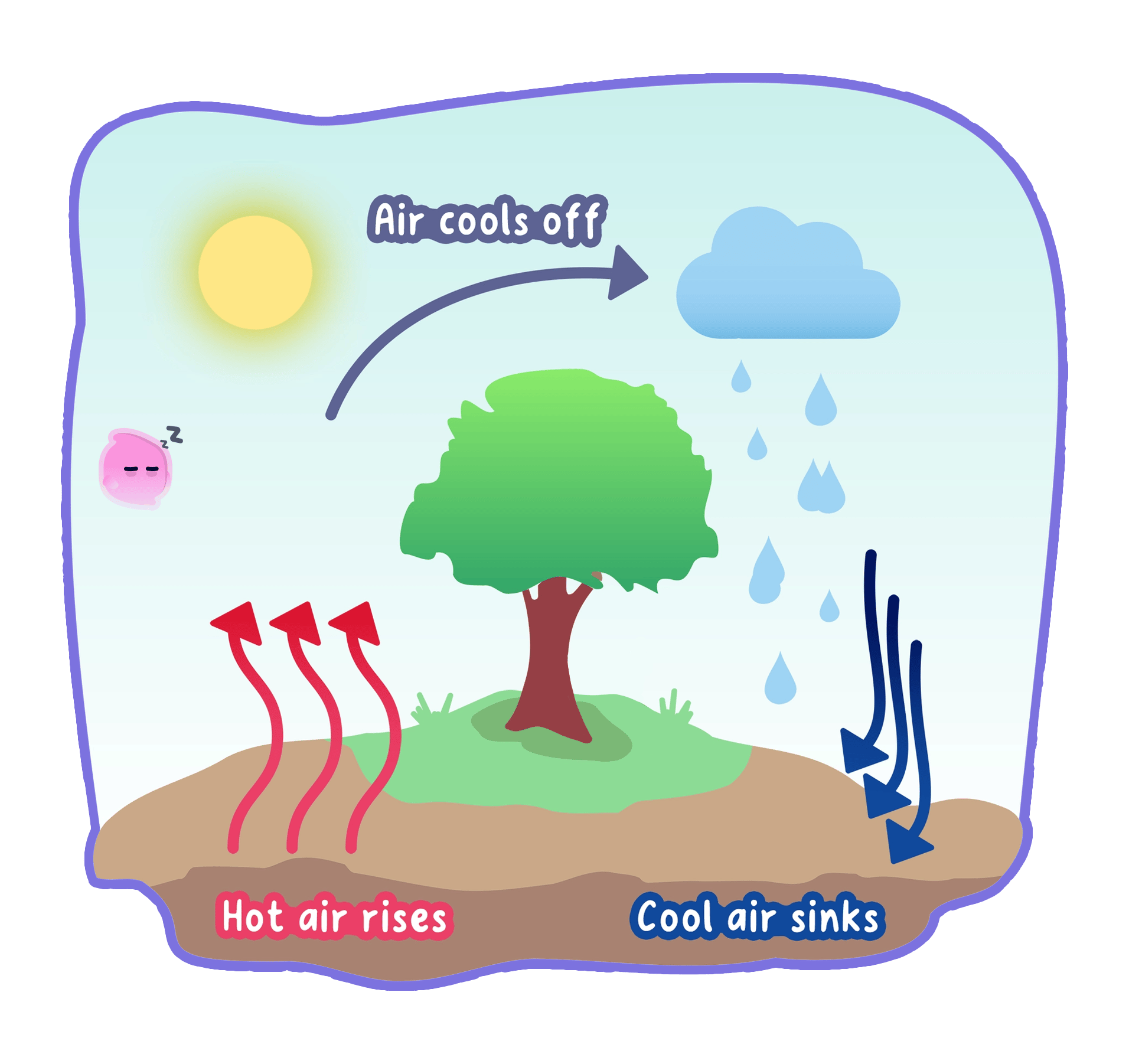
- On a sunny afternoon at the coast, the land warms up much faster than the sea.
- Air above the land is warmed, expands, becomes less dense and rises.
- Cooler, denser air over the sea moves in across the shore to take its place.
- That inrush is the sea breeze you feel on the beach, and it is a convection current on a very large scale.
Common Mistake
- Do not write that "heat rises", because what rises is less dense fluid, and that phrase is not given credit.
- Do not skip the middle of the chain, because the mark sequence is expands, density falls, rises, and missing out the density step costs the mark.
- Do not suggest convection happens in a solid or in a vacuum, because it needs a fluid that can move.
- Do not say the mass of the warmed fluid changes when it expands, because the mass stays the same and it is the volume that grows.
Exam technique
- Write the explanation as a chain of four links every time: warms, expands, becomes less dense, rises, with cooler denser fluid sinking to replace it.
- Draw arrows on any diagram you are given, showing the fluid going up over the heater and down on the far side, since a labelled loop can earn the marks on its own.
- Describing an experiment scores for the tracer, the crystal or the smoke, and for where the heater sits, so name both.
- If asked why a heater goes at the bottom, answer with the current it sets up rather than saying "so the heat spreads".
Self review
- In which states of matter can convection happen, and why not in the third?
- Explain, in terms of density, why warmed fluid rises.
- Describe an experiment that shows a convection current in water.
- In the convection box, why is the smoke drawn down the chimney furthest from the candle?
- Why is a kettle's heating element placed near the bottom?
