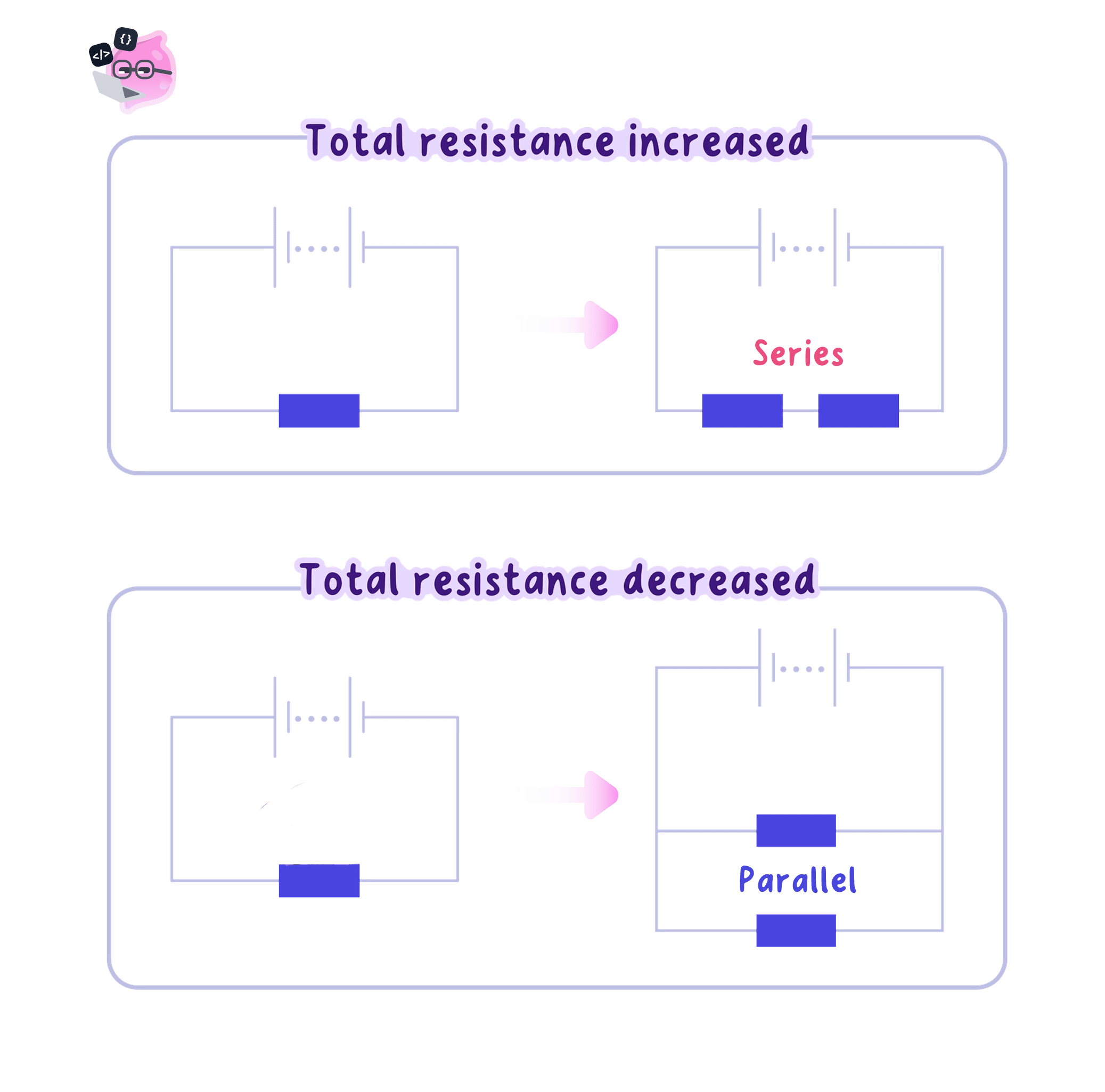
Resistors in parallel combine through their reciprocals
- The formula for two resistors in parallel is 1R=1R1+1R2\dfrac{1}{R} = \dfrac{1}{R_1} + \dfrac{1}{R_2}R1=R11+R21.
- Rearranged for exactly two resistors it becomes R=R1R2R1+R2R = \dfrac{R_1 R_2}{R_1 + R_2}R=R1+R2R1R2, which is quicker to key into a calculator.
- The answer is always less than the smaller of the two resistances, which is the check to run every single time.
- Two identical resistors give exactly half the value of one, so two 10 Ω10\ \Omega10 Ω resistors in parallel give 5.0 Ω5.0\ \Omega5.0 Ω.
- The reason is physical rather than algebraic: a second branch gives the charge an extra route, so more current flows for the same p.d. and the resistance must be lower.
Working the calculation without losing the reciprocal
- Work out 1R1\dfrac{1}{R_1}R11 and 1R2\dfrac{1}{R_2}R21 first and add them, remembering that the total you now have is 1R\dfrac{1}{R}R1 and not RRR.
- Take the reciprocal of that total at the end, because forgetting this last step is the most common error in the whole topic.
- Keep the full value on the calculator rather than rounding the reciprocals, since rounding early can shift the final answer noticeably.
- Give the answer in ohms to two or three significant figures, matching the precision of the values you were given.
- Once you have the combined resistance you can treat the pair as a single resistor and find the supply current from I=VRI = \dfrac{V}{R}I=RV.
Common Mistake
- Do not add parallel resistances the way you would in series, because 4.0+124.0 + 124.0+12 is not the answer.
- Do not stop at 1R\dfrac{1}{R}R1, since the final step is taking the reciprocal of it.
- The product-over-sum shortcut works for two resistors only, so go back to the reciprocal formula for three or more.
- If the answer comes out larger than either resistor, the reciprocal has been dropped somewhere.
Exam technique
- Write the formula out first, because the equation line is usually worth a mark on its own even if the arithmetic goes wrong.
- Show the value of 1R\dfrac{1}{R}R1 on its own line, so a marker can award the method even if the reciprocal is fumbled.
- State the sanity check in your answer, as in "3.0 Ω3.0\ \Omega3.0 Ω is less than 4.0 Ω4.0\ \Omega4.0 Ω, as expected for a parallel pair".
- In a mixed circuit, reduce the parallel pair to one value before touching the series part of the calculation.
Self review
- State the formula for the combined resistance of two resistors in parallel.
- Calculate the combined resistance of a 6.0 Ω6.0\ \Omega6.0 Ω and a 3.0 Ω3.0\ \Omega3.0 Ω resistor in parallel.
- What is the combined resistance of two 8.0 Ω8.0\ \Omega8.0 Ω resistors in parallel?
- Why must the combined resistance always be smaller than either individual resistance?
- The parallel pair from question 2 is connected to a 9.0 V9.0\ \text{V}9.0 V supply. Find the current drawn.
