Revision notes for Oxford AQA IGCSE Maths Bounds. Open the guide for explanations and worked examples. Written against the Oxford AQA IGCSE Maths (9260) specification, so the content matches what's examinable rather than general Maths background.
Bounds
What you'll learn
- How to find lower and upper bounds from rounded numbers.
- How to use bounds in perimeter, area, circumference and formula questions.
- How to choose the correct bounds when dividing or subtracting.
- How to give a value to a suitable degree of accuracy.
Why rounded values have bounds
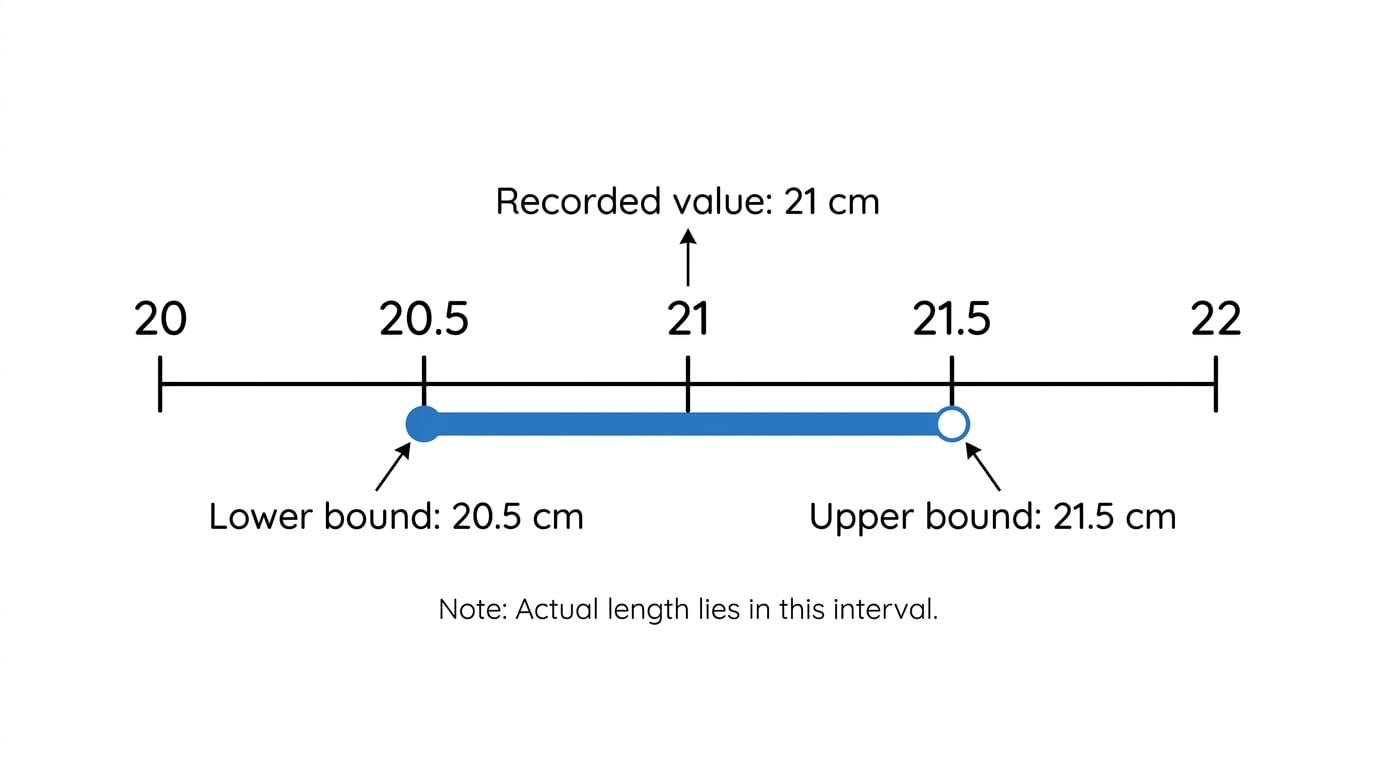
A rounded measurement is not usually exact. If a length is given as 21 cm to the nearest cm, the real length could be slightly smaller than 21 cm or slightly bigger than 21 cm.
An interval is a continuous range of possible values between two end points.
Definition
Bounds
A lower bound is the smallest possible value a rounded number could have. An upper bound is the boundary at the top of the possible interval. If the true value is xxx, we often write the interval as L≤x<UL \le x < UL≤x<U.
For example, a length recorded as 21 cm to the nearest cm has possible values from 20.5 cm up to, but not including, 21.5 cm.
The half-unit rule
The rounding unit is the size of the step used when rounding. To find bounds, halve the rounding unit.
- To the nearest cm: half-unit is 0.5 cm.
- To the nearest mm, but written in cm: nearest 0.1 cm, so half-unit is 0.05 cm.
- Correct to 2 decimal places: nearest 0.01, so half-unit is 0.005.
- To the nearest 5 metres: half-unit is 2.5 metres.
- Correct to 3 significant figures: look at the place value of the last significant figure, then halve that place value.
Example
Turning rounded values into intervals
-
A length is 130 m to the nearest 5 m. The half-unit is 2.5 m, so subtract and add 2.5:
127.5≤L<132.5127.5 \le L < 132.5127.5≤L<132.5 -
A mass is 7.82 kg correct to 2 decimal places. The half-unit is 0.005 kg:
7.815≤M<7.8257.815 \le M < 7.8257.815≤M<7.825
Common Mistake
Why the upper bound uses <
The upper boundary is usually not included. For example, 21.5 cm would round to 22 cm, not 21 cm. In calculations, though, we still use 21.5 as the upper bound value.
Using bounds in geometry
Perimeter is the total distance around a shape. Area is the space inside a shape. Circumference is the perimeter of a circle.
For positive lengths, making the lengths bigger makes the perimeter, area and circumference bigger.
Key Idea
Positive measurements
If a formula only adds or multiplies positive measurements, use upper bounds to find an upper bound, and lower bounds to find a lower bound.
Example
Rectangle bounds
A rectangle has length 38 cm to the nearest cm and width 7.4 cm to the nearest mm. Find the upper bound for the perimeter and the lower bound for the area.
-
Find the length bounds. The length is to the nearest cm, so the half-unit is 0.5 cm:
37.5≤L<38.537.5 \le L < 38.537.5≤L<38.5 -
Find the width bounds. The width is to the nearest mm, which is nearest 0.1 cm, so the half-unit is 0.05 cm:
7.35≤W<7.457.35 \le W < 7.457.35≤W<7.45 -
For the upper bound of the perimeter, use both upper bounds:
Pupper=2(38.5+7.45)=91.9P_{\text{upper}} = 2(38.5 + 7.45) = 91.9Pupper=2(38.5+7.45)=91.9 -
For the lower bound of the area, use both lower bounds:
Alower=37.5×7.35=275.625A_{\text{lower}} = 37.5 \times 7.35 = 275.625Alower=37.5×7.35=275.625 -
The upper bound for the perimeter is 91.9 cm, and the lower bound for the area is 275.625 cm².
Circles
For a circle with radius rrr:
C=2πrC = 2\pi rC=2πr A=πr2A = \pi r^2A=πr2Both circumference and area increase when the positive radius increases.
Example
Circle bounds in terms of pi
A circle has radius 6 cm to the nearest cm. Find the lower bound for the circumference and the upper bound for the area.
-
Find the bounds for the radius:
5.5≤r<6.55.5 \le r < 6.55.5≤r<6.5 -
For the lower bound of the circumference, use the lower radius:
Clower=2π(5.5)=11πC_{\text{lower}} = 2\pi(5.5) = 11\piClower=2π(5.5)=11π -
For the upper bound of the area, use the upper radius:
Aupper=π(6.5)2=42.25πA_{\text{upper}} = \pi(6.5)^2 = 42.25\piAupper=π(6.5)2=42.25π -
The answers are 11π11\pi11π cm and 42.25π42.25\pi42.25π cm².
Formulae with multiplication and division
Many bounds questions use formulae such as speed, pressure or electrical formulae.
For positive quantities:
- To make a product as large as possible, use upper bounds.
- To make a product as small as possible, use lower bounds.
- To make a fraction as large as possible, use the upper bound of the numerator and the lower bound of the denominator.
- To make a fraction as small as possible, use the lower bound of the numerator and the upper bound of the denominator.
Common Mistake
Denominator goes the opposite way
For an upper bound of a fraction, do not use the upper bound of the denominator. A larger denominator makes the fraction smaller.
Example
Upper bound for a quotient
The formula for speed is v=stv = \frac{s}{t}v=ts. A distance is 5.42 correct to 2 decimal places, and a time is 1.37 correct to 2 decimal places. Find the upper bound for vvv.
-
Find the bounds for the distance:
5.415≤s<5.4255.415 \le s < 5.4255.415≤s<5.425 -
Find the bounds for the time:
1.365≤t<1.3751.365 \le t < 1.3751.365≤t<1.375 -
To make v=stv = \frac{s}{t}v=ts as large as possible, use the largest distance and the smallest time:
vupper=5.4251.365=3.974358…v_{\text{upper}} = \frac{5.425}{1.365} = 3.974358\ldotsvupper=1.3655.425=3.974358… -
The upper bound for vvv is 3.974 to 3 decimal places.
Pythagoras and rearranged formulae
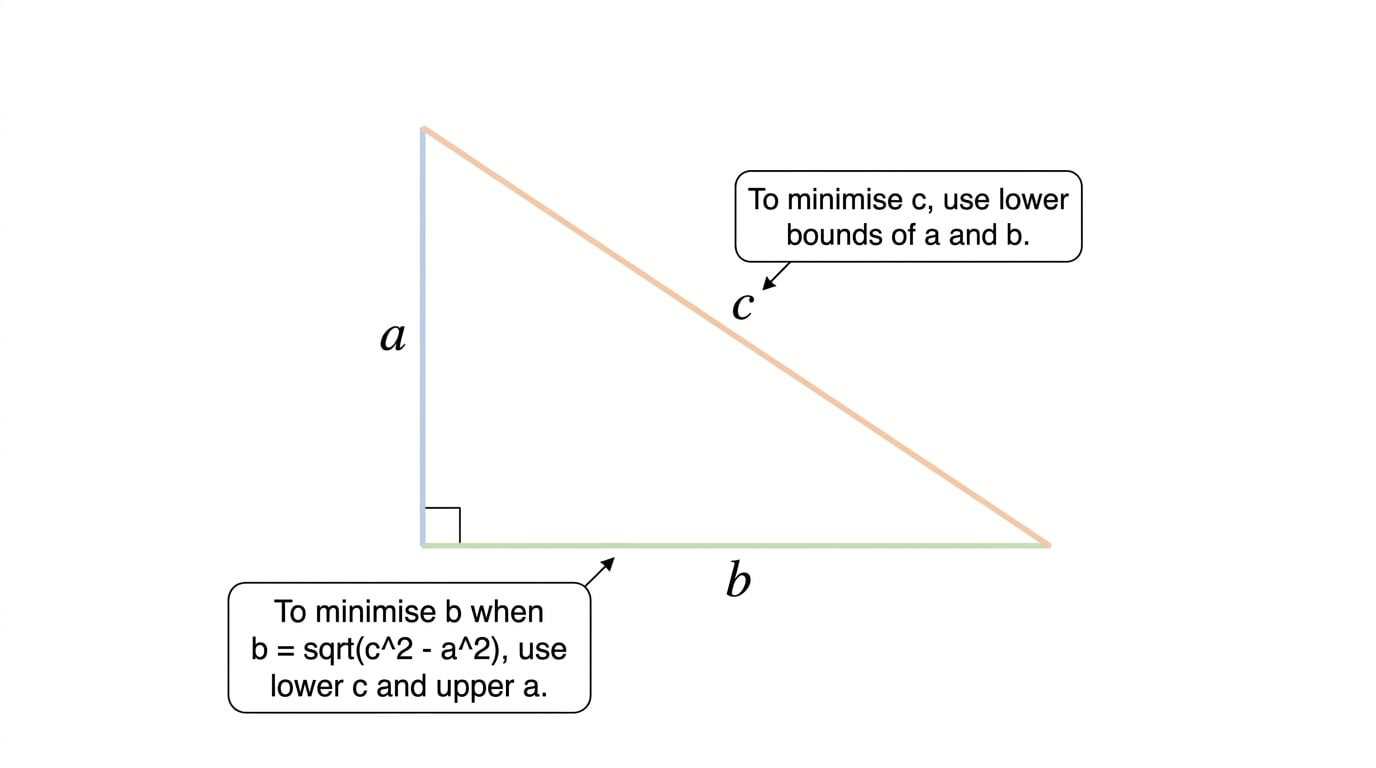
In a right-angled triangle, the hypotenuse is the longest side, opposite the right angle. Pythagoras’ theorem says:
c2=a2+b2c^2 = a^2 + b^2c2=a2+b2For positive lengths, squaring and square-rooting keep the order the same: bigger input gives bigger output.
Example
Lower bound for a missing side
In a right-angled triangle, side aaa is 3.8 cm to the nearest mm, and the hypotenuse ccc is 9 cm to the nearest cm. Find the lower bound for side bbb.
-
Find the bounds for aaa:
3.75≤a<3.853.75 \le a < 3.853.75≤a<3.85 -
Find the bounds for ccc:
8.5≤c<9.58.5 \le c < 9.58.5≤c<9.5 -
Rearrange Pythagoras’ theorem:
b=c2−a2b = \sqrt{c^2 - a^2}b=c2−a2 -
To make bbb as small as possible, use the smallest hypotenuse and the largest value of aaa:
blower=8.52−3.852=57.4275=7.577…b_{\text{lower}} = \sqrt{8.5^2 - 3.85^2} = \sqrt{57.4275} = 7.577\ldotsblower=8.52−3.852=57.4275=7.577… -
The lower bound for bbb is 7.6 cm to 1 decimal place.
More complex formulae
When a formula has subtraction, think carefully. If something is being subtracted, making it bigger makes the final answer smaller.
Example
Upper bound after rearranging
Suppose v2=u2+2asv^2 = u^2 + 2asv2=u2+2as, where v=28.6v = 28.6v=28.6 correct to 1 decimal place, a=4.7a = 4.7a=4.7 correct to 1 decimal place, and s=42.3s = 42.3s=42.3 correct to 1 decimal place. Find the upper bound for uuu.
-
Rearrange the formula to make uuu the subject:
u=v2−2asu = \sqrt{v^2 - 2as}u=v2−2as -
Write the bounds:
28.55≤v<28.65,4.65≤a<4.75,42.25≤s<42.3528.55 \le v < 28.65,\quad 4.65 \le a < 4.75,\quad 42.25 \le s < 42.3528.55≤v<28.65,4.65≤a<4.75,42.25≤s<42.35 -
To make uuu as large as possible, use the upper bound for vvv, but the lower bounds for aaa and sss because 2as2as2as is being subtracted:
uupper=28.652−2×4.65×42.25u_{\text{upper}} = \sqrt{28.65^2 - 2 \times 4.65 \times 42.25}uupper=28.652−2×4.65×42.25 -
Calculate the value:
uupper=427.8975=20.685…u_{\text{upper}} = \sqrt{427.8975} = 20.685\ldotsuupper=427.8975=20.685… -
The upper bound for uuu is 20.7 to 3 significant figures.
Choosing a suitable degree of accuracy
A suitable degree of accuracy means a level of rounding where every possible value gives the same rounded answer. Decimal places count digits after the decimal point. Significant figures count from the first non-zero digit.
Example
Suitable accuracy from bounds
Pressure is given by p=FAp = \frac{F}{A}p=AF. A force is 31.42 N correct to 2 decimal places, and an area is 5.18 m² correct to 3 significant figures. Find ppp to a suitable degree of accuracy.
-
Find the bounds:
31.415≤F<31.425,5.175≤A<5.18531.415 \le F < 31.425,\quad 5.175 \le A < 5.18531.415≤F<31.425,5.175≤A<5.185 -
Since p=FAp = \frac{F}{A}p=AF, the lower bound uses lower force and upper area; the upper bound uses upper force and lower area.
-
Calculate both bounds:
plower=31.4155.185=6.0588…pupper=31.4255.175=6.0724…\begin{aligned} p_{\text{lower}} &= \frac{31.415}{5.185} = 6.0588\ldots\\ p_{\text{upper}} &= \frac{31.425}{5.175} = 6.0724\ldots \end{aligned}plowerpupper=5.18531.415=6.0588…=5.17531.425=6.0724… -
To 2 decimal places, the bounds round to 6.06 and 6.07, so 2 decimal places is not safe.
-
To 2 significant figures, both bounds round to 6.1, so p=6.1p = 6.1p=6.1 to 2 significant figures is suitable.
Exam technique
In the exam
-
Write the lower and upper bounds for each rounded value before substituting into a formula.
-
Ask: “What makes the answer bigger?” or “What makes the answer smaller?” Remember that denominators work the opposite way.
-
Do not round during working. Keep calculator values, then round only the final answer.
-
For “suitable degree of accuracy” questions, calculate the lower and upper possible answers, then choose a rounding level where they match.
Self review
Check yourself
-
A length is 14.6 cm to the nearest mm. What are its lower and upper bounds in cm?
-
For y=xzy = \frac{x}{z}y=zx, which bounds of xxx and zzz make yyy as small as possible?
-
In b=c2−a2b = \sqrt{c^2 - a^2}b=c2−a2, why might you use the upper bound of aaa when finding a lower bound for bbb?

Recap questions
Test yourself with 5 quick questions on this guide. Answer them all correctly to complete it.
You've reached the end
Test yourself on this topic, or move on to the next guide.
How was this guide?